
Story
TJX Stock Slides as Weak Forecast Overshadows Earnings Beat
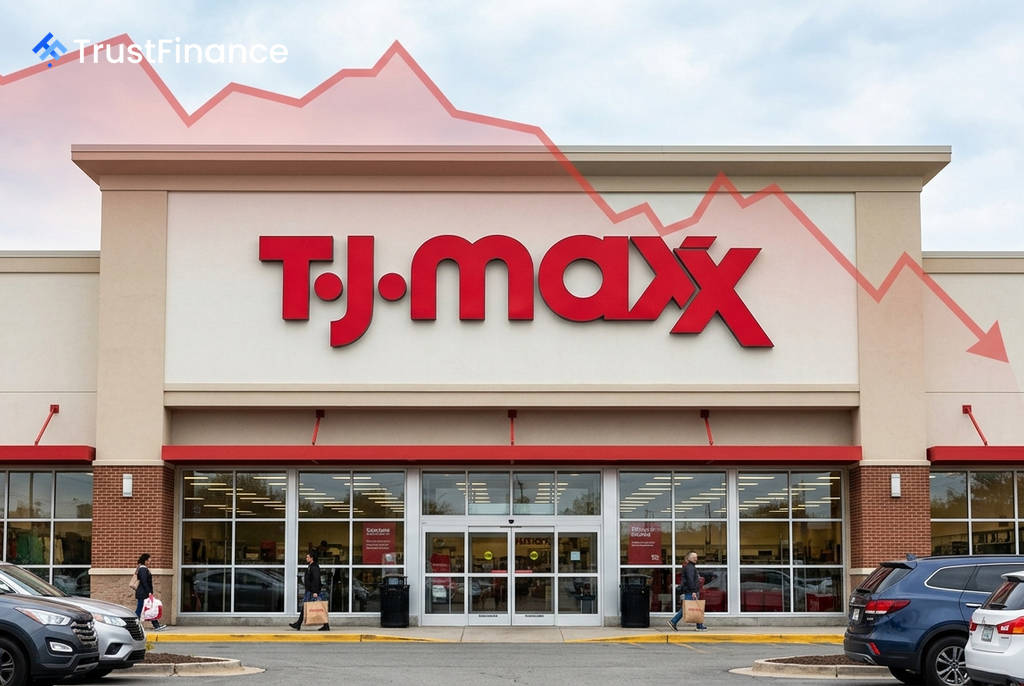
Shares of TJX Companies (NYSE: TJX) extended their decline in pre-market trading, falling after a disappointing third-quarter forecast and signs of slowing sales overshadowed a quarterly earnings beat. The continued sell-off highlights investor concern over the retailer's near-term profitability and operational performance.
Guidance and Sales Weaken
While the parent of T.J. Maxx and Marshalls reported second-quarter adjusted earnings per share of $1.22 on revenue of $15.2 billion, beating consensus estimates of $1.19, investors focused on the weaker outlook. The company's guidance for third-quarter adjusted EPS of $1.30 to $1.32 came in below the analyst expectation of $1.35, triggering the initial downturn.
Adding to the concerns was a significant deceleration in the Marmaxx segment, which includes T.J. Maxx and Marshalls. Comparable sales growth in the division slowed to just 1% in the second quarter, a sharp drop from the 6% growth reported in the prior quarter. Management attributed the slowdown to what it described as self-inflicted issues with merchandise mix execution.
Expansion Plans Raise Cost Concerns
 Ad
TJX also unveiled ambitious long-term growth plans, announcing an acceleration of new store openings to a 4% pace starting in fiscal 2028. The company raised its global store target to 7,500 locations.
This announcement raised questions among investors regarding near-term capital discipline and the potential impact on profit margins, especially as the stock had been trading at a premium valuation. The pressure on TJX shares may have been amplified by analysts highlighting sector peers Ross Stores and Burlington Stores as preferred alternatives.
Market Reaction
The stock was trading down approximately 0.8% to $143.37 in pre-open trading, continuing the slide from the previous session. With major indices like the S&P 500 and Nasdaq trading flat, the negative performance is company-specific, directly tied to its earnings report and forward-looking statements.
Read next
More on Stocks
FTC Orders Walmart, Uber, Delta to Disclose Data on Personalized Pricing
The U.S. Federal Trade Commission is demanding nine major companies, including leading retail, travel, and gig economy firms, to provide information on how they use consumer data for setting individual prices and wages.

Google Launches Gemini 4 Carbon AI Model to Bolster Cybersecurity Capabilities
Alphabet's Google has unveiled Gemini 4 Carbon, its latest AI model specifically designed for advanced cybersecurity tasks like vulnerability detection and secure code generation. The launch escalates competition with rivals OpenAI and Anthropic in the enterprise AI market.

Oracle Shares Surge After Unveiling $225 Billion Revenue Target for 2030
Oracle stock rose sharply after the company presented a long-term financial outlook targeting at least $225 billion in annual revenue by fiscal 2030, driven by its expanding AI infrastructure business.

DOJ Scrutinizes Nvidia's $12.9B Hugging Face Deal Amid Broader Antitrust Probe, Sources Say
The U.S. Department of Justice is reportedly examining Nvidia's planned $12.93 billion acquisition of AI platform Hugging Face as part of a wider, ongoing antitrust investigation into the chipmaker's market conduct.