
Story
Tenable Stock Dips After Short-Seller Report Cites AI Disruption Risks
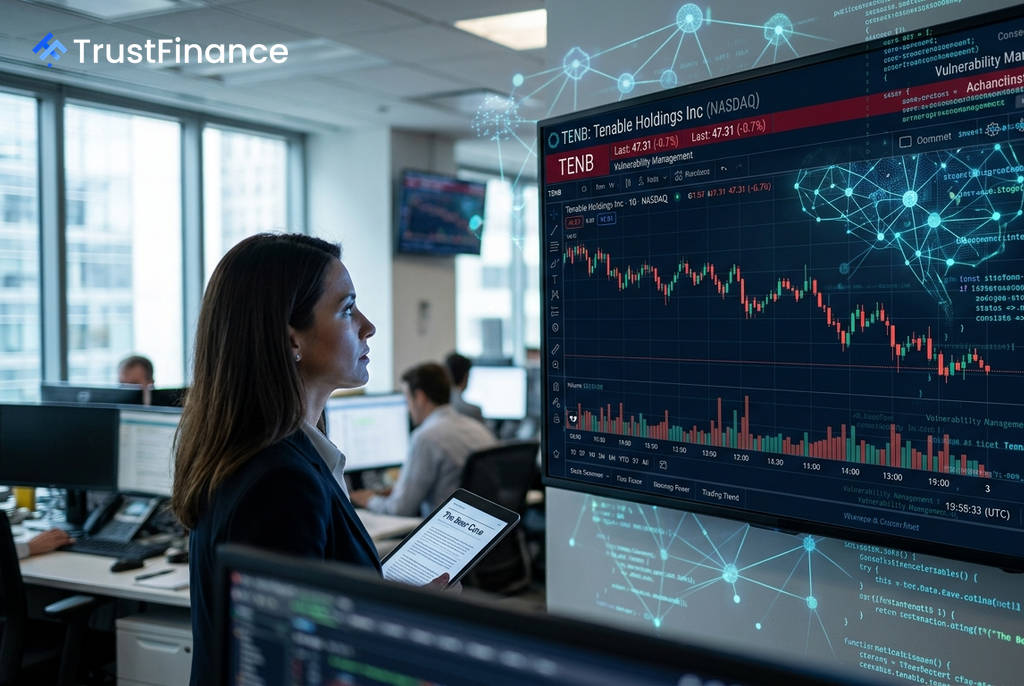
Shares of Tenable Holdings Inc. (NASDAQ:TENB) fell 0.7% in Friday trading after short-selling research firm The Bear Cave published a critical report on the company's future. The report alleges that Tenable faces significant competitive threats as artificial intelligence reshapes the cybersecurity landscape.
Report Highlights Competitive Pressures
The report, issued by The Bear Cave in collaboration with Citrini Research, argues that Tenable's core vulnerability management business is under pressure from multiple fronts. The firm, owned by Hunterbrook Media, disclosed that its affiliated fund, Hunterbrook Capital, holds a short position in Tenable and is long a basket of its competitors, including CrowdStrike and SentinelOne.
Based on interviews with over a dozen industry experts, the report identified several key threats:
- Platform Consolidation: Large security firms like CrowdStrike (NASDAQ:CRWD), Palo Alto Networks (NASDAQ:PANW), and Microsoft (NASDAQ:MSFT) are increasingly bundling vulnerability management into their broader security platforms.
- AI-Native Startups: New, specialized companies are building their products from the ground up with artificial intelligence.
- Frontier AI Companies: Major AI labs are launching their own security tools, such as Anthropic's Claude Code Security, which scans code for vulnerabilities.
- Open-Source Models: The increasing capability of open-source AI presents another potential challenge.
 Ad
The report also noted that Tenable's rate of sequential quarterly revenue growth has been declining, even as overall demand for cybersecurity has risen.
Industry Context and Response
Tenable has made its own moves to address the evolving market, including a partnership with Anthropic and the launch of AI-powered tools like Hexa AI. According to The Bear Cave, Tenable did not respond to its repeated requests for comment on the report's findings.
A competitor, Qualys Inc. (NASDAQ:QLYS), provided a comment to the research firm, stating that while "traditional scanning and detection have indeed become table stakes," it now competes on more advanced features like "risk-based prioritization, exploit validation, and remediation." This suggests a broader industry shift where basic vulnerability scanning is becoming a commoditized feature.
Read next
More on Stocks
FTC Orders Walmart, Uber, Delta to Disclose Data on Personalized Pricing
The U.S. Federal Trade Commission is demanding nine major companies, including leading retail, travel, and gig economy firms, to provide information on how they use consumer data for setting individual prices and wages.

Google Launches Gemini 4 Carbon AI Model to Bolster Cybersecurity Capabilities
Alphabet's Google has unveiled Gemini 4 Carbon, its latest AI model specifically designed for advanced cybersecurity tasks like vulnerability detection and secure code generation. The launch escalates competition with rivals OpenAI and Anthropic in the enterprise AI market.

Oracle Shares Surge After Unveiling $225 Billion Revenue Target for 2030
Oracle stock rose sharply after the company presented a long-term financial outlook targeting at least $225 billion in annual revenue by fiscal 2030, driven by its expanding AI infrastructure business.

DOJ Scrutinizes Nvidia's $12.9B Hugging Face Deal Amid Broader Antitrust Probe, Sources Say
The U.S. Department of Justice is reportedly examining Nvidia's planned $12.93 billion acquisition of AI platform Hugging Face as part of a wider, ongoing antitrust investigation into the chipmaker's market conduct.