
Story
Target Shares Fall After Costume Controversy, Highlighting Brand Risks
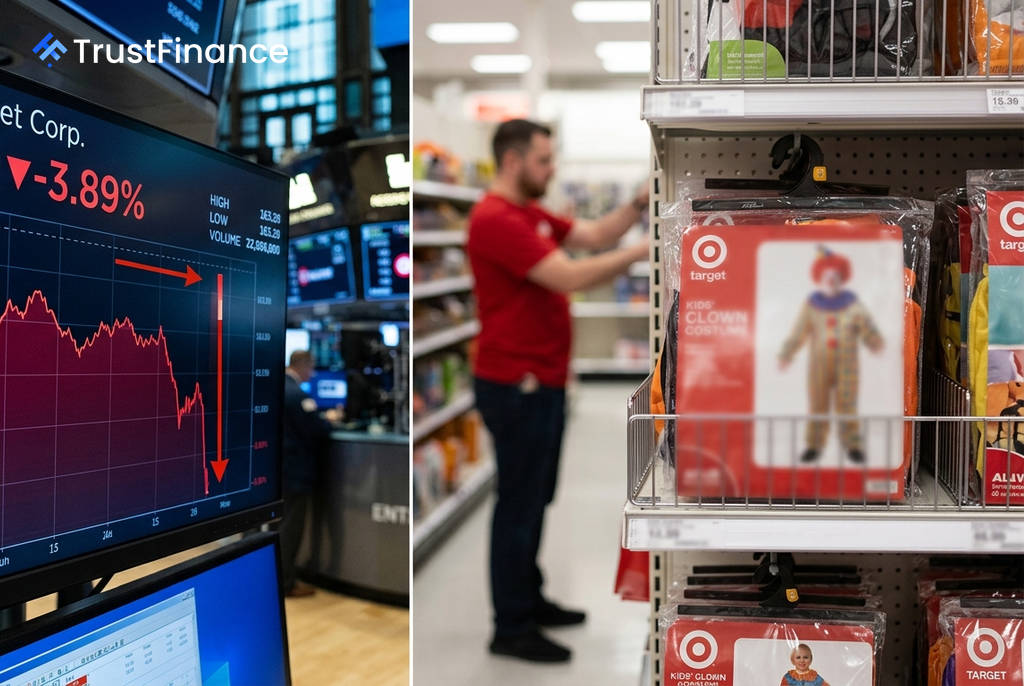
Target's stock price came under pressure Tuesday after the retailer faced intense social media backlash over a Halloween costume that critics said resembled a racist caricature. The incident is the latest in a series of costly cultural missteps by major global brands, highlighting the significant financial and reputational risks associated with controversial products and marketing campaigns.
Target's Latest Controversy
The product at the center of the backlash was a "Kids’ Glows Under Blacklight Circus Clown Halloween Costume." According to a Reuters report, critics on social media argued that the design evoked blackface and minstrel shows, prompting a swift public outcry.
In response to the criticism, Target issued an apology and confirmed it had pulled the product from its stores. This marks the second time in recent years the retailer has faced a high-profile controversy, following its 2023 decision to remove some LGBTQ-themed merchandise from its 'Pride Collection' amid customer backlash, a move the company said was to protect employee safety.
A Pattern of Costly Brand Missteps
Consumer backlash over marketing and products has led to tangible financial consequences for several publicly traded companies, demonstrating a direct link between brand perception and business performance.
 Ad
- Anheuser-Busch InBev: A 2023 social media promotion for Bud Light with transgender influencer Dylan Mulvaney sparked a conservative backlash that toppled the brand from its long-held position as America's best-selling beer. The top spot was subsequently claimed by Constellation Brands’ Modelo Especial.
- Starbucks: The coffee chain's South Korean unit experienced what the company described as a "very significant" decline in sales in early 2026. The downturn followed a marketing campaign that appeared to reference a brutal 1980 military crackdown, leading to the dismissal of the head of Starbucks Korea.
- H&M: In 2018, the fashion retailer apologized and removed an ad featuring a black child in a sweatshirt with the slogan "Coolest Monkey in the Jungle" after it was widely condemned as racist.
- PepsiCo: The company pulled a 2017 commercial featuring Kendall Jenner within 24 hours after critics said it trivialized civil rights protests. A separate 2013 ad for its Mountain Dew brand was also removed for what critics called the reinforcement of racial stereotypes.
Implications for Investors
These events underscore the increasing importance of environmental, social, and governance (ESG) factors, specifically the social component, in assessing a company's risk profile. In an era of rapid social media mobilization, a single product or ad campaign can quickly escalate into a public relations crisis with immediate effects on sales and market capitalization.
For investors, these controversies serve as a reminder that brand reputation is a critical, albeit intangible, asset. The financial fallout from these missteps, ranging from boycotts and sales slumps to stock price declines, demonstrates that navigating sensitive cultural issues is now a key challenge for consumer-facing companies.
Read next
More on Stocks
FTC Orders Walmart, Uber, Delta to Disclose Data on Personalized Pricing
The U.S. Federal Trade Commission is demanding nine major companies, including leading retail, travel, and gig economy firms, to provide information on how they use consumer data for setting individual prices and wages.

Google Launches Gemini 4 Carbon AI Model to Bolster Cybersecurity Capabilities
Alphabet's Google has unveiled Gemini 4 Carbon, its latest AI model specifically designed for advanced cybersecurity tasks like vulnerability detection and secure code generation. The launch escalates competition with rivals OpenAI and Anthropic in the enterprise AI market.

Oracle Shares Surge After Unveiling $225 Billion Revenue Target for 2030
Oracle stock rose sharply after the company presented a long-term financial outlook targeting at least $225 billion in annual revenue by fiscal 2030, driven by its expanding AI infrastructure business.

DOJ Scrutinizes Nvidia's $12.9B Hugging Face Deal Amid Broader Antitrust Probe, Sources Say
The U.S. Department of Justice is reportedly examining Nvidia's planned $12.93 billion acquisition of AI platform Hugging Face as part of a wider, ongoing antitrust investigation into the chipmaker's market conduct.