
Story
Tactical Resources Begins Nasdaq Trading, Focuses on US Rare Earth Supply Chain
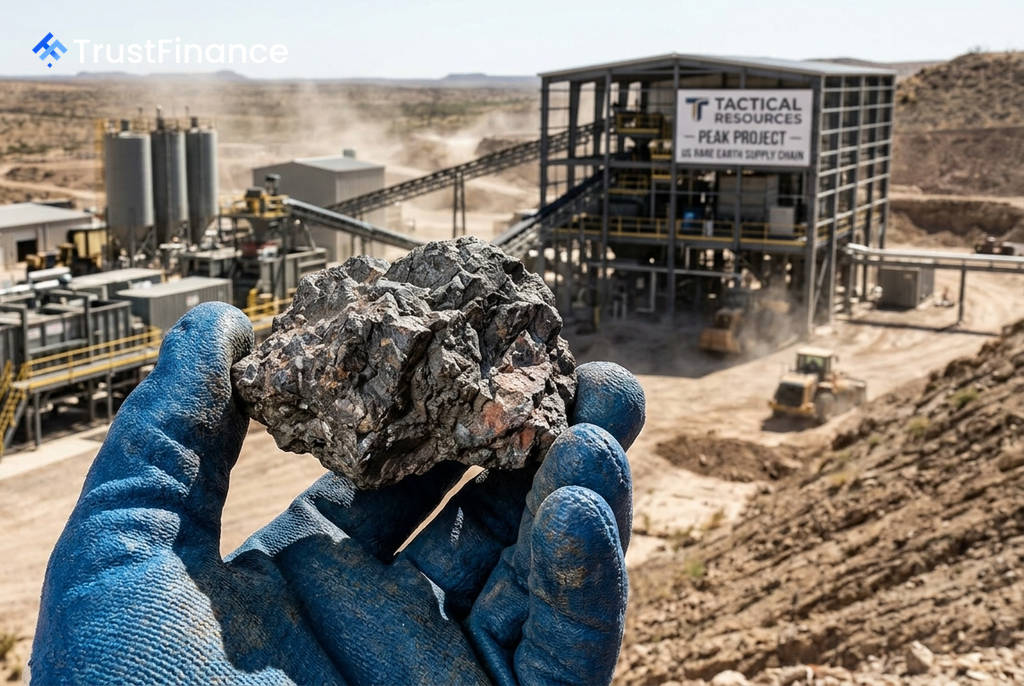
Tactical Resources Corp. began trading on the Nasdaq Capital Market on Thursday following the completion of its merger with a blank-check firm, a move its chief executive said is aimed at building a U.S.-focused rare earths platform. Shares of the Vancouver-based miner dropped in early trading during its public debut.
The listing was accomplished through a tie-up with special purpose acquisition vehicle (SPAC) Plum Acquisition III Corp. In exclusive comments to Investing.com, CEO Ranjeet Sundher said the deal gives the company access to “the market where our project, potential partners and natural investor base are located.”
U.S. 'Mine-to-Magnet' Strategy
Tactical Resources is centered on its Peak Project in Texas, which the company describes as one of the only hard rock, direct-to-leach rare earth opportunities in the United States. The company's strategy involves advancing permitting for a processing facility and continuing metallurgical development to create a vertically integrated domestic supply chain.
“Our objective is not simply to demonstrate that rare earths are present at Peak -- it is to show a credible pathway from the material already sitting at the site into a usable rare-earth product,” Sundher stated. He added that the company is working “toward becoming part of a domestic mine-to-magnet supply chain.”
 Ad
Geopolitical Context
The move comes as the U.S. and other G7 nations seek to reduce their dependence on China for critical minerals. Rare earth elements are vital for manufacturing a wide range of products, from electric vehicles and solar panels to high-tech weapons systems. According to International Energy Agency data cited by Reuters, China refines a dominant share of the world's critical minerals, including between 47% and 87% of copper, lithium, cobalt, and rare earths.
Sundher noted that Washington's policy on rare earths has been “remarkably consistent,” viewing the issue as one of both economic and national security. “The broader policy objective is increasingly clear: the U.S. needs a resilient mine-to-magnet supply chain that reduces dependence on China,” he said. This has shifted the focus beyond simply identifying resources to finding projects with a “realistic pathway to processing, separation and usable material.”
Read next
More on Stocks
FTC Orders Walmart, Uber, Delta to Disclose Data on Personalized Pricing
The U.S. Federal Trade Commission is demanding nine major companies, including leading retail, travel, and gig economy firms, to provide information on how they use consumer data for setting individual prices and wages.

Google Launches Gemini 4 Carbon AI Model to Bolster Cybersecurity Capabilities
Alphabet's Google has unveiled Gemini 4 Carbon, its latest AI model specifically designed for advanced cybersecurity tasks like vulnerability detection and secure code generation. The launch escalates competition with rivals OpenAI and Anthropic in the enterprise AI market.

Oracle Shares Surge After Unveiling $225 Billion Revenue Target for 2030
Oracle stock rose sharply after the company presented a long-term financial outlook targeting at least $225 billion in annual revenue by fiscal 2030, driven by its expanding AI infrastructure business.

DOJ Scrutinizes Nvidia's $12.9B Hugging Face Deal Amid Broader Antitrust Probe, Sources Say
The U.S. Department of Justice is reportedly examining Nvidia's planned $12.93 billion acquisition of AI platform Hugging Face as part of a wider, ongoing antitrust investigation into the chipmaker's market conduct.