
Story
S&P Revises Mosaic Outlook to Negative on High Costs, Weakening Cash Flow
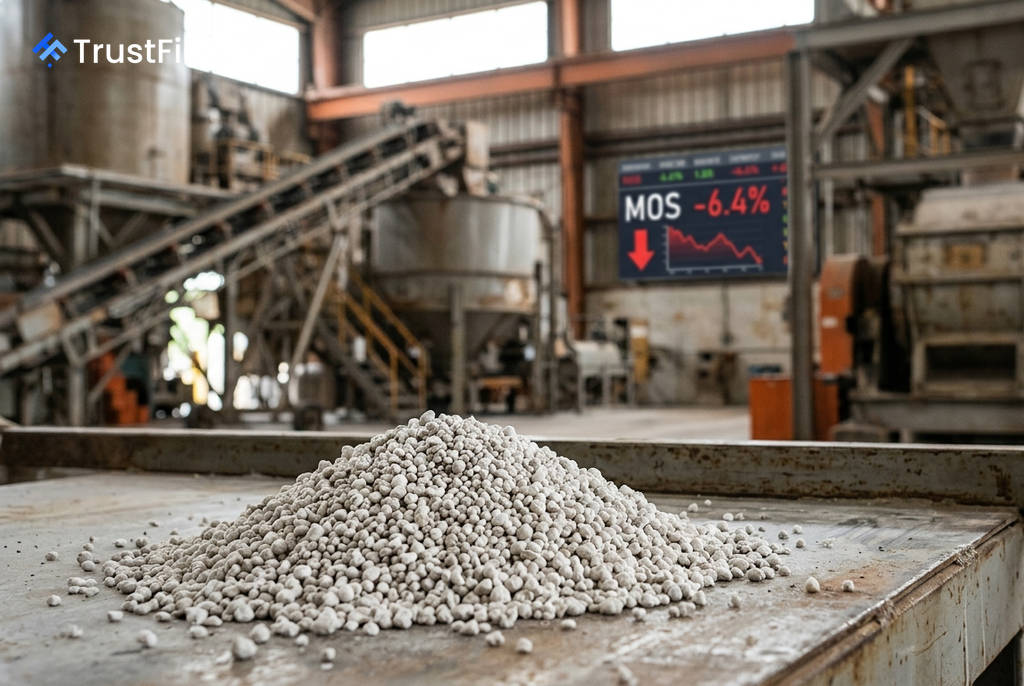
S&P Global Ratings has revised its outlook on The Mosaic Co. (NYSE:MOS) to negative from stable, signaling a potential for a future downgrade. The rating agency affirmed the fertilizer company's BBB issuer credit rating, but warned of mounting pressure from high raw material costs and weakening cash flow.
Margin Squeeze and Demand Headwinds
The primary driver for the outlook change is the severe compression of margins in Mosaic's phosphate segment, according to S&P. This is a result of soaring costs for key inputs like sulfur and ammonia, which have made some production uneconomical.
Key factors cited by the rating agency include:
- An acute shortage of sulfur from the Persian Gulf, which has pushed spot prices above $1,000 per ton.
- Ammonia costs exceeding $600 per ton.
- Weak demand from farmers in key markets, who are deferring fertilizer purchases due to record unaffordability and low crop prices. Management expects phosphate application to fall by about 30% in both Brazil and North America.
In response to these conditions, Mosaic has been forced to curtail marginal production where stripping margins have turned negative.
Deteriorating Financial Metrics
 Ad
S&P projects that the challenging operating environment will significantly weaken Mosaic's financial performance. The agency now expects the company's funds from operations (FFO) to debt ratio to fall below 20% in 2026, a key credit metric that was previously triggered at 30%.
Furthermore, S&P forecasts that Mosaic's adjusted EBITDA will decline to approximately $1.6 billion in 2026 from an estimated $2.6 billion in 2025. The company is also expected to post a discretionary cash flow deficit of $400 million to $500 million in 2026, driven by weak earnings and significant maintenance and reliability expenditures. This negative cash flow is anticipated to increase Mosaic's debt load before turning modestly positive in 2027.
Debt and Liquidity Profile
Mosaic's balance sheet is under scrutiny amid the operational challenges. As of June 30, the company held about $1 billion in short-term debt. It faces significant upcoming maturities, including $700 million in 2027 and $547 million in 2028.
To manage its liquidity, Mosaic recently issued a $1 billion delayed draw term loan to refinance about $500 million of its commercial paper. The company also lowered its 2026 capital expenditure guidance by $250 million earlier this year to preserve cash.
Read next
More on Stocks
FTC Orders Walmart, Uber, Delta to Disclose Data on Personalized Pricing
The U.S. Federal Trade Commission is demanding nine major companies, including leading retail, travel, and gig economy firms, to provide information on how they use consumer data for setting individual prices and wages.

Google Launches Gemini 4 Carbon AI Model to Bolster Cybersecurity Capabilities
Alphabet's Google has unveiled Gemini 4 Carbon, its latest AI model specifically designed for advanced cybersecurity tasks like vulnerability detection and secure code generation. The launch escalates competition with rivals OpenAI and Anthropic in the enterprise AI market.

Oracle Shares Surge After Unveiling $225 Billion Revenue Target for 2030
Oracle stock rose sharply after the company presented a long-term financial outlook targeting at least $225 billion in annual revenue by fiscal 2030, driven by its expanding AI infrastructure business.

DOJ Scrutinizes Nvidia's $12.9B Hugging Face Deal Amid Broader Antitrust Probe, Sources Say
The U.S. Department of Justice is reportedly examining Nvidia's planned $12.93 billion acquisition of AI platform Hugging Face as part of a wider, ongoing antitrust investigation into the chipmaker's market conduct.