
Story
South Korea's KOSPI Tumbles 33% From Peak as AI-Fueled Rally Unwinds
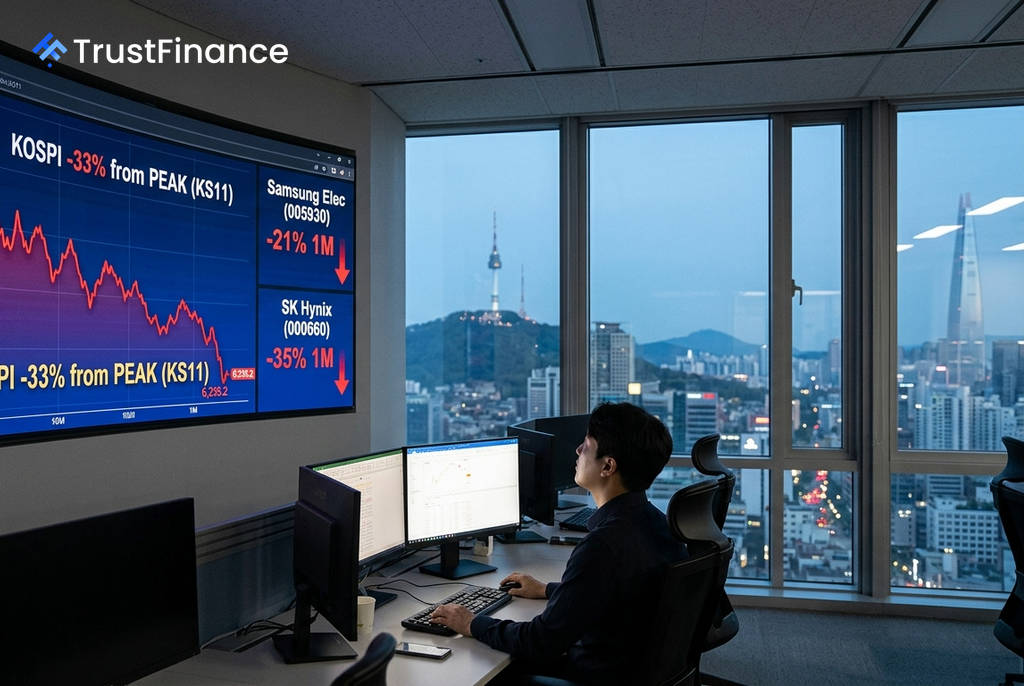
South Korea’s benchmark KOSPI index has plummeted more than 33% from its all-time high, entering a sharp correction driven by a global reassessment of the artificial intelligence trade and an unwind of heavily leveraged retail positions. The index closed at 6,235.2 after suffering its worst month since 2008 in July, wiping out 22% of its value.
The Scale of the Correction
While the recent sell-off is severe, the KOSPI remains significantly elevated on a longer-term basis, highlighting the magnitude of its preceding rally. The index has fallen from a peak of 9,385.59 but is still up 47.82% year-to-date and 93.47% over the past 12 months, according to market data.
The rapid descent was amplified by a 5.32% slide in a single week, underscoring the velocity of the reversal as investor sentiment shifts.
Anatomy of the Unwind
The KOSPI's performance is disproportionately influenced by two semiconductor giants, Samsung Electronics (005930) and SK Hynix (000660), which together constitute over half of the index's market capitalization. These stocks have been at the center of the sell-off, with SK Hynix falling over 17% and Samsung down over 11% in the past week. The declines followed a disappointing AI outlook from U.S. chipmaker AMD, sparking concerns that the boom in AI capital spending may not generate proportional returns.
 Ad
This market downturn is also linked to a period of speculative excess earlier in the year. Key factors include:
- Retail Leverage: In May and June 2026, retail investors reportedly poured approximately ₩78 trillion ($54.2 billion) into KOSPI shares, often using newly introduced leveraged single-stock ETFs.
- Regulatory Signals: In mid-July, South Korean financial authorities halted new listings of these leveraged products, a move widely interpreted as a signal of concern over market overheating.
- Forced Selling: As global AI sentiment soured, these leveraged retail positions came under pressure, creating forced sellers and amplifying downside momentum.
Conflicting Signals and Analyst Outlook
The market correction presents a paradox for investors, as it clashes with strong underlying fundamentals from key Korean tech firms. Samsung recently reported a 250-fold increase in its semiconductor operating profit and warned that global memory chip shortages could last through 2028. Despite this, its shares have fallen.
A recent positioning report from Citi noted that bearish flows in the KOSPI are intensifying, driven by new short positions rather than just the closing of long trades. The bank warned that "capitulation risk could rise further" if the market weakness persists, suggesting a bottom may not yet be established.
Read next
More on Stocks
FTC Orders Walmart, Uber, Delta to Disclose Data on Personalized Pricing
The U.S. Federal Trade Commission is demanding nine major companies, including leading retail, travel, and gig economy firms, to provide information on how they use consumer data for setting individual prices and wages.

Google Launches Gemini 4 Carbon AI Model to Bolster Cybersecurity Capabilities
Alphabet's Google has unveiled Gemini 4 Carbon, its latest AI model specifically designed for advanced cybersecurity tasks like vulnerability detection and secure code generation. The launch escalates competition with rivals OpenAI and Anthropic in the enterprise AI market.

Oracle Shares Surge After Unveiling $225 Billion Revenue Target for 2030
Oracle stock rose sharply after the company presented a long-term financial outlook targeting at least $225 billion in annual revenue by fiscal 2030, driven by its expanding AI infrastructure business.

DOJ Scrutinizes Nvidia's $12.9B Hugging Face Deal Amid Broader Antitrust Probe, Sources Say
The U.S. Department of Justice is reportedly examining Nvidia's planned $12.93 billion acquisition of AI platform Hugging Face as part of a wider, ongoing antitrust investigation into the chipmaker's market conduct.