
Story
South Korea's KOSPI Plunges Over 5% as Global Chip Selloff Batters Asian Markets
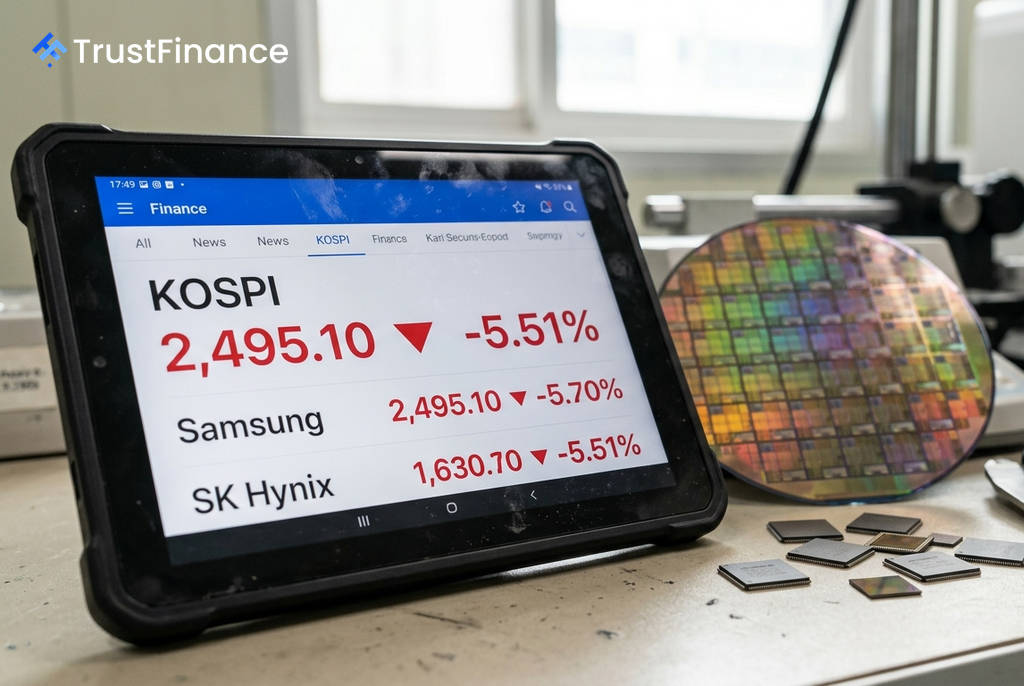
Asian equity markets slumped on Wednesday, with technology-heavy indices in South Korea and Japan bearing the brunt of a global selloff in semiconductor stocks. The decline follows a sharp drop on Wall Street, as persistently high U.S. bond yields and geopolitical tensions in the Middle East soured investor sentiment toward growth-oriented sectors.
Semiconductor Rout Hits Seoul and Tokyo
South Korea’s KOSPI index was the region's biggest loser, tumbling 5.5% to 6,495.1 points in a sharp reversal of its recent six-day rally. The selloff was intense enough to briefly trigger a “sidecar” mechanism, which temporarily halts program trading to cool volatile markets. The index's heavy weighting in chipmakers fueled the decline:
- SK Hynix Inc. plunged 8.4%.
- Samsung Electronics Co. fell 7.3%.
In Japan, the Nikkei 225 index dropped 2.4%, while the broader TOPIX fell 2.7%. Technology firms led the losses, with chip-related company Kioxia Holdings Corp. declining 8.9% and electronic components maker TDK Corp. falling 4.1%.
Wall Street Weakness and Yields Drive Caution
 Ad
The negative sentiment in Asia followed a significant downturn in U.S. markets. The Philadelphia Semiconductor Index (SOX) plunged 5.6% overnight, its largest single-day drop since late July. Key U.S. chip stocks like Micron Technology and Nvidia fell 7% and 2.3%, respectively.
Broader macroeconomic headwinds are pressuring valuations for technology stocks. U.S. Treasury yields remain near multi-decade highs, with the 30-year yield recently touching 5.3371%, its highest level since 2007. Higher yields increase the discount rate used to value future corporate earnings, making high-growth stocks less attractive. Investors are also watching for the release of the Federal Reserve's July meeting minutes for clues on monetary policy, while Brent crude prices remain elevated above $90 a barrel.
Mixed Fortunes in Chinese Markets
Chinese stocks also retreated, with the blue-chip CSI 300 index falling 2.4% and the Shanghai Composite losing 2%. Search giant Baidu plummeted 12.5% in Hong Kong after its quarterly revenue missed analyst estimates.
However, there were pockets of strength. Smartphone maker Xiaomi rose 6.4% as investors focused on growth in its electric vehicle and AI businesses, despite a drop in quarterly profit. In a notable market debut, humanoid-robot manufacturer Unitree Robotics surged nearly sixfold on its first day of trading in Shanghai, indicating selective investor appetite for specific technology narratives.
Read next
More on Stocks
FTC Orders Walmart, Uber, Delta to Disclose Data on Personalized Pricing
The U.S. Federal Trade Commission is demanding nine major companies, including leading retail, travel, and gig economy firms, to provide information on how they use consumer data for setting individual prices and wages.

Google Launches Gemini 4 Carbon AI Model to Bolster Cybersecurity Capabilities
Alphabet's Google has unveiled Gemini 4 Carbon, its latest AI model specifically designed for advanced cybersecurity tasks like vulnerability detection and secure code generation. The launch escalates competition with rivals OpenAI and Anthropic in the enterprise AI market.

Oracle Shares Surge After Unveiling $225 Billion Revenue Target for 2030
Oracle stock rose sharply after the company presented a long-term financial outlook targeting at least $225 billion in annual revenue by fiscal 2030, driven by its expanding AI infrastructure business.

DOJ Scrutinizes Nvidia's $12.9B Hugging Face Deal Amid Broader Antitrust Probe, Sources Say
The U.S. Department of Justice is reportedly examining Nvidia's planned $12.93 billion acquisition of AI platform Hugging Face as part of a wider, ongoing antitrust investigation into the chipmaker's market conduct.