
Story
South Korea Stock Volatility Eases as Forced Liquidations Curb Leveraged Trades
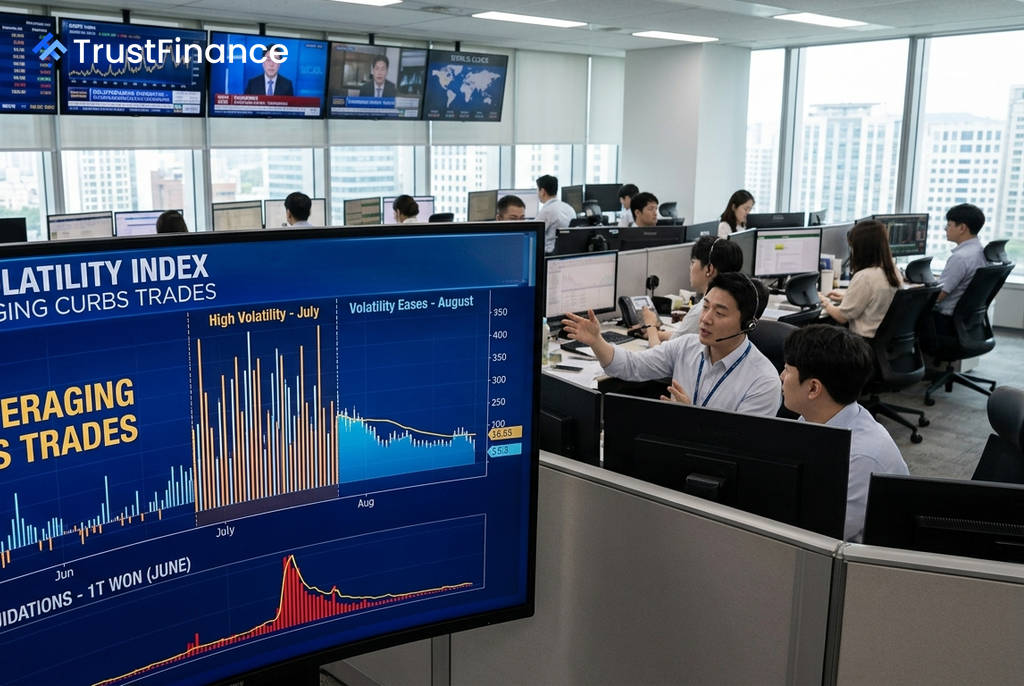
Recent data suggests the most severe phase of South Korea’s stock market turmoil may be over, as a wave of forced liquidations has reduced leveraged positions and new regulations have curbed speculative trading. According to a Bloomberg report, a key volatility index for Korean equities fell to a two-month low last week after hitting a record high in June.
Market Deleveraging
The recent cooldown follows a period of intense market swings amplified by leverage. The Kospi Index had fallen nearly 40% from its June peak, and a volatility gauge surged to 96.9 in June from 28.9 at the end of 2025. In July, market-wide 20-minute trading halts were triggered a record four times.
Analysts at Morgan Stanley estimate that the market’s deleveraging process is now more than halfway complete. This has been driven by significant forced selling and a reduction in borrowed funds:
- Forced liquidations hit approximately 1 trillion won ($710 million) of retail accounts in June and another 993 billion won in July.
- Outstanding margin loans fell to 27.4 trillion won on August 4, the lowest level this year.
 Ad
Regulatory Response and Investor Sentiment
In response to the instability, regulators increased cash deposit requirements for single-stock leveraged exchange-traded funds (ETFs), effective July 31. The move led to a subsequent drop in trading volumes and assets for leveraged products linked to market heavyweights like Samsung Electronics and SK Hynix.
While foreign investors have slowed their retreat, they continue to be net sellers of Korean equities. Overseas funds withdrew a record $30 billion in June, followed by $6.2 billion in July and $4.3 billion in the first part of August. Investors are now weighing the lingering volatility against historically low valuations, with the Kospi trading at a record-low 5.1 times projected 12-month earnings. Goldman Sachs maintained its 12-month Kospi target of 12,000, implying significant upside, while Aberdeen fund manager Isaac Thong noted a cautiously optimistic stance, stating, “We are getting constructive, but we’re still not fully comfortable.”
Read next
More on Stocks
FTC Orders Walmart, Uber, Delta to Disclose Data on Personalized Pricing
The U.S. Federal Trade Commission is demanding nine major companies, including leading retail, travel, and gig economy firms, to provide information on how they use consumer data for setting individual prices and wages.

Google Launches Gemini 4 Carbon AI Model to Bolster Cybersecurity Capabilities
Alphabet's Google has unveiled Gemini 4 Carbon, its latest AI model specifically designed for advanced cybersecurity tasks like vulnerability detection and secure code generation. The launch escalates competition with rivals OpenAI and Anthropic in the enterprise AI market.

Oracle Shares Surge After Unveiling $225 Billion Revenue Target for 2030
Oracle stock rose sharply after the company presented a long-term financial outlook targeting at least $225 billion in annual revenue by fiscal 2030, driven by its expanding AI infrastructure business.

DOJ Scrutinizes Nvidia's $12.9B Hugging Face Deal Amid Broader Antitrust Probe, Sources Say
The U.S. Department of Justice is reportedly examining Nvidia's planned $12.93 billion acquisition of AI platform Hugging Face as part of a wider, ongoing antitrust investigation into the chipmaker's market conduct.