
Story
SoftBank's 46% NAV Discount Signals Investor Concern Over Debt-Fueled AI Bets
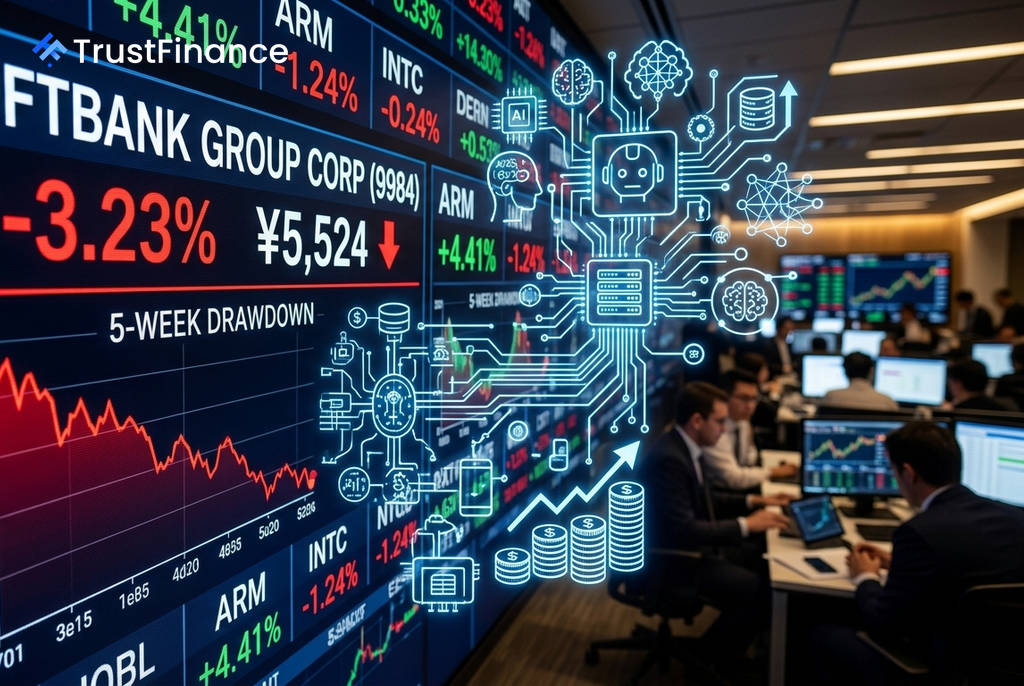
SoftBank Group's stock is trading at a roughly 46% discount to its net asset value (NAV), signaling significant market apprehension over the company's aggressive, debt-fueled expansion into artificial intelligence. This valuation gap persists despite the Japanese conglomerate reporting strong investment gains, underscoring that investors are focused more on the risks of its leveraged balance sheet than the paper value of its holdings.
A Tale of Two Valuations
SoftBank's recent financial disclosures present a paradox for the market. The company's NAV soared to a record ¥72.3 trillion ($445.2 billion) as of June 30, only to drop sharply by nearly ¥14 trillion to ¥58.3 trillion just five weeks later on August 5. While its market capitalization stands at ¥31.46 trillion, the vast difference highlights investor skepticism.
For its first fiscal quarter of 2026, SoftBank posted investment gains of ¥1.86 trillion, largely driven by its stakes in Intel and ByteDance. However, this was overshadowed by a 17.7% year-over-year decline in net income to ¥347.3 billion, as financing costs and administrative expenses more than doubled. The company's cash position also shrank from ¥3.5 trillion to ¥2.3 trillion.
Debt and AI Ambitions
The market's primary concern is the substantial debt SoftBank has incurred to finance its AI strategy. The company has taken on significant new liabilities, including:
 Ad
- A $40 billion bridge loan to fund its investments in OpenAI.
- A $10 billion margin loan signed on August 5, backed by its ownership stake in OpenAI.
These loans support a projected total commitment of $64.6 billion to OpenAI by October 1, 2026, for an approximate 13% ownership stake. Simultaneously, SoftBank has pledged billions for AI data center projects in France, Ohio, and Texas, creating a large capital commitment gap as its cash reserves dwindle.
Key Risks on the Radar
Investors are pricing in several specific risks associated with SoftBank's strategy. The $10 billion OpenAI-backed loan includes a clause that could trigger early repayment if the AI company's private share value declines substantially, a major risk for an illiquid, pre-IPO asset. The company's valuation is also heavily concentrated in its Arm Holdings stake, making it vulnerable to headwinds in the smartphone market, even as Arm's AI-related orders grow.
Ultimately, SoftBank's high-stakes bet on OpenAI is dependent on a successful public offering at or above its current implied valuation. With its loan-to-value ratio at 13%—well below its 25% policy cap—the company has room, but its financial structure increasingly resembles a leveraged hedge fund. The path of OpenAI to the public markets and Arm's ability to navigate market shifts remain the critical variables for investors.
Read next
More on Stocks
FTC Orders Walmart, Uber, Delta to Disclose Data on Personalized Pricing
The U.S. Federal Trade Commission is demanding nine major companies, including leading retail, travel, and gig economy firms, to provide information on how they use consumer data for setting individual prices and wages.

Google Launches Gemini 4 Carbon AI Model to Bolster Cybersecurity Capabilities
Alphabet's Google has unveiled Gemini 4 Carbon, its latest AI model specifically designed for advanced cybersecurity tasks like vulnerability detection and secure code generation. The launch escalates competition with rivals OpenAI and Anthropic in the enterprise AI market.

Oracle Shares Surge After Unveiling $225 Billion Revenue Target for 2030
Oracle stock rose sharply after the company presented a long-term financial outlook targeting at least $225 billion in annual revenue by fiscal 2030, driven by its expanding AI infrastructure business.

DOJ Scrutinizes Nvidia's $12.9B Hugging Face Deal Amid Broader Antitrust Probe, Sources Say
The U.S. Department of Justice is reportedly examining Nvidia's planned $12.93 billion acquisition of AI platform Hugging Face as part of a wider, ongoing antitrust investigation into the chipmaker's market conduct.