
Story
Senator Urges Trump Administration to Bolster US Open-Weight AI Against Chinese Competition
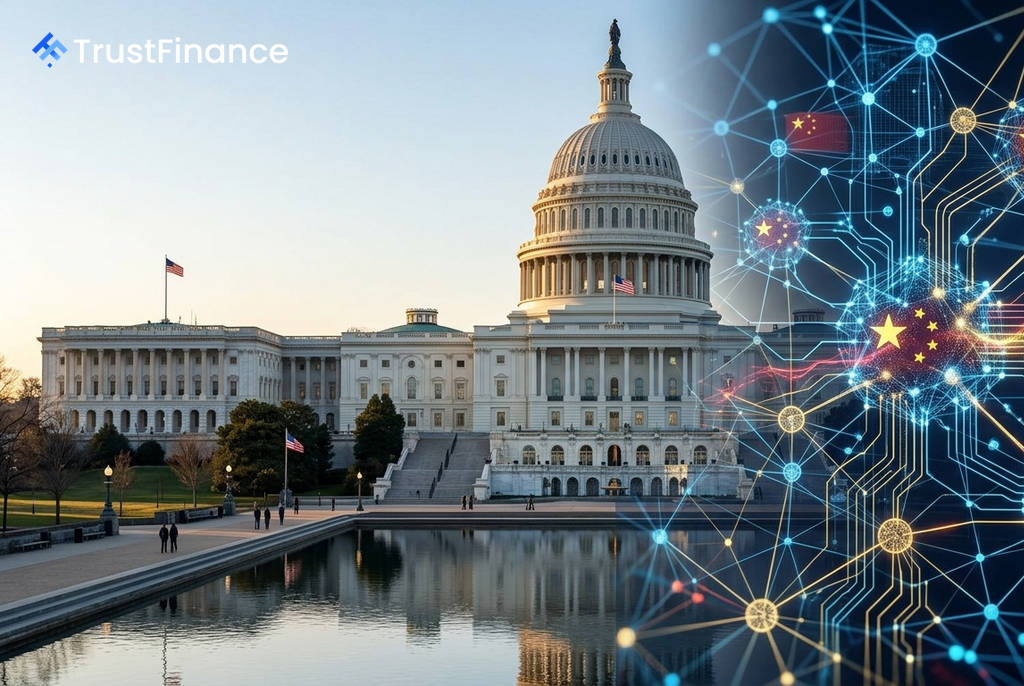
Republican Senator Jim Banks is urging the Trump administration to create incentives for U.S. technology firms to develop open-weight artificial intelligence models, according to a letter released Friday. The move aims to counter the rising popularity of Chinese-developed AI systems and addresses growing national security concerns.
A Push for US Competitiveness
In a letter to President Donald Trump’s economic adviser, Christopher Phelan, Banks called for the administration to devise policies that would "limit dependence" on Chinese-made open-weight models. A member of the Senate Armed Services Committee, Banks also argued that the U.S. must tighten restrictions on the use of American semiconductors by Chinese firms for building AI products.
"America cannot afford to see Chinese open models proliferate and burrow into the global economy only to be weaponized, like rare earths, at a time and place of China’s choosing," Banks wrote. The letter positions the development of a domestic open-weight AI ecosystem as a strategic imperative.
The Open vs. Closed AI Debate
The letter adds a political dimension to a significant debate within the technology sector. The core difference lies in accessibility and control:
 Ad
- Open-weight models, such as Meta’s Muse Glimmer and Nvidia’s Nemotron, have publicly accessible core components. This allows users to download and customize, or fine-tune, the models for specific tasks, often at a lower cost.
- Closed-weight models, including OpenAI’s ChatGPT, Anthropic’s Claude, and Google’s Gemini, are proprietary systems where the creators maintain full control. These are generally considered to be the most powerful AI tools available.
Industry Split on Security Risks
The tech industry remains divided on the implications of open-weight AI. In July, a coalition including Nvidia and Meta urged policymakers to avoid imposing restrictions on the technology, highlighting its potential for innovation and accessibility.
Conversely, some industry leaders have expressed caution. Anthropic CEO Dario Amodei has previously stated that open-weight models could pose a security risk, noting the difficulty in monitoring how they are used. Senator Banks' letter echoes these concerns, framing the issue as a critical aspect of U.S. national and economic security.
Read next
More on Stocks
FTC Orders Walmart, Uber, Delta to Disclose Data on Personalized Pricing
The U.S. Federal Trade Commission is demanding nine major companies, including leading retail, travel, and gig economy firms, to provide information on how they use consumer data for setting individual prices and wages.

Google Launches Gemini 4 Carbon AI Model to Bolster Cybersecurity Capabilities
Alphabet's Google has unveiled Gemini 4 Carbon, its latest AI model specifically designed for advanced cybersecurity tasks like vulnerability detection and secure code generation. The launch escalates competition with rivals OpenAI and Anthropic in the enterprise AI market.

Oracle Shares Surge After Unveiling $225 Billion Revenue Target for 2030
Oracle stock rose sharply after the company presented a long-term financial outlook targeting at least $225 billion in annual revenue by fiscal 2030, driven by its expanding AI infrastructure business.

DOJ Scrutinizes Nvidia's $12.9B Hugging Face Deal Amid Broader Antitrust Probe, Sources Say
The U.S. Department of Justice is reportedly examining Nvidia's planned $12.93 billion acquisition of AI platform Hugging Face as part of a wider, ongoing antitrust investigation into the chipmaker's market conduct.