
Story
Semiconductor and South Korean Stocks Show Bubble Characteristics, Citi Says
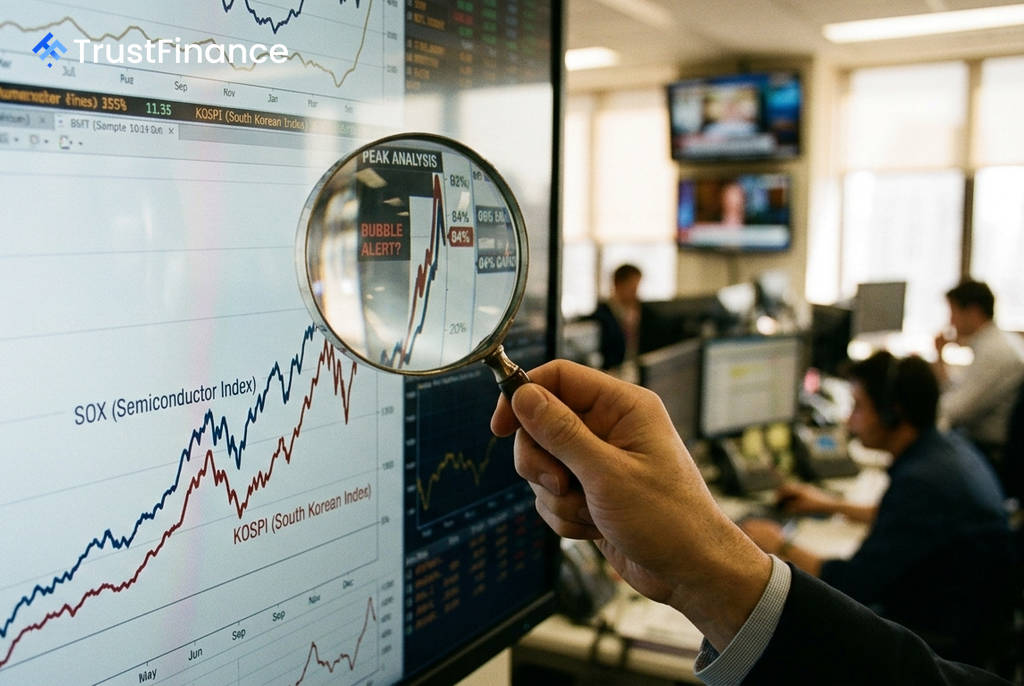
Investor attention regarding potential asset bubbles has pivoted away from broad U.S. benchmarks and toward semiconductor stocks and the South Korean market, according to a recent client note from Citi.
While the bank has previously argued that U.S. equities are in a bubble, it noted that the Nasdaq 100 has not experienced a rally on the scale of its 54% surge in the fourth quarter of 1999. The focus has now shifted to markets with heavy exposure to the chip sector.
Record-Breaking Rallies
Citi highlighted extraordinary recent gains in both the Philadelphia Semiconductor Index (SOX) and South Korea's KOSPI. The bank's analysis pointed to record-setting quarterly performances that surpass historical precedents, including the dot-com era.
- The SOX index surged 88% in the second quarter of 2026, an all-time record that exceeds its previous high of 68% in the first quarter of 2000.
- The KOSPI gained 84% over the same period, also a record, surpassing its 83% move in the fourth quarter of 1998 as markets recovered from the Asian financial crisis.
Bubble Conditions Triggered
 Ad
Applying its proprietary methodology, which flags a bubble when an asset rises more than two standard deviations above its trend in real terms, Citi said the condition has been met for semiconductors. "For SOX, the bubble condition has triggered," the analysts wrote, specifying that the trigger was met in April.
This marks the third time the index has met these criteria, following episodes in 2000 and 2020. The bank cautioned that while entering the bubble phase was not problematic in the past, the exit proved to be damaging for investors.
Historical Context and Outlook
Looking at past occurrences, Citi noted that after the bubble condition was exited, the SOX index lost 43% and 23% of the gains made during the 2000 and 2020 bubbles, respectively. The sell-offs continued for the subsequent year.
However, the firm concluded that because the SOX has not yet exited the current bubble phase, its methodology does not provide a clear warning signal at this moment. Citi maintains a constructive, but tactical, view on U.S. equities, noting that its separate "Generals indicator" for broad market risk has not yet been triggered.
Read next
More on Stocks
FTC Orders Walmart, Uber, Delta to Disclose Data on Personalized Pricing
The U.S. Federal Trade Commission is demanding nine major companies, including leading retail, travel, and gig economy firms, to provide information on how they use consumer data for setting individual prices and wages.

Google Launches Gemini 4 Carbon AI Model to Bolster Cybersecurity Capabilities
Alphabet's Google has unveiled Gemini 4 Carbon, its latest AI model specifically designed for advanced cybersecurity tasks like vulnerability detection and secure code generation. The launch escalates competition with rivals OpenAI and Anthropic in the enterprise AI market.

Oracle Shares Surge After Unveiling $225 Billion Revenue Target for 2030
Oracle stock rose sharply after the company presented a long-term financial outlook targeting at least $225 billion in annual revenue by fiscal 2030, driven by its expanding AI infrastructure business.

DOJ Scrutinizes Nvidia's $12.9B Hugging Face Deal Amid Broader Antitrust Probe, Sources Say
The U.S. Department of Justice is reportedly examining Nvidia's planned $12.93 billion acquisition of AI platform Hugging Face as part of a wider, ongoing antitrust investigation into the chipmaker's market conduct.