
Story
Samsung Shares Fall Despite Record Return Plan as Investors Favor SK Hynix
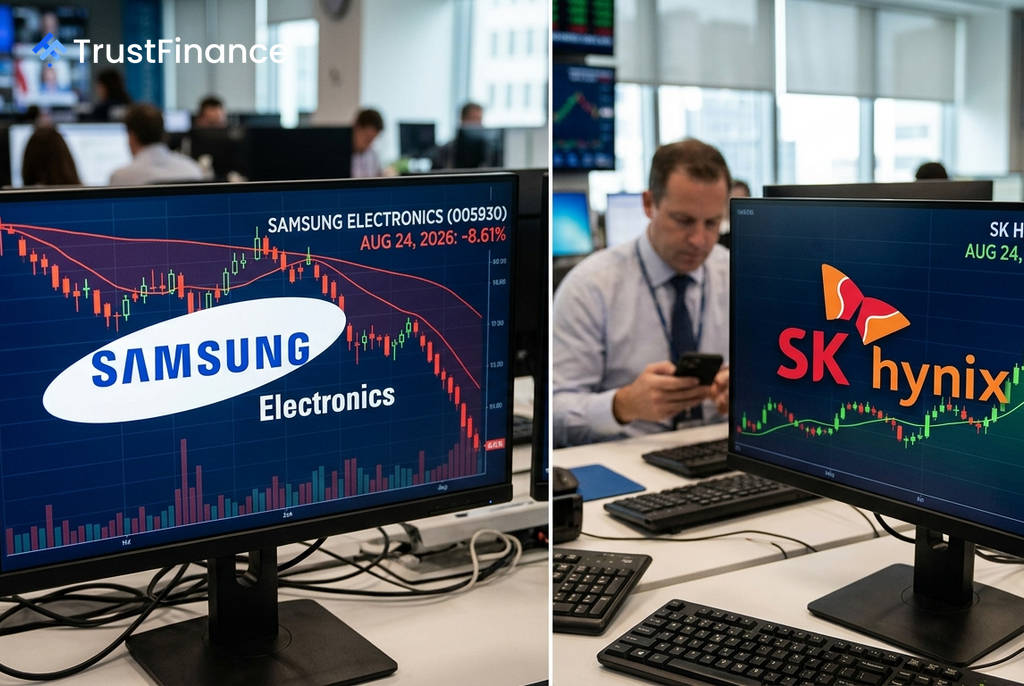
Samsung Electronics unveiled a record ₩110 trillion ($80 billion) shareholder return framework in August, but the announcement was met with a sharp sell-off in its shares. Investors instead rewarded rival chipmaker SK Hynix for its comparatively leaner but more aggressive capital return plan, highlighting a market preference for conviction over raw scale amid an AI-fueled cash windfall.
A Divergent Market Reaction
On August 24, the day the plans were detailed, the market delivered a clear verdict on the two competing strategies. Samsung's shares fell 8%, while SK Hynix's stock climbed 2.4%.
The two South Korean memory giants, both benefiting from a historic recovery in the memory chip cycle, outlined different approaches to distributing their massive free cash flows to investors:
- Samsung Electronics: Pledged a total return of ₩90–110 trillion, including an immediate ₩30 trillion stock buyback. The company committed to returning 50% of its free cash flow (FCF) to shareholders.
- SK Hynix: Announced a larger immediate buyback of ₩40 trillion. While not disclosing a total plan value, it committed to returning more than 50% of its FCF to shareholders from 2025 through 2027.
Reading Between the Lines
 Ad
Investors interpreted SK Hynix's plan as a more decisive commitment to shareholder value. Although Samsung's headline number was larger, SK Hynix's ₩40 trillion buyback is proportionally more significant relative to its market size. Furthermore, its pledge to return ">50%" of FCF was perceived as a more ambitious target than Samsung's firm "50%" commitment.
Both companies have seen their cash generation soar, swinging from negative FCF in fiscal 2023 to substantial positive figures. According to company data, SK Hynix’s FCF grew 87% year-over-year to ₩25.9 trillion, outpacing Samsung's 75% growth to ₩37.8 trillion.
Performance and Valuation Context
The market's reaction aligns with recent performance trends, where SK Hynix has been rewarded as a more focused beneficiary of AI-driven demand for high-bandwidth memory. Over the past year, SK Hynix stock has returned 592%, nearly double Samsung's 299% gain, according to market data.
Despite its stronger performance, SK Hynix trades at a lower valuation, with a last-twelve-months price-to-earnings (P/E) ratio of 7.8x compared to Samsung's 11.2x. This suggests investors see continued high growth potential in the pure-play memory manufacturer, rewarding its aggressive capital return policy as a sign of confidence.
Read next
More on Stocks
FTC Orders Walmart, Uber, Delta to Disclose Data on Personalized Pricing
The U.S. Federal Trade Commission is demanding nine major companies, including leading retail, travel, and gig economy firms, to provide information on how they use consumer data for setting individual prices and wages.

Google Launches Gemini 4 Carbon AI Model to Bolster Cybersecurity Capabilities
Alphabet's Google has unveiled Gemini 4 Carbon, its latest AI model specifically designed for advanced cybersecurity tasks like vulnerability detection and secure code generation. The launch escalates competition with rivals OpenAI and Anthropic in the enterprise AI market.

Oracle Shares Surge After Unveiling $225 Billion Revenue Target for 2030
Oracle stock rose sharply after the company presented a long-term financial outlook targeting at least $225 billion in annual revenue by fiscal 2030, driven by its expanding AI infrastructure business.

DOJ Scrutinizes Nvidia's $12.9B Hugging Face Deal Amid Broader Antitrust Probe, Sources Say
The U.S. Department of Justice is reportedly examining Nvidia's planned $12.93 billion acquisition of AI platform Hugging Face as part of a wider, ongoing antitrust investigation into the chipmaker's market conduct.