
Story
Retail Profit Margins Diverge as Some Hit Peak, Others See Room to Grow
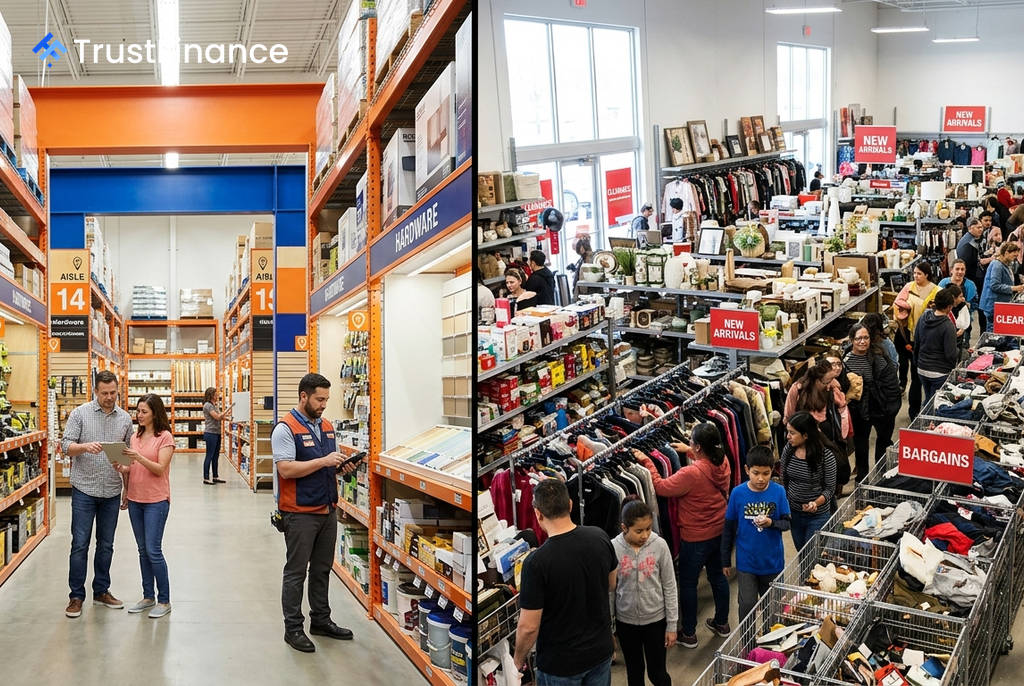
A deep dive into the retail sector's profitability reveals a starkly divided landscape, with company performance increasingly dependent on business models. While off-price retailers and e-commerce leaders continue to expand their profit margins, others in the home improvement and auto-parts segments appear to have already passed their peak profitability and are now facing margin compression.
Margin Expansion Leaders
Amazon.com (AMZN) stands out for its significant margin growth, driven by its high-margin AWS cloud and advertising businesses. The company's operating margin has nearly doubled over five years, rising from 5.3% to 11.2%. However, the pace of this expansion is slowing, suggesting that much of the efficiency gains from its post-pandemic adjustments have been realized. The analysis suggests a potential ceiling for Amazon's operating margin in the 13-15% range.
Off-price retailers such as TJX Companies (TJX) and Ross Stores (ROST) also demonstrate continued strength. TJX has seen its operating margin climb from 9.8% to 11.9% with no signs of deceleration. Their business model, which relies on acquiring inventory at a structural discount, provides a runway for another 2-3 percentage points of operating margin expansion before hitting a historical ceiling for the discount retail segment of around 14%.
Retailers Facing Compression
In contrast, the home improvement sector shows clear signs of a downturn. Home Depot (HD) has experienced a compression in its operating margin from a peak of 15.2% down to 12.7%, even as its gross margins held steady. This trend, mirrored at Lowe's (LOW), is tied to the turning housing cycle, with an expected new normal for operating margins in the 11-13% range—a permanent reduction from recent peaks.
 Ad
Auto-parts retailers like O’Reilly Automotive (ORLY) and AutoZone (AZO) have also likely passed their point of maximum profitability. Despite high gross margins above 50%, their operating margins have fallen as rising selling, general, and administrative (SG&A) costs, including labor and distribution, erode profits. O'Reilly's operating margin has contracted from 22.0% to 19.5%, indicating its pricing power is no longer sufficient to offset expense growth.
The Broader Market Picture
Some retailers operate on an entirely different model where low margins are a strategic choice. Costco (COST), for example, maintains a stable operating margin of just 3.8% by design, using its membership fee structure to pass savings to customers. Its ceiling is a management decision, not a market constraint, likely capped around 4.0-4.5%.
The overall takeaway for investors is that the period of broad-based margin expansion in the retail sector is likely past its midpoint. Future performance will hinge on identifying companies with structural advantages that support continued growth, rather than those whose record profits were tied to a favorable cycle that has now turned.
Read next
More on Stocks
FTC Orders Walmart, Uber, Delta to Disclose Data on Personalized Pricing
The U.S. Federal Trade Commission is demanding nine major companies, including leading retail, travel, and gig economy firms, to provide information on how they use consumer data for setting individual prices and wages.

Google Launches Gemini 4 Carbon AI Model to Bolster Cybersecurity Capabilities
Alphabet's Google has unveiled Gemini 4 Carbon, its latest AI model specifically designed for advanced cybersecurity tasks like vulnerability detection and secure code generation. The launch escalates competition with rivals OpenAI and Anthropic in the enterprise AI market.

Oracle Shares Surge After Unveiling $225 Billion Revenue Target for 2030
Oracle stock rose sharply after the company presented a long-term financial outlook targeting at least $225 billion in annual revenue by fiscal 2030, driven by its expanding AI infrastructure business.

DOJ Scrutinizes Nvidia's $12.9B Hugging Face Deal Amid Broader Antitrust Probe, Sources Say
The U.S. Department of Justice is reportedly examining Nvidia's planned $12.93 billion acquisition of AI platform Hugging Face as part of a wider, ongoing antitrust investigation into the chipmaker's market conduct.