
Story
NVIDIA's $500B AI Financing Deal Poised to Boost TSMC Chip Demand
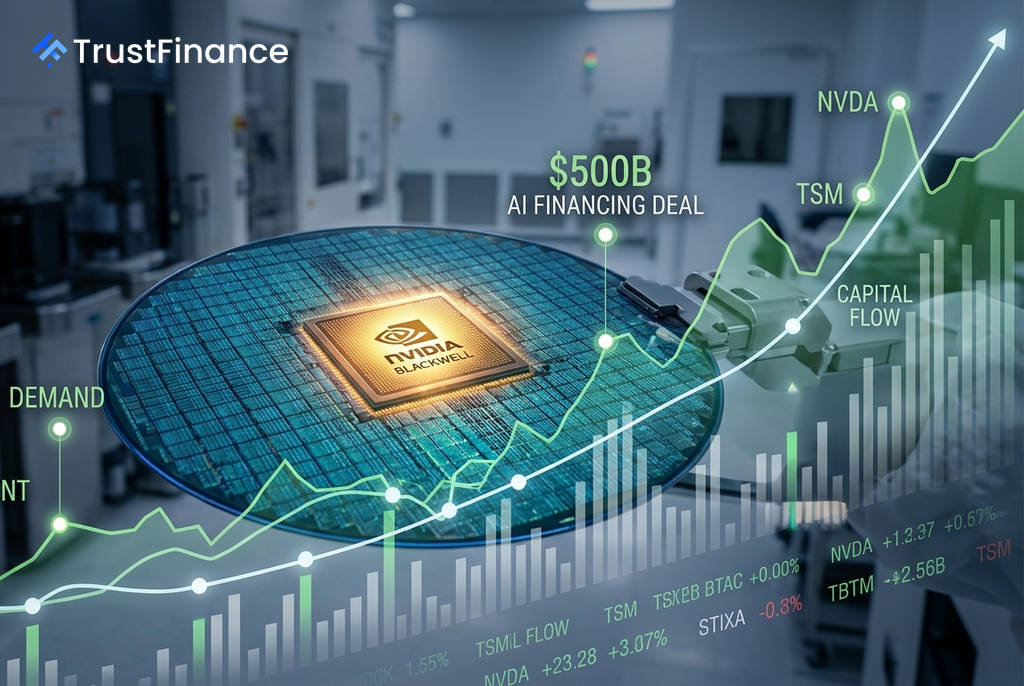
NVIDIA has orchestrated a financing consortium of over $500 billion to fund the development of artificial intelligence data centers, creating a significant demand channel for its high-end GPUs. This arrangement positions key supplier Taiwan Semiconductor Manufacturing Co. (TSMC) as a primary beneficiary of the long-term capital commitment to the AI sector.
The Financing Initiative
Announced on August 10, 2026, the deal involves NVIDIA and a group of major alternative asset managers, including Apollo, BlackRock, Blackstone, Brookfield, Goldman Sachs, and KKR. The consortium will provide capital to AI infrastructure customers, such as neocloud operators CoreWeave and Nebius, facilitating their purchase of NVIDIA's advanced processors.
This structure effectively shifts financing risk from NVIDIA's own balance sheet, freeing up an estimated 15% of its projected free cash flow exposure, according to the source report. By ensuring its customers have access to credit, NVIDIA aims to sustain a high-volume order flow for its AI chips.
Direct Impact on TSMC
As the near-exclusive manufacturer of NVIDIA's most advanced GPUs, including the Blackwell and upcoming Rubin architectures, TSMC is set to directly benefit from the increased and more predictable demand. The flow of capital into data center construction translates almost directly into wafer orders for the Taiwanese foundry.
The key advantages for TSMC stemming from this financing deal include:
 Ad
- Sustained Volume: Cheaper credit for GPU buyers is expected to lock in high-volume orders, ensuring high utilization rates for TSMC's advanced manufacturing facilities.
- Pricing Power: The $500 billion capital pool signals a multi-year AI buildout, which could allow TSMC to maintain its premium pricing for advanced wafers.
- Demand Acceleration: Analysts cited in the report suggest the financing may pull forward GPU orders, potentially providing a near-term revenue upside for the chipmaker, which has recently reported over 30% revenue growth and a 64% gross profit margin.
Market Outlook and Caveats
The market has already recognized TSMC's central role in the AI supply chain, with its stock having risen 68% over the past year as of August 11. Following the announcement, shares of data center operators CoreWeave and Nebius also rose 1.6% and 2.6%, respectively.
However, analysts caution that the Memoranda of Understanding (MOUs) represent financing commitments, not yet deployed capital or confirmed GPU purchases. The full materialization of these funds could depend on broader macroeconomic conditions and the demonstrated return on investment from AI infrastructure.
Investors will be watching NVIDIA's upcoming earnings call on August 26 for further clarification on the deal's structure and the company's remaining vendor-financing exposure.
Read next
More on Stocks
FTC Orders Walmart, Uber, Delta to Disclose Data on Personalized Pricing
The U.S. Federal Trade Commission is demanding nine major companies, including leading retail, travel, and gig economy firms, to provide information on how they use consumer data for setting individual prices and wages.

Google Launches Gemini 4 Carbon AI Model to Bolster Cybersecurity Capabilities
Alphabet's Google has unveiled Gemini 4 Carbon, its latest AI model specifically designed for advanced cybersecurity tasks like vulnerability detection and secure code generation. The launch escalates competition with rivals OpenAI and Anthropic in the enterprise AI market.

Oracle Shares Surge After Unveiling $225 Billion Revenue Target for 2030
Oracle stock rose sharply after the company presented a long-term financial outlook targeting at least $225 billion in annual revenue by fiscal 2030, driven by its expanding AI infrastructure business.

DOJ Scrutinizes Nvidia's $12.9B Hugging Face Deal Amid Broader Antitrust Probe, Sources Say
The U.S. Department of Justice is reportedly examining Nvidia's planned $12.93 billion acquisition of AI platform Hugging Face as part of a wider, ongoing antitrust investigation into the chipmaker's market conduct.