
Story
Nvidia Reportedly Plans New AI Chip for China to Navigate US Export Curbs
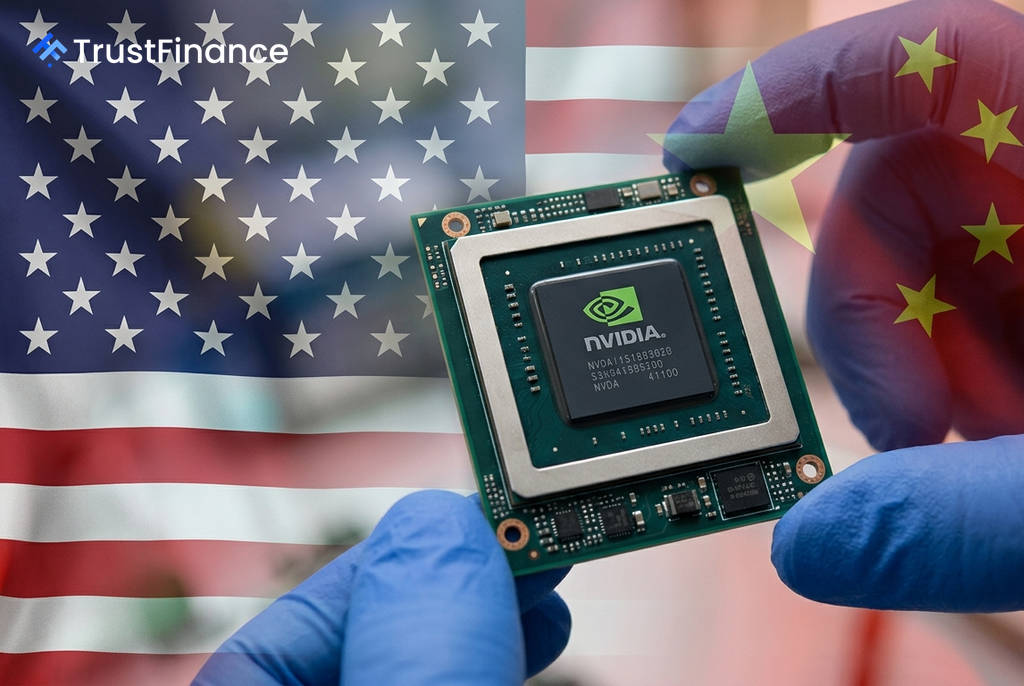
NVIDIA Corporation (NASDAQ:NVDA) is preparing to ship a new artificial intelligence chip tailored for the Chinese market, with initial small-batch deliveries planned by the end of the year, according to a report from The Information. The move signals the company's intent to maintain its presence in China despite stringent U.S. export restrictions that block its most advanced technology.
Following the report, Nvidia's shares saw a brief uptick before paring gains.
A Compliant Chip Design
The new product is reportedly a modified version of Nvidia’s Language Processing Unit (LPU), which was developed using licensed technology from Groq. This chip is designed to work alongside primary graphics processors to accelerate AI inference and response times.
To comply with U.S. export rules that prohibit the sale of its next-generation Vera Rubin architecture to China, Nvidia engineers reportedly modified the LPU's software. This change allows the otherwise compliant hardware to integrate with processors that are accessible within the Chinese market. According to the report, several Chinese companies have already placed orders for the new device.
Market Opportunity and Competition
Nvidia's strategy targets a significant AI computing shortage in China. The supply deficit has become so acute that it recently forced local firms like Moonshot AI to halt new user sign-ups and DeepSeek to increase its developer fees. This bottleneck provides Nvidia a critical opportunity to re-engage with customers before they fully commit to domestic alternatives.
 Ad
The initiative places Nvidia in direct competition with local hardware providers, most notably Huawei Technologies and its upcoming Ascend 950DT inference chip. The move also contrasts with earlier remarks from Nvidia CEO Jensen Huang, who had suggested the company had largely conceded the region to Huawei due to the export controls.
Execution Risks Remain
While the new chip presents a pathway back into the market, its success is not guaranteed. A key uncertainty is potential regulatory pushback from Beijing, which has a history of restricting foreign technology to promote its domestic semiconductor industry.
Beyond the LPU, the report notes that Nvidia is also expanding its China-focused efforts by:
- Scaling shipments of its cleared H200 processors, with packaging partner Amkor Technology reportedly finishing over one million units in the second quarter.
- Developing two new lower-power gaming chips specifically for the Chinese market.
Read next
More on Stocks
FTC Orders Walmart, Uber, Delta to Disclose Data on Personalized Pricing
The U.S. Federal Trade Commission is demanding nine major companies, including leading retail, travel, and gig economy firms, to provide information on how they use consumer data for setting individual prices and wages.

Google Launches Gemini 4 Carbon AI Model to Bolster Cybersecurity Capabilities
Alphabet's Google has unveiled Gemini 4 Carbon, its latest AI model specifically designed for advanced cybersecurity tasks like vulnerability detection and secure code generation. The launch escalates competition with rivals OpenAI and Anthropic in the enterprise AI market.

Oracle Shares Surge After Unveiling $225 Billion Revenue Target for 2030
Oracle stock rose sharply after the company presented a long-term financial outlook targeting at least $225 billion in annual revenue by fiscal 2030, driven by its expanding AI infrastructure business.

DOJ Scrutinizes Nvidia's $12.9B Hugging Face Deal Amid Broader Antitrust Probe, Sources Say
The U.S. Department of Justice is reportedly examining Nvidia's planned $12.93 billion acquisition of AI platform Hugging Face as part of a wider, ongoing antitrust investigation into the chipmaker's market conduct.