
Story
Nvidia, Broadcom AI Financing Deals Signal Strong Demand but Raise Oversupply Flags, Says Wolfe Research
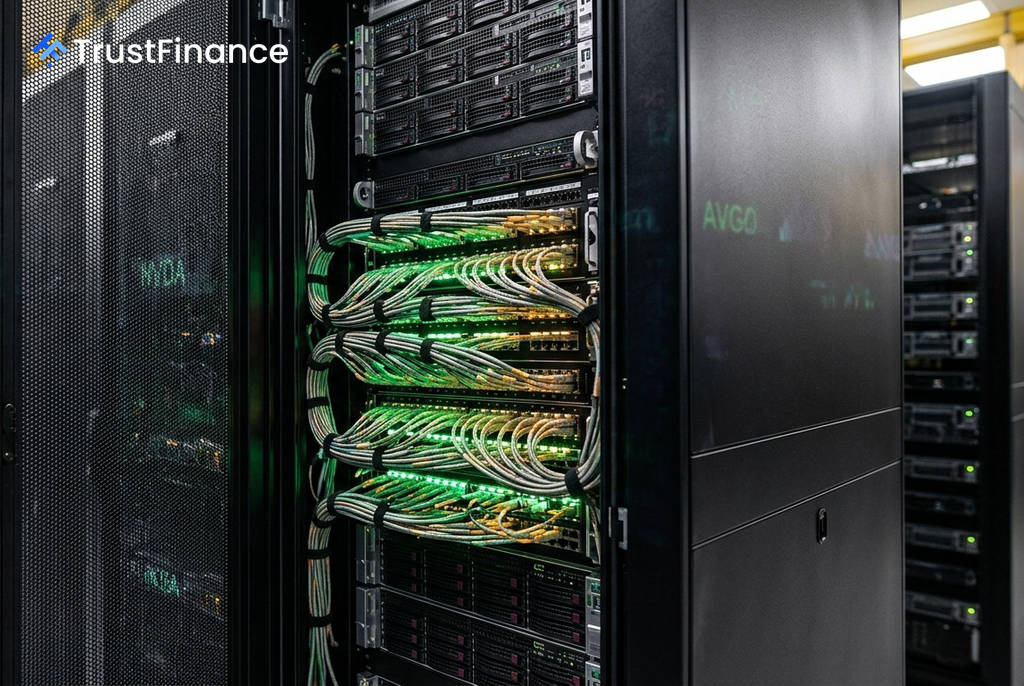
Nvidia and Broadcom have unveiled large-scale financing programs for artificial intelligence infrastructure, signaling robust near-term demand but also introducing potential long-term risks, according to an analysis by Wolfe Research. The initiatives are designed to facilitate massive capital deployment into AI data centers, but the financial guarantees provided by the chipmakers have drawn scrutiny.
The Financing Initiatives
Both chip giants are partnering with major financial institutions to fund the next wave of AI compute capacity. These deals could translate into hundreds of billions of dollars in future revenue.
- Nvidia (NASDAQ:NVDA) established a compute financing platform with partners including Blackrock, Blackstone, and Goldman Sachs. The platform targets over $500 billion in third-party capital for AI infrastructure. Nvidia has the option to backstop up to $125 billion, or 25%, of the potential deals, which Wolfe Research estimates could deliver $350 billion in revenue for Nvidia if fully realized.
- Broadcom (NASDAQ:AVGO) announced an XPV financing vehicle with Apollo and Blackstone to fund XPU purchases by key customers Anthropic and OpenAI. The goal is to enable over 20GW of compute capacity by 2028. An initial tranche of $36 billion is backed by $30 billion in residual value guarantees from Broadcom.
Long-Term Risks and Market Implications
Wolfe Research expressed concern about what might happen if the AI industry overbuilds capacity and supply eventually outstrips demand. The firm noted that the financial backstops from Nvidia and Broadcom act as a form of reinsurance against the failure of individual customers.
 Ad
However, this structure exposes the chipmakers to greater systemic risk if the entire AI sector faces an oversupply glut. While historical precedent shows strong demand—Nvidia’s six-year-old Ampere platform remains fully utilized—the unprecedented scale of the new financing raises questions about future market balance.
Near-Term Constraints Mitigate Oversupply
Despite the long-term concerns, Wolfe Research does not anticipate an imminent oversupply issue. The firm’s analysis suggests that physical and supply chain constraints will likely keep the market tight through 2028.
Key bottlenecks include the time required to build new clean room capacity for manufacturing. Furthermore, the supply of essential components from partners like TSMC and DRAM manufacturers is expected to remain constrained for the next several years, acting as a natural brake on the pace of AI infrastructure deployment.
Read next
More on Stocks
FTC Orders Walmart, Uber, Delta to Disclose Data on Personalized Pricing
The U.S. Federal Trade Commission is demanding nine major companies, including leading retail, travel, and gig economy firms, to provide information on how they use consumer data for setting individual prices and wages.

Google Launches Gemini 4 Carbon AI Model to Bolster Cybersecurity Capabilities
Alphabet's Google has unveiled Gemini 4 Carbon, its latest AI model specifically designed for advanced cybersecurity tasks like vulnerability detection and secure code generation. The launch escalates competition with rivals OpenAI and Anthropic in the enterprise AI market.

Oracle Shares Surge After Unveiling $225 Billion Revenue Target for 2030
Oracle stock rose sharply after the company presented a long-term financial outlook targeting at least $225 billion in annual revenue by fiscal 2030, driven by its expanding AI infrastructure business.

DOJ Scrutinizes Nvidia's $12.9B Hugging Face Deal Amid Broader Antitrust Probe, Sources Say
The U.S. Department of Justice is reportedly examining Nvidia's planned $12.93 billion acquisition of AI platform Hugging Face as part of a wider, ongoing antitrust investigation into the chipmaker's market conduct.