
Story
NorthStrive Acquisition Prices $100 Million SPAC IPO on Nasdaq
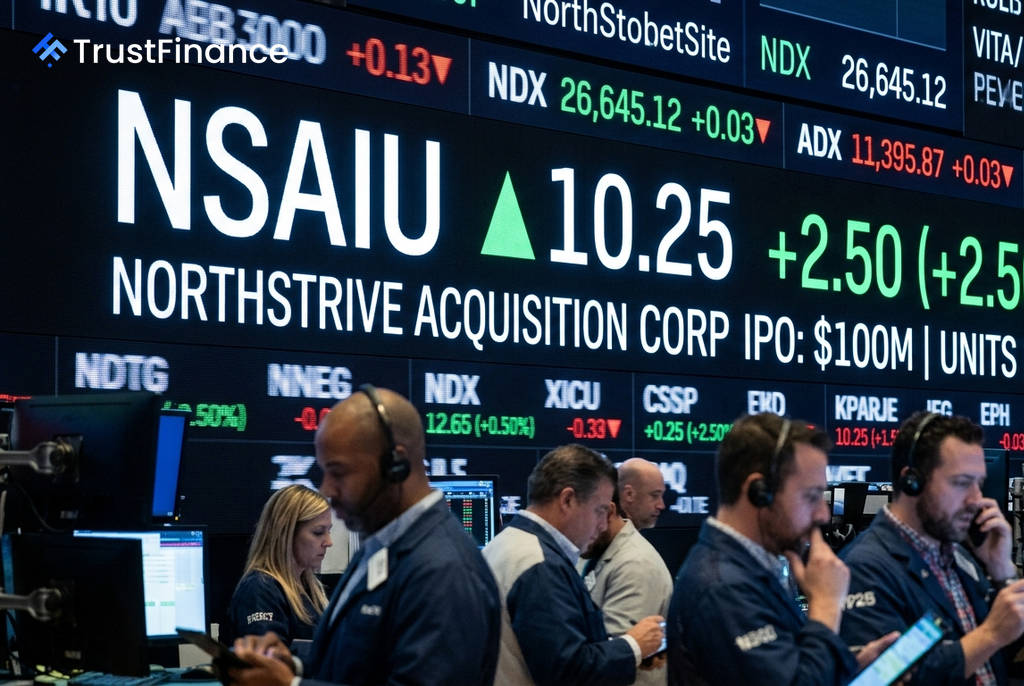
NorthStrive Acquisition Corp I., a special purpose acquisition company (SPAC), announced Monday it has priced its initial public offering of $100 million. The Cayman Islands-incorporated firm will offer 10,000,000 units at a price of $10.00 per unit, according to a company statement.
Offering Details
The units are scheduled to begin trading on the Nasdaq stock exchange on August 18, 2026, under the ticker symbol "NSAIU". The offering is expected to close on August 19, 2026, subject to customary closing conditions.
Each unit sold in the IPO consists of:
- One Class A ordinary share
- One redeemable warrant to purchase one Class A ordinary share at an exercise price of $11.50
- One right to receive one-fourth of one Class A ordinary share upon the completion of an initial business combination
 Ad
Once the securities comprising the units begin separate trading, the Class A ordinary shares, warrants, and rights are expected to be listed on the Nasdaq under the symbols "NSAI," "NSAIW," and "NSAIR," respectively.
Company Strategy
NorthStrive Acquisition is a "blank check" company formed for the purpose of effecting a merger, asset acquisition, or other business combination with one or more businesses. The company has stated its intention to focus its search for a target in the manufacturing sector, including aerospace and defense, industrial technology, and critical supply chains. As is typical for a SPAC at the IPO stage, NorthStrive has not yet selected a specific acquisition target.
The U.S. Securities and Exchange Commission (SEC) declared the company's registration statement effective on August 17, 2026. D. Boral Capital LLC is acting as the sole book-running manager for the offering. The underwriter also has a 45-day option to purchase up to an additional 1,500,000 units to cover any over-allotments.
Read next
More on Stocks
FTC Orders Walmart, Uber, Delta to Disclose Data on Personalized Pricing
The U.S. Federal Trade Commission is demanding nine major companies, including leading retail, travel, and gig economy firms, to provide information on how they use consumer data for setting individual prices and wages.

Google Launches Gemini 4 Carbon AI Model to Bolster Cybersecurity Capabilities
Alphabet's Google has unveiled Gemini 4 Carbon, its latest AI model specifically designed for advanced cybersecurity tasks like vulnerability detection and secure code generation. The launch escalates competition with rivals OpenAI and Anthropic in the enterprise AI market.

Oracle Shares Surge After Unveiling $225 Billion Revenue Target for 2030
Oracle stock rose sharply after the company presented a long-term financial outlook targeting at least $225 billion in annual revenue by fiscal 2030, driven by its expanding AI infrastructure business.

DOJ Scrutinizes Nvidia's $12.9B Hugging Face Deal Amid Broader Antitrust Probe, Sources Say
The U.S. Department of Justice is reportedly examining Nvidia's planned $12.93 billion acquisition of AI platform Hugging Face as part of a wider, ongoing antitrust investigation into the chipmaker's market conduct.