
Story
Nasdaq Proposes 23-Hour Stock Trading, Facing Major Regulatory Hurdles
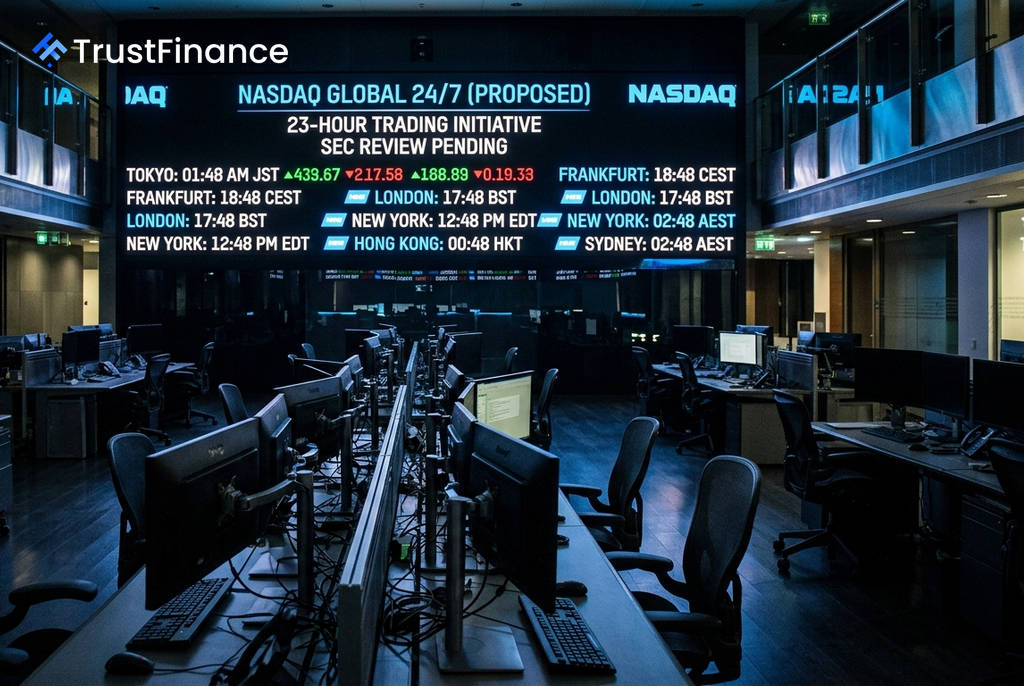
Nasdaq Inc. (NDAQ) has unveiled a plan to extend U.S. stock market trading to nearly 23 hours a day, a move aimed at serving global investors but one that raises fundamental questions about market structure and regulation. The exchange operator intends to add an overnight session from 9 PM to 4 AM ET, potentially starting as early as December 6, 2026, pending approval from the Securities and Exchange Commission (SEC).
Operational and Regulatory Challenges
The proposal comes with a complex set of operational constraints and unresolved regulatory issues. To manage volatility in what is expected to be a thinly traded environment, Nasdaq plans to prohibit market orders during the overnight session, accepting only limit orders. The exchange would also implement static price bands to reject orders outside a specified range, a rigid mechanism that may not adapt quickly to breaking news.
A more significant hurdle is the readiness of the market's core infrastructure. The National Best Bid and Offer (NBBO), the consolidated price quote aggregated by the Securities Information Processor (SIP), was not designed for 23-hour operation. Nasdaq acknowledged that "SIP readiness" is a key precondition, and if it operates as the sole overnight exchange, its own quote would effectively become the NBBO, challenging the concept of a truly "national" best price.
Intersecting Rule Changes
The timing of Nasdaq's proposal coincides with a critical debate over existing market regulations. The SEC has proposed eliminating Rule 610 of Regulation NMS, also known as the Order Protection Rule, which mandates that trades execute at the best available displayed price. In a notable development, major wholesaler Citadel Securities has publicly opposed the rule's elimination, arguing it would harm retail investors by allowing brokers to bypass the best prices on exchanges.
 Ad
If Rule 610 is rescinded while Nasdaq operates a solo overnight session, brokers would not have a regulatory obligation to route orders to Nasdaq's best price. This could create an environment where the concept of "best execution" for investors becomes ambiguous, particularly when only one public exchange is active.
Impact on Market Participants
The plan would also recalibrate the economics of the U.S. equity market, particularly for wholesalers who engage in Payment for Order Flow (PFOF). During overnight hours, market makers would face wider spreads, lower volume, and significantly higher hedging risks. This increased risk would likely lead to much lower PFOF rates paid to retail brokers for their order flow.
While Nasdaq's goal is to provide regulated market access to international investors, the structural challenges are substantial. The success of a 23-hour trading day hinges on the SIP being upgraded, competing exchanges like the NYSE and Cboe joining to create genuine price competition, and clarity on the future of critical investor protections like Rule 610. Without these elements in place, trading at 2 AM could be a fundamentally riskier endeavor than trading during standard market hours.
Read next
More on Stocks
FTC Orders Walmart, Uber, Delta to Disclose Data on Personalized Pricing
The U.S. Federal Trade Commission is demanding nine major companies, including leading retail, travel, and gig economy firms, to provide information on how they use consumer data for setting individual prices and wages.

Google Launches Gemini 4 Carbon AI Model to Bolster Cybersecurity Capabilities
Alphabet's Google has unveiled Gemini 4 Carbon, its latest AI model specifically designed for advanced cybersecurity tasks like vulnerability detection and secure code generation. The launch escalates competition with rivals OpenAI and Anthropic in the enterprise AI market.

Oracle Shares Surge After Unveiling $225 Billion Revenue Target for 2030
Oracle stock rose sharply after the company presented a long-term financial outlook targeting at least $225 billion in annual revenue by fiscal 2030, driven by its expanding AI infrastructure business.

DOJ Scrutinizes Nvidia's $12.9B Hugging Face Deal Amid Broader Antitrust Probe, Sources Say
The U.S. Department of Justice is reportedly examining Nvidia's planned $12.93 billion acquisition of AI platform Hugging Face as part of a wider, ongoing antitrust investigation into the chipmaker's market conduct.