
Story
Moderna Stock Soars 60% as Personalized Melanoma Vaccine Succeeds in Key Trial
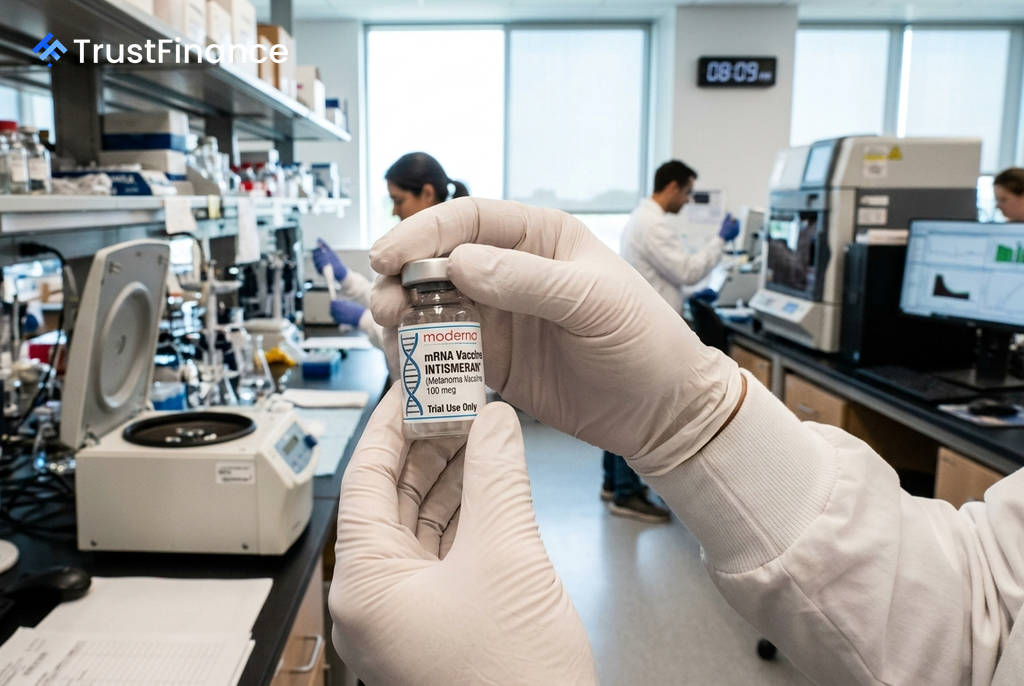
Moderna (MRNA) and Merck (MRK) announced Wednesday that their personalized mRNA cancer vaccine in combination with the immunotherapy drug Keytruda succeeded in a late-stage trial for melanoma. The positive interim results sent Moderna's shares soaring 60% in premarket trading, a significant boost for the company's efforts to expand its technology beyond COVID-19 vaccines.
Trial Success and Market Impact
The companies reported that the combination therapy, which uses a vaccine called Intismeran, met both its primary and secondary goals in the study. The treatment successfully reduced the recurrence of skin cancer and kept the cancer from spreading to other parts of the body in high-risk patients.
Investors reacted strongly to the news, which serves as a major catalyst for Moderna's stock:
- Moderna (MRNA) shares surged 60% to trade at $103.60 before the market opened.
- Merck (MRK) shares also saw a significant lift, climbing 7.5% in premarket trading.
The companies stated that no new safety concerns emerged during the trial and that they plan to present the full results at an upcoming medical conference and share the data with regulatory authorities.
A Personalized Approach to Cancer
 Ad
The treatment combines Merck's widely used immunotherapy, Keytruda, with a custom-built mRNA vaccine from Moderna. The vaccine is personalized for each patient based on a genetic analysis of their specific tumor mutations, designed to train the immune system to target and attack cancer cells.
The late-stage trial enrolled 1,137 patients with stage IIB-IV melanoma whose tumors had been surgically removed. Patients were randomly assigned to receive either Keytruda alone or Keytruda in combination with the personalized vaccine. This positive outcome builds on earlier mid-stage trial data, which showed the combination reduced the risk of recurrence or death by 49% after five years.
Strategic Importance for Moderna
This trial success is a critical step in Moderna's strategy to diversify its product pipeline and validate its mRNA platform for oncology. Analysts have highlighted the cancer vaccine's potential, with Barclays previously estimating the therapy could generate approximately $3 billion in revenue for treating melanoma by 2035.
Melanoma is the most dangerous form of skin cancer. According to the National Cancer Institute, more than 1.5 million people in the U.S. were living with the disease in 2023. A successful therapy for high-risk patients represents a significant unmet medical need and a substantial commercial opportunity.
Read next
More on Stocks
FTC Orders Walmart, Uber, Delta to Disclose Data on Personalized Pricing
The U.S. Federal Trade Commission is demanding nine major companies, including leading retail, travel, and gig economy firms, to provide information on how they use consumer data for setting individual prices and wages.

Google Launches Gemini 4 Carbon AI Model to Bolster Cybersecurity Capabilities
Alphabet's Google has unveiled Gemini 4 Carbon, its latest AI model specifically designed for advanced cybersecurity tasks like vulnerability detection and secure code generation. The launch escalates competition with rivals OpenAI and Anthropic in the enterprise AI market.

Oracle Shares Surge After Unveiling $225 Billion Revenue Target for 2030
Oracle stock rose sharply after the company presented a long-term financial outlook targeting at least $225 billion in annual revenue by fiscal 2030, driven by its expanding AI infrastructure business.

DOJ Scrutinizes Nvidia's $12.9B Hugging Face Deal Amid Broader Antitrust Probe, Sources Say
The U.S. Department of Justice is reportedly examining Nvidia's planned $12.93 billion acquisition of AI platform Hugging Face as part of a wider, ongoing antitrust investigation into the chipmaker's market conduct.