
Story
Mitsubishi Heavy Industries Stock Falls 3.4% Amid Hawkish Fed Fears
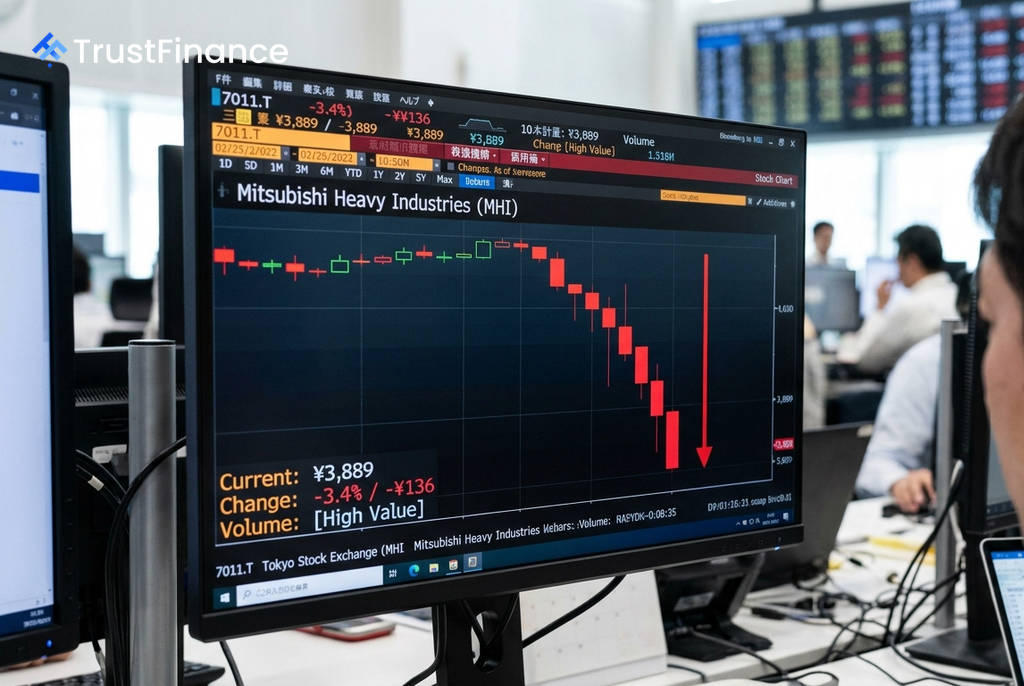
Mitsubishi Heavy Industries (TYO:7011) shares fell 3.4% to close at ¥3,889 on Monday, caught in a broad, macro-driven selloff that swept through Tokyo's equity market. The decline was triggered by hawkish remarks from the U.S. Federal Reserve Chair at the Jackson Hole symposium, which dampened global risk appetite.
Macro Headwinds Rattle Tokyo Equities
The Fed Chair's warning that inflation remains a primary policy focus rattled investors, signaling that tight monetary conditions may persist. This sentiment led to a risk-off mood globally, with Chicago Nikkei 225 futures pointing to a sharp drop before the Tokyo market opened. The benchmark Nikkei 225 index ultimately finished the session with a more modest loss of 0.23%.
Industrial and technology-linked stocks bore the brunt of the selling pressure. Mitsubishi Heavy's significant decline outpaced the broader market, reflecting its sensitivity to global economic sentiment due to its status as a high-beta conglomerate with elevated valuation multiples.
Industrials Underperform
 Ad
The selloff was not isolated to MHI, as other major industrial names also posted steep losses. This pattern highlights a sector-wide retreat from names closely tied to global growth and investment cycles.
- Mitsubishi Materials (TYO:5711) fell 6.6%
- Japan Steel Works (TYO:5631) declined 5.6%
- Advantest (TYO:6857) dropped 4.5%
Fundamentals Fail to Buffer a Risk-Off Mood
Recent positive catalysts, including price target upgrades from several U.S. brokerages and upward earnings estimate revisions in late August, provided no buffer against the macroeconomic pressures. Furthermore, a recent technical breakout above key moving averages failed to hold, suggesting the prior recovery lacked strong conviction and was vulnerable to a shift in market sentiment.
Read next
More on Stocks
FTC Orders Walmart, Uber, Delta to Disclose Data on Personalized Pricing
The U.S. Federal Trade Commission is demanding nine major companies, including leading retail, travel, and gig economy firms, to provide information on how they use consumer data for setting individual prices and wages.

Google Launches Gemini 4 Carbon AI Model to Bolster Cybersecurity Capabilities
Alphabet's Google has unveiled Gemini 4 Carbon, its latest AI model specifically designed for advanced cybersecurity tasks like vulnerability detection and secure code generation. The launch escalates competition with rivals OpenAI and Anthropic in the enterprise AI market.

Oracle Shares Surge After Unveiling $225 Billion Revenue Target for 2030
Oracle stock rose sharply after the company presented a long-term financial outlook targeting at least $225 billion in annual revenue by fiscal 2030, driven by its expanding AI infrastructure business.

DOJ Scrutinizes Nvidia's $12.9B Hugging Face Deal Amid Broader Antitrust Probe, Sources Say
The U.S. Department of Justice is reportedly examining Nvidia's planned $12.93 billion acquisition of AI platform Hugging Face as part of a wider, ongoing antitrust investigation into the chipmaker's market conduct.