
Story
Meituan Expands 'Happy Monkey' Discount Stores in China's Competitive Retail Market
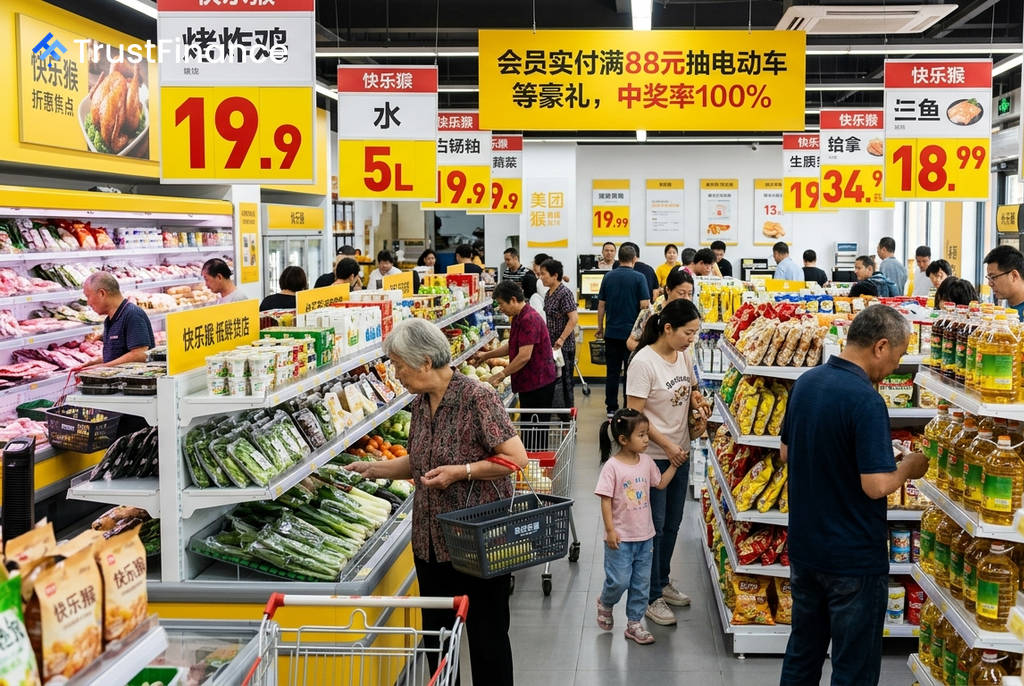
Chinese technology and e-commerce platform Meituan is accelerating its push into physical retail, opening three new locations of its hard-discount supermarket chain, "Happy Monkey," in Beijing and Tianjin on August 7. The expansion brings the chain's total footprint to over 40 stores in just a year, signaling a deeper strategic investment in the brick-and-mortar grocery sector, according to a report from Time Weekly.
A Deeper Push into Physical Retail
A visit to the first "Happy Monkey" store in Beijing's Daxing district revealed a compact, no-frills format focused on aggressive pricing. The store, located on the ground floor of a commercial building, heavily promotes low prices on everyday items, such as a whole fried chicken for 19.9 yuan (approx. $2.75) and a 100g serving of salmon sashimi for 18.99 yuan.
With over 1,600 stock-keeping units (SKUs), the store mixes third-party products with its own "Happy Monkey" private-label goods across categories like fresh produce, pantry staples, and ready-to-eat meals. The store primarily attracts local residents, including a significant number of elderly shoppers and families, with customer traffic peaking in the mornings, according to store staff.
The New Battlefield: Hard-Discount Grocery
Meituan's expansion places it in direct competition with other Chinese tech giants that have entered the hard-discount arena. This includes Alibaba's "Chaohuasuan NB," which has over 500 stores, and JD.com's "JD Discount Supermarket," with more than 10 locations. The collective move reflects a strategic shift in China's instant retail market, which is evolving from a competition for online traffic to an integrated battle over supply chain efficiency and online-offline synergy.
 Ad
Analysts note that the rise of the hard-discount model is fueled by increasingly price-conscious consumers and weaknesses in traditional retail, such as inconsistent supply from small independent shops and declining foot traffic at large hypermarkets. The model focuses on a limited selection of high-demand goods, using bulk purchasing and private labels to lower costs. These physical stores also double as forward-deployed warehouses for their parent companies' rapid online delivery services.
Supply Chain and Differentiation are Key
According to Li Ziqi, Vice Chairman of the Beijing Federation of Industry and Commerce, the core challenge for players in this crowded market is to avoid a simple price war that erodes already thin margins. "The way to break through is to build differentiation through supply chains, private-label brands, and online-offline integration," Li told Time Weekly.
Each competitor brings distinct advantages: Meituan leverages its vast network of delivery riders, JD.com relies on its extensive self-operated procurement and logistics infrastructure, and Alibaba's Hema (Freshippo) has an established lead in fresh food supply chains. However, success in physical retail requires long-term investment in store management, local sourcing, and spoilage control—operational skills that online giants must cultivate. The long-term winners, analysts say, will be those who can master efficiency, quality control, and supply chain management rather than relying on temporary subsidies.
Read next
More on Stocks
FTC Orders Walmart, Uber, Delta to Disclose Data on Personalized Pricing
The U.S. Federal Trade Commission is demanding nine major companies, including leading retail, travel, and gig economy firms, to provide information on how they use consumer data for setting individual prices and wages.

Google Launches Gemini 4 Carbon AI Model to Bolster Cybersecurity Capabilities
Alphabet's Google has unveiled Gemini 4 Carbon, its latest AI model specifically designed for advanced cybersecurity tasks like vulnerability detection and secure code generation. The launch escalates competition with rivals OpenAI and Anthropic in the enterprise AI market.

Oracle Shares Surge After Unveiling $225 Billion Revenue Target for 2030
Oracle stock rose sharply after the company presented a long-term financial outlook targeting at least $225 billion in annual revenue by fiscal 2030, driven by its expanding AI infrastructure business.

DOJ Scrutinizes Nvidia's $12.9B Hugging Face Deal Amid Broader Antitrust Probe, Sources Say
The U.S. Department of Justice is reportedly examining Nvidia's planned $12.93 billion acquisition of AI platform Hugging Face as part of a wider, ongoing antitrust investigation into the chipmaker's market conduct.