
Story
KOSPI Nears 6% Weekly Decline as Semiconductor Selloff Intensifies
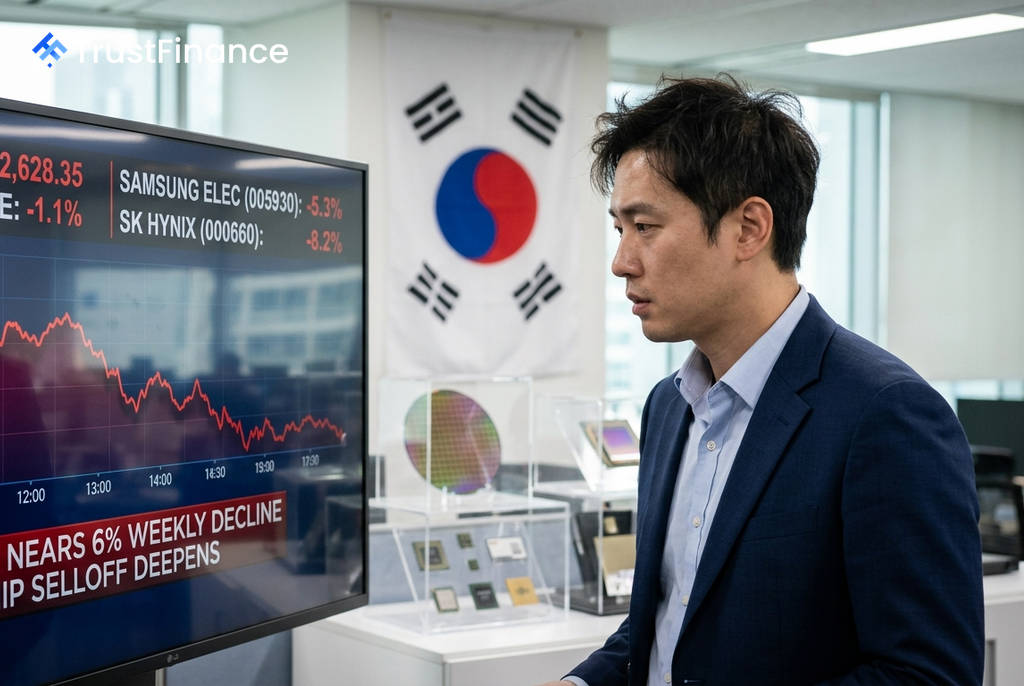
South Korea's benchmark KOSPI index extended its sharp downturn on Friday, positioning it for a weekly loss of more than 6% as investors continued to unwind positions in semiconductor stocks. The decline marks the index's worst weekly performance since a major artificial intelligence-driven selloff last month, reflecting growing unease about the sustainability of the AI trade.
Chipmakers Lead Market Plunge
The selloff has been heavily concentrated in the technology sector, which has an outsized influence on the South Korean market. On Friday, the KOSPI was trading down approximately 1.1% at around 6,228 points, having risen in just two of the last ten trading sessions, according to market data.
Key semiconductor stocks were again the primary drivers of the decline:
- SK Hynix Inc. fell more than 4%, adding to an over 8% loss from the previous session.
- Samsung Electronics Co Ltd. traded near flat after sliding 5% on Thursday.
The pressure was felt across the regional semiconductor supply chain, with Japan's Kioxia Holdings dropping nearly 9% and Murata Manufacturing losing over 6%.
US Earnings Fuel Valuation Concerns
 Ad
The latest wave of selling in Asia follows disappointing investor reactions to earnings reports from key U.S. technology firms. An underwhelming outlook from Advanced Micro Devices and concerns over high AI-related capital spending at SpaceX, following its first quarterly report as a public company, have shaken confidence.
Earlier in the week, earnings from memory-chip makers Sandisk and Western Digital also reignited worries about the sector's cycle, weighing on their Asian counterparts. This has intensified a broader reassessment among investors about whether massive spending on AI infrastructure can continue to support the sector's elevated valuations.
Outlook Tied to Global AI Sentiment
The recent correction highlights the KOSPI's heavy dependence on Samsung and SK Hynix, which together account for a dominant share of the index's market capitalization. This concentration leaves the benchmark highly sensitive to shifts in global semiconductor sentiment.
While the chipmakers continue to report solid earnings, the current volatility appears driven more by investor positioning than by a deterioration in fundamentals. With some institutional investors viewing the pullback as a valuation reset, the market's direction will likely hinge on the next major catalyst for global technology stocks and whether AI demand can ultimately meet the market's lofty expectations.
Read next
More on Stocks
FTC Orders Walmart, Uber, Delta to Disclose Data on Personalized Pricing
The U.S. Federal Trade Commission is demanding nine major companies, including leading retail, travel, and gig economy firms, to provide information on how they use consumer data for setting individual prices and wages.

Google Launches Gemini 4 Carbon AI Model to Bolster Cybersecurity Capabilities
Alphabet's Google has unveiled Gemini 4 Carbon, its latest AI model specifically designed for advanced cybersecurity tasks like vulnerability detection and secure code generation. The launch escalates competition with rivals OpenAI and Anthropic in the enterprise AI market.

Oracle Shares Surge After Unveiling $225 Billion Revenue Target for 2030
Oracle stock rose sharply after the company presented a long-term financial outlook targeting at least $225 billion in annual revenue by fiscal 2030, driven by its expanding AI infrastructure business.

DOJ Scrutinizes Nvidia's $12.9B Hugging Face Deal Amid Broader Antitrust Probe, Sources Say
The U.S. Department of Justice is reportedly examining Nvidia's planned $12.93 billion acquisition of AI platform Hugging Face as part of a wider, ongoing antitrust investigation into the chipmaker's market conduct.