
Story
KOSPI Index Becomes Key Risk Barometer for Volatile Memory Chip Sector
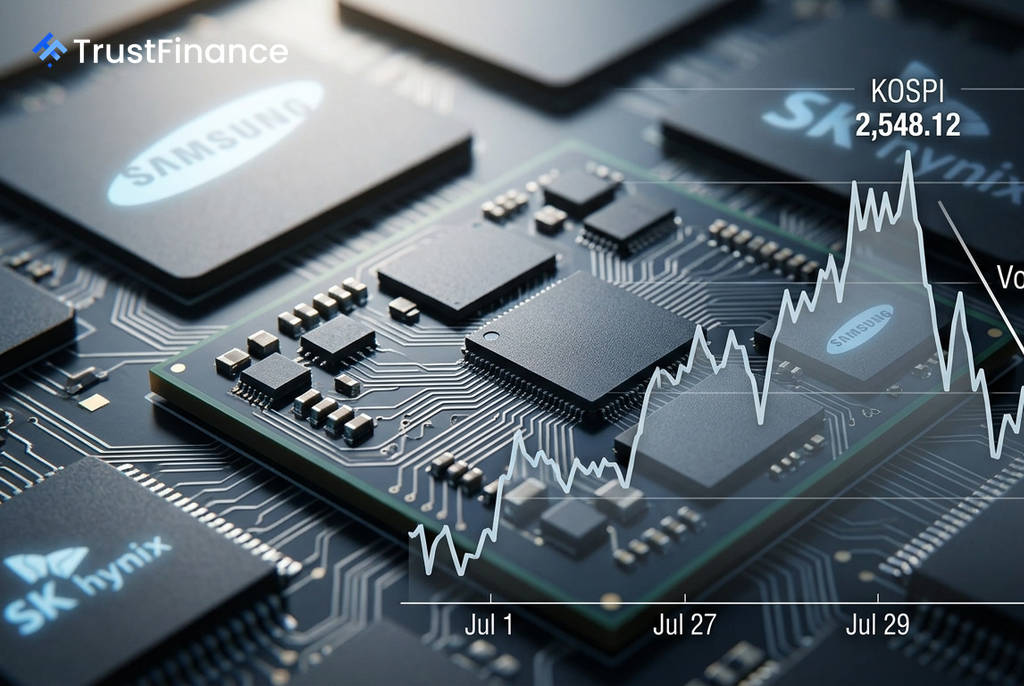
South Korea's KOSPI index has emerged as a critical bellwether for the global memory chip market, driven by the significant weight of industry leaders Samsung Electronics and SK Hynix. The index's performance, which saw a 71.9% surge over the past year, provides a macroeconomic lens on the sector, while the amplified movements of its largest semiconductor constituents highlight both opportunities and risks for investors.
A Magnifier for Market Volatility
The performance of the KOSPI often reflects broader sentiment in the memory sector, but the volatility is frequently magnified in its key component stocks. While the index posted strong annual gains, individual memory producers experienced much wider swings.
- Samsung Electronics (005930.KS) saw its shares climb 184.8% over the past year, yet also recorded a sharp single-day decline of 13.4% on July 27, 2026, following news of an IPO by a Chinese competitor, according to market data.
- SK Hynix (000660.KS) shares experienced a -24.5% one-year return, marked by significant daily fluctuations. The stock fell 7.5% on July 27 amid concerns over Chinese competition, just days after rising 6.6% on July 22 on optimism surrounding AI chip demand.
External Pressures and Policy Impacts
 Ad
The KOSPI's sensitivity to external factors makes it a useful gauge for global memory market dynamics. Geopolitical events, supply chain news, and regulatory changes can trigger significant reactions in the index and its constituent stocks. For example, a 7.3% drop in the KOSPI was noted after the announcement of the Chinese competitor's IPO, underscoring the market's sensitivity to shifts in the competitive landscape.
Furthermore, domestic policy can directly impact market stability. South Korea's finance ministry announced new rules for leveraged ETFs on July 29, 2026, a move aimed at curbing volatility that can have direct ripple effects on heavily traded stocks like Samsung and SK Hynix. These companies' deep integration in the global tech supply chain also makes their valuations susceptible to news from U.S. tech spending to new smartphone launches.
Why the Index Matters for Investors
Because Samsung and SK Hynix dominate both the KOSPI and the global memory chip industry, the index serves as a proxy for sector-wide health. Its movements signal investor sentiment regarding key issues like DRAM pricing, global technology demand, and capital expenditure cycles in the semiconductor industry. For market participants, monitoring the KOSPI provides crucial context for the outsized price movements often seen in leading memory stocks.
Read next
More on Stocks
FTC Orders Walmart, Uber, Delta to Disclose Data on Personalized Pricing
The U.S. Federal Trade Commission is demanding nine major companies, including leading retail, travel, and gig economy firms, to provide information on how they use consumer data for setting individual prices and wages.

Google Launches Gemini 4 Carbon AI Model to Bolster Cybersecurity Capabilities
Alphabet's Google has unveiled Gemini 4 Carbon, its latest AI model specifically designed for advanced cybersecurity tasks like vulnerability detection and secure code generation. The launch escalates competition with rivals OpenAI and Anthropic in the enterprise AI market.

Oracle Shares Surge After Unveiling $225 Billion Revenue Target for 2030
Oracle stock rose sharply after the company presented a long-term financial outlook targeting at least $225 billion in annual revenue by fiscal 2030, driven by its expanding AI infrastructure business.

DOJ Scrutinizes Nvidia's $12.9B Hugging Face Deal Amid Broader Antitrust Probe, Sources Say
The U.S. Department of Justice is reportedly examining Nvidia's planned $12.93 billion acquisition of AI platform Hugging Face as part of a wider, ongoing antitrust investigation into the chipmaker's market conduct.