
Story
JetBlue Stock Slides After Seaport Downgrade on Geopolitical Fuel Risks
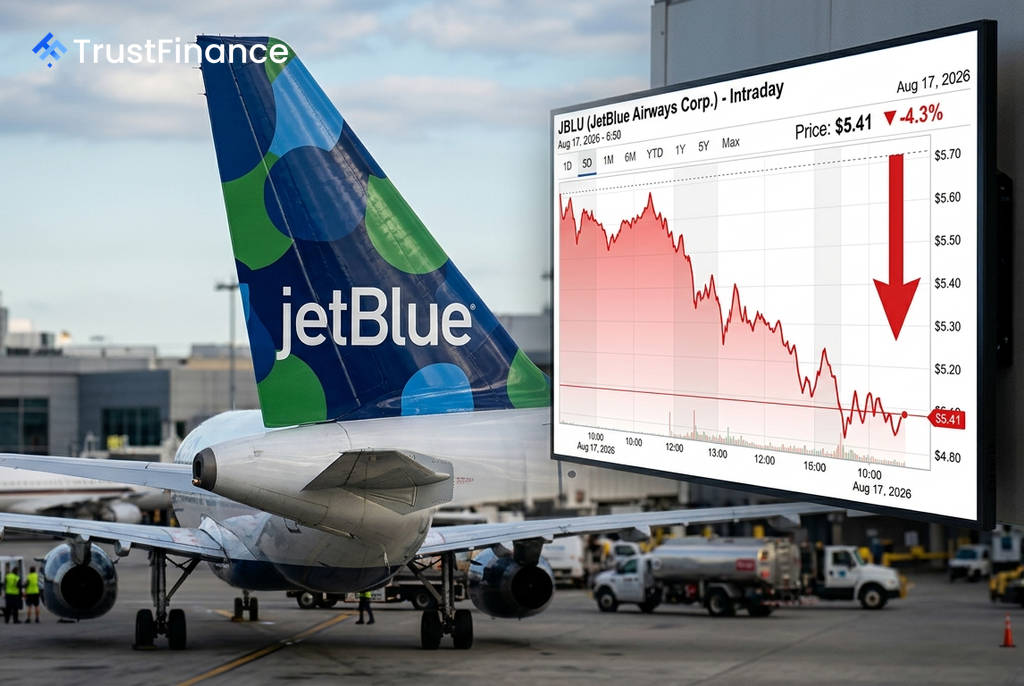
JetBlue Airways (NASDAQ: JBLU) shares fell more than 4% in morning trading after Seaport Global Securities downgraded the stock to Neutral from Buy, citing renewed geopolitical risks that threaten to inflate fuel costs for the financially leveraged carrier.
Seaport Reverses Stance
Seaport Global Securities reversed its previous upgrade from April 2026, pointing to a "sharply deteriorated geopolitical backdrop," according to its report. The firm's primary concern is that a recent ceasefire with Iran has ended without the reopening of the Strait of Hormuz, a key condition that had underpinned its earlier bullish outlook.
The potential for Middle East supply disruptions has renewed pressure on jet fuel price assumptions. This headwind is particularly concerning for JetBlue, which Seaport identified as having significant financial fragility.
Balance Sheet Under Scrutiny
JetBlue's vulnerability to higher operating costs stems from its balance sheet. The carrier holds $9.4 billion in total debt against a current ratio of just 0.7, a figure indicating that its short-term liabilities exceed its liquid assets.
 Ad
Seaport acknowledged that industry-wide pricing remains solid and that JetBlue could potentially beat its second-half 2026 revenue forecasts. However, the analyst firm concluded that the risk posed by the airline's balance sheet in a high-fuel-cost environment warranted a lower valuation multiple.
Wall of Bearish Sentiment
The downgrade adds to a growing chorus of bearish analyst coverage on JetBlue. In early August, Citigroup downgraded the stock to Sell, citing weaker long-term earnings relative to larger competitors, while Bank of America has maintained its Underperform rating on the carrier.
Following the downgrade, JetBlue's stock was trading at $5.41, a decline of 4.3%. The price is now closer to its 52-week low of $3.87 than its 52-week high of $6.62, reflecting investor anxiety over the combination of fuel price risk and a stretched balance sheet.
Read next
More on Stocks
FTC Orders Walmart, Uber, Delta to Disclose Data on Personalized Pricing
The U.S. Federal Trade Commission is demanding nine major companies, including leading retail, travel, and gig economy firms, to provide information on how they use consumer data for setting individual prices and wages.

Google Launches Gemini 4 Carbon AI Model to Bolster Cybersecurity Capabilities
Alphabet's Google has unveiled Gemini 4 Carbon, its latest AI model specifically designed for advanced cybersecurity tasks like vulnerability detection and secure code generation. The launch escalates competition with rivals OpenAI and Anthropic in the enterprise AI market.

Oracle Shares Surge After Unveiling $225 Billion Revenue Target for 2030
Oracle stock rose sharply after the company presented a long-term financial outlook targeting at least $225 billion in annual revenue by fiscal 2030, driven by its expanding AI infrastructure business.

DOJ Scrutinizes Nvidia's $12.9B Hugging Face Deal Amid Broader Antitrust Probe, Sources Say
The U.S. Department of Justice is reportedly examining Nvidia's planned $12.93 billion acquisition of AI platform Hugging Face as part of a wider, ongoing antitrust investigation into the chipmaker's market conduct.