
Story
JBS Shares Tumble on Surprise Q2 Loss and Leadership Shake-Up
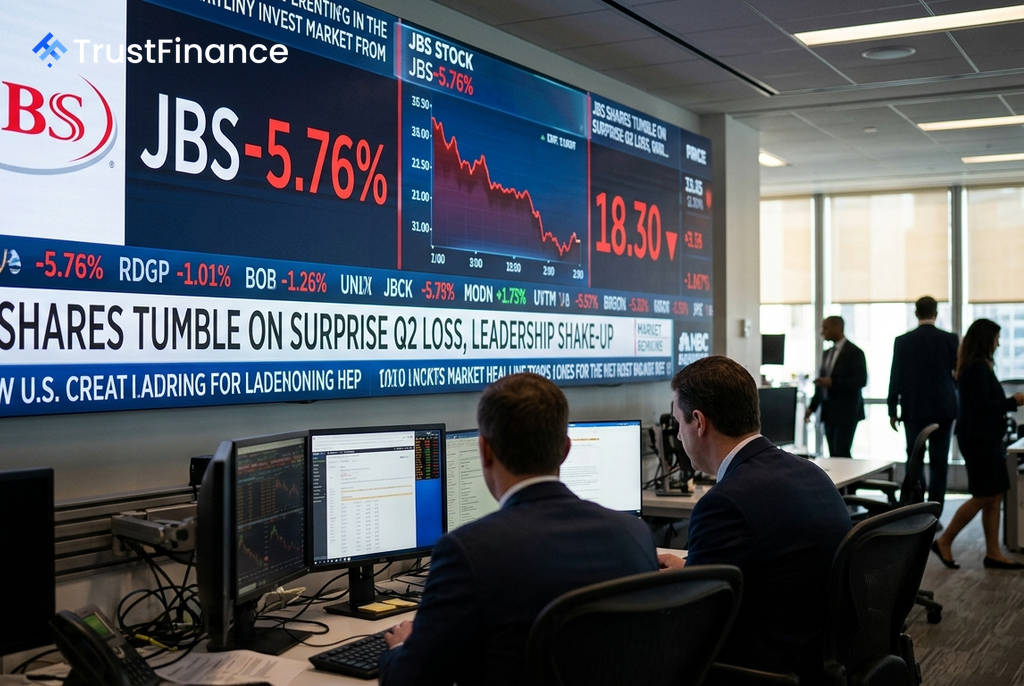
Shares of JBS NV extended their decline in pre-market trading Tuesday after the meat-processing giant reported a surprise second-quarter net loss and announced a leadership transition that has raised investor concerns over corporate governance.
Significant Earnings Miss
JBS disclosed a net loss attributable to shareholders of $102.1 million, or $0.10 per share, for the second quarter, according to its report released after Monday's market close. This marks a sharp reversal from the $528.1 million profit recorded in the same period a year ago and fell well short of the consensus analyst estimate for a profit of approximately $0.32 per share.
The company's Adjusted EBITDA, a key measure of profitability, declined 18.5% year-over-year to $1.429 billion. The results were further weighed down by sharp increases in both net operating expenses and finance costs.
Leadership Change Raises Governance Concerns
Compounding the weak financial results, JBS announced that Wesley Batista Filho, son of controlling shareholder Wesley Batista, will become Global CEO effective January 2027. He will replace current CEO Gilberto Tomazoni, who is set to become Vice Chairman of the Board.
 Ad
The appointment marks the return of the founding family to the company's top executive position after an eight-year interval, a move that prompted unease among investors. The stock had already fallen roughly 5.8% during Monday's regular session before the earnings figures were released.
U.S. Beef Segment Drags on Performance
The primary driver of the financial weakness was the company's Beef North America segment. This division, JBS's largest by revenue, posted an Adjusted EBITDA loss of $320 million.
Company results indicate the loss reflects persistent headwinds from a prolonged U.S. cattle shortage and record-high livestock costs. These challenging market conditions have turned a core part of the business into a significant drag on overall profitability.
Read next
More on Stocks
FTC Orders Walmart, Uber, Delta to Disclose Data on Personalized Pricing
The U.S. Federal Trade Commission is demanding nine major companies, including leading retail, travel, and gig economy firms, to provide information on how they use consumer data for setting individual prices and wages.

Google Launches Gemini 4 Carbon AI Model to Bolster Cybersecurity Capabilities
Alphabet's Google has unveiled Gemini 4 Carbon, its latest AI model specifically designed for advanced cybersecurity tasks like vulnerability detection and secure code generation. The launch escalates competition with rivals OpenAI and Anthropic in the enterprise AI market.

Oracle Shares Surge After Unveiling $225 Billion Revenue Target for 2030
Oracle stock rose sharply after the company presented a long-term financial outlook targeting at least $225 billion in annual revenue by fiscal 2030, driven by its expanding AI infrastructure business.

DOJ Scrutinizes Nvidia's $12.9B Hugging Face Deal Amid Broader Antitrust Probe, Sources Say
The U.S. Department of Justice is reportedly examining Nvidia's planned $12.93 billion acquisition of AI platform Hugging Face as part of a wider, ongoing antitrust investigation into the chipmaker's market conduct.