
Story
Japanese 10-Year Bond Yield Hits 30-Year High Amid Rate Hike Speculation
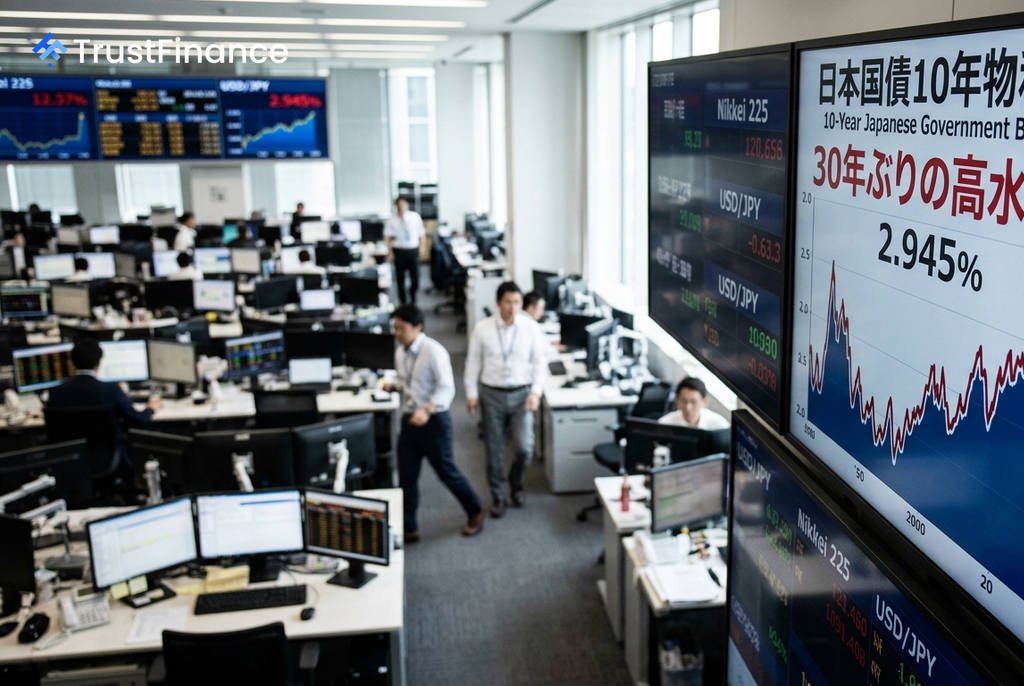
The yield on Japan's benchmark 10-year government bond climbed to a level not seen in three decades on Tuesday, a significant milestone that signals the potential end of the nation's long era of ultra-low interest rates and carries major implications for global financial markets.
Yields Surge to Generational High
The 10-year Japanese Government Bond (JGB) yield touched 2.945% on Tuesday, August 18, its highest point since September 1996, according to market data cited by Investing.com. The move reflects a broader sell-off in the country's debt market, with benchmark 10-year JGB futures declining 0.19 yen to ¥125.97.
The recent surge marks a dramatic repricing for a market long suppressed by central bank intervention. The 10-year yield has now risen 87% over the past year and is up more than 41% year-to-date, nearly doubling from its 52-week low of 1.54% as the Bank of Japan unwinds its Yield Curve Control (YCC) policy.
Drivers of the Bond Sell-Off
Several factors are converging to push Japanese borrowing costs higher, putting pressure on one of the world's most important debt markets. Key drivers include:
 Ad
- Monetary Policy Shift: Markets are increasingly pricing in the possibility of a rate hike from the Bank of Japan (BOJ) at its September policy meeting, with reports suggesting policymakers may pursue more aggressive tightening to combat inflation.
- Global Bond Rout: Japanese bonds are moving in tandem with a global rise in yields. Recent U.S. Treasury auctions saw the 10-year note clear at a 19-year high of 4.683% and the 30-year bond at a 25-year peak of 5.216%, pulling global rates upward.
- Inflation Concerns: A recent rise in oil prices, linked to geopolitical tensions, has reignited inflation fears, prompting investors to demand higher compensation for holding long-term government debt.
Implications for Global Markets
The shift in Japan's bond market has profound consequences beyond its borders, primarily due to the country's status as the world's largest creditor nation. For decades, low domestic returns pushed Japanese institutional investors, such as pension funds and insurers, to purchase trillions of yen worth of foreign assets, including U.S. Treasuries and European bonds.
As domestic yields become more attractive, the incentive to invest abroad weakens. This potential repatriation of capital could remove a key source of demand for government bonds globally at a time when sovereign debt issuance is already high. The Bank of Japan now faces a difficult policy balancing act: tightening to control inflation without triggering a debt crisis, given that Japan's government debt-to-GDP ratio exceeds 260%.
Read next
More on Stocks
FTC Orders Walmart, Uber, Delta to Disclose Data on Personalized Pricing
The U.S. Federal Trade Commission is demanding nine major companies, including leading retail, travel, and gig economy firms, to provide information on how they use consumer data for setting individual prices and wages.

Google Launches Gemini 4 Carbon AI Model to Bolster Cybersecurity Capabilities
Alphabet's Google has unveiled Gemini 4 Carbon, its latest AI model specifically designed for advanced cybersecurity tasks like vulnerability detection and secure code generation. The launch escalates competition with rivals OpenAI and Anthropic in the enterprise AI market.

Oracle Shares Surge After Unveiling $225 Billion Revenue Target for 2030
Oracle stock rose sharply after the company presented a long-term financial outlook targeting at least $225 billion in annual revenue by fiscal 2030, driven by its expanding AI infrastructure business.

DOJ Scrutinizes Nvidia's $12.9B Hugging Face Deal Amid Broader Antitrust Probe, Sources Say
The U.S. Department of Justice is reportedly examining Nvidia's planned $12.93 billion acquisition of AI platform Hugging Face as part of a wider, ongoing antitrust investigation into the chipmaker's market conduct.