
Story
Investors Shift AI Focus to Hyperscalers as Capex Concerns Subside
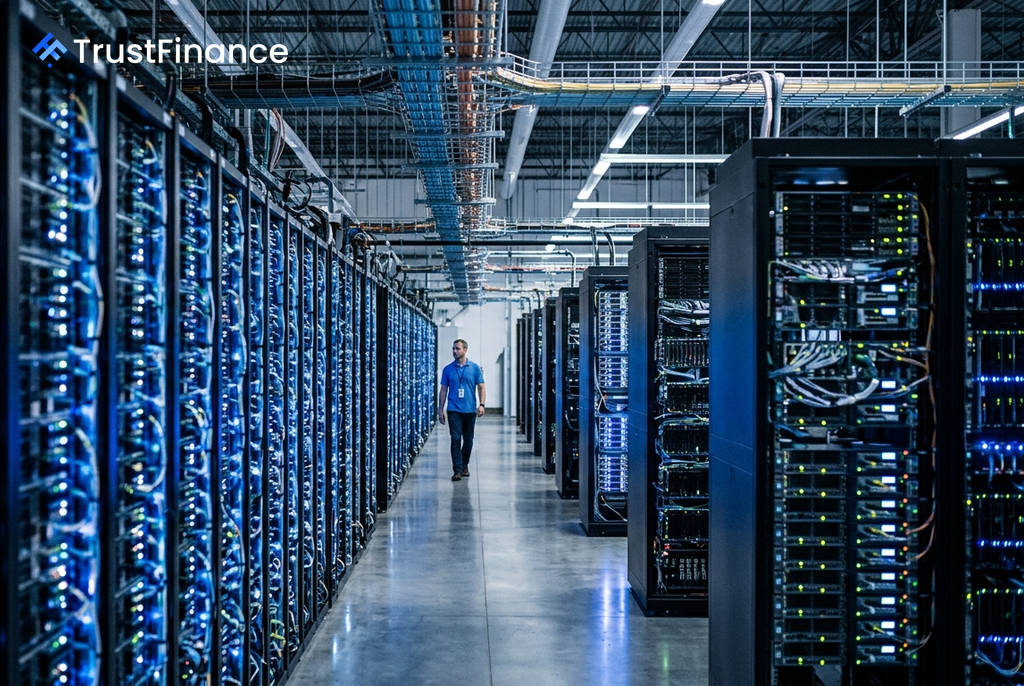
Major institutional investors are shifting their artificial intelligence strategy, looking beyond the initial semiconductor rally to identify long-term winners among the hyperscaler cloud providers. Recent earnings reports have eased concerns that massive capital expenditures by tech giants would fail to generate returns, turning the focus to which companies can sustain profit growth in a maturing market.
From Chips to Cloud Infrastructure
The latest earnings season, with strong results from Microsoft and Amazon, has reassured markets that demand for the infrastructure powering AI remains robust. This has prompted a pivot among some of the world's largest asset managers, who are increasing their exposure to the biggest cloud service providers.
"The hyperscalers are being recognised in this moment as companies that are likely to be very large beneficiaries of this AI paradigm shift," Brian Barbetta, co-head of the technology platform at Wellington Management, told Reuters. He noted that the firm, which manages about $1.3 trillion in assets, has recently increased its positions in these companies.
This shift comes even as shares in the four largest AI capex spenders have lagged the 75% surge in the Philadelphia Semiconductor Index. They have also underperformed smaller "neocloud" providers like CoreWeave and Nebius, which have seen rallies of around 50% and over 200%, respectively, by capitalizing on scarce computing capacity.
The Capex-to-Revenue Equation
While the spending is massive, investors increasingly believe it will translate into future growth. "Today’s capex is tomorrow’s sales," said Richard Clode, portfolio manager for Janus Henderson’s Bankers Investment Trust, who identified Amazon as one of his fund’s largest overweight positions.
A Reuters analysis estimates that hyperscalers will generate about $340 billion more in annual operating cash flow in 2027 than in 2025, while their capital expenditures are expected to rise by roughly $534 billion over the same period. This investment cycle is a long-term play, as data centers typically take 12 to 18 months to progress from construction to revenue generation, according to John Lamb, equity investment director at Capital Group.
 Ad
Long-Term Advantages and Valuations
Many strategists argue that the scale and deep customer relationships of hyperscalers like Amazon, Microsoft, and Google give them a more durable competitive advantage than neocloud providers. These newer firms could be vulnerable if more computing capacity comes online and normalizes pricing, according to BCA Research Chief U.S. Equity Strategist Noah Weisberger, who recommends a long-hyperscalers, short-neoclouds trade.
Despite their strategic advantages, hyperscaler valuations have compressed this year and remain below their post-pandemic peaks. Microsoft currently trades at a forward earnings multiple of 24.6, while Meta trades at 17.6, according to the report.
A Consolidating Market Ahead
Significant challenges remain, as the path to monetizing these vast AI investments is still developing. Alberto Conca, CIO at Swiss wealth manager LGF+ZEST, estimates that AI monetization needs to increase fivefold to thirteenfold to justify the current spending plans.
As the market matures, competition is expected to intensify, leading to consolidation. Investors anticipate that companies with the broadest technology portfolios and strongest customer control will pull ahead of more specialized rivals. "There are absolutely going to be fewer winners in the future than there likely are players today," said Wellington Management's Barbetta.
Read next
More on Stocks
FTC Orders Walmart, Uber, Delta to Disclose Data on Personalized Pricing
The U.S. Federal Trade Commission is demanding nine major companies, including leading retail, travel, and gig economy firms, to provide information on how they use consumer data for setting individual prices and wages.

Google Launches Gemini 4 Carbon AI Model to Bolster Cybersecurity Capabilities
Alphabet's Google has unveiled Gemini 4 Carbon, its latest AI model specifically designed for advanced cybersecurity tasks like vulnerability detection and secure code generation. The launch escalates competition with rivals OpenAI and Anthropic in the enterprise AI market.

Oracle Shares Surge After Unveiling $225 Billion Revenue Target for 2030
Oracle stock rose sharply after the company presented a long-term financial outlook targeting at least $225 billion in annual revenue by fiscal 2030, driven by its expanding AI infrastructure business.

DOJ Scrutinizes Nvidia's $12.9B Hugging Face Deal Amid Broader Antitrust Probe, Sources Say
The U.S. Department of Justice is reportedly examining Nvidia's planned $12.93 billion acquisition of AI platform Hugging Face as part of a wider, ongoing antitrust investigation into the chipmaker's market conduct.