
Story
Investors Monitor Key Sectors Ahead of Trump-Xi Washington Summit
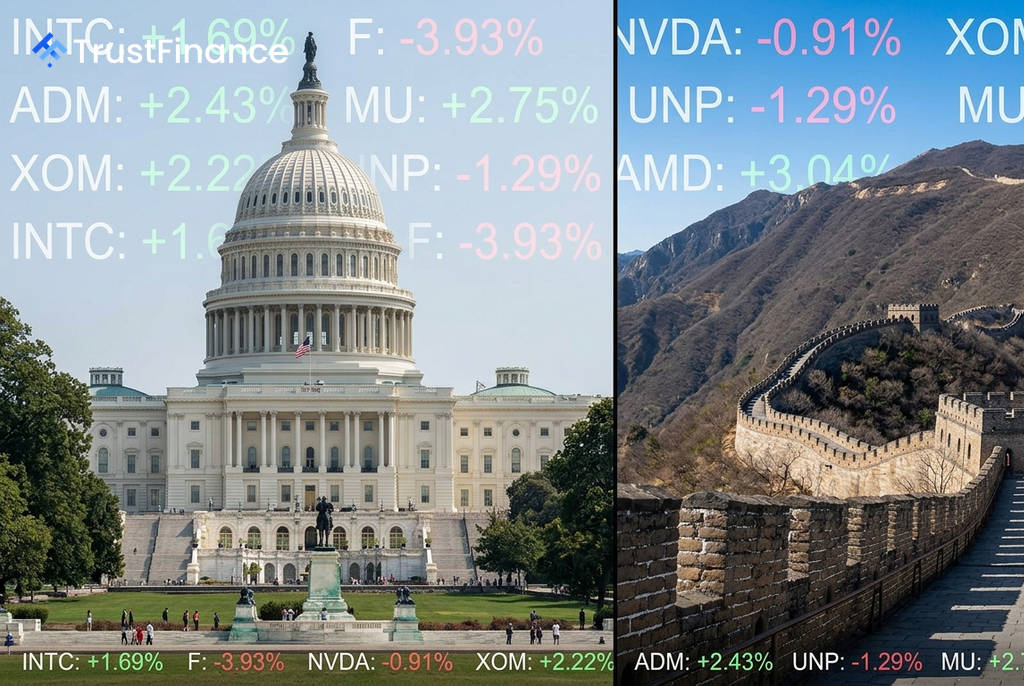
A planned meeting between Chinese President Xi Jinping and U.S. counterpart Donald Trump in Washington later this month has investors closely monitoring sectors sensitive to the economic relationship between the two countries. According to an analysis by Investing.com, the summit's outcome could have significant implications for companies in the semiconductor, agriculture, and automotive industries.
Semiconductors in the Spotlight
The semiconductor industry remains a focal point of U.S.-China tensions, with any policy shifts on export controls or technology licensing poised to impact major chipmakers. The market will be looking for specific language regarding access to advanced chips and manufacturing equipment.
Key companies under watch include:
- NVIDIA (NVDA)
- Advanced Micro Devices (AMD)
- Micron Technology (MU)
- Intel (INTC)
A move toward softer restrictions or clearer licensing rules could serve as a bullish catalyst for these stocks. Conversely, the announcement of new controls, particularly on AI accelerators, would likely be viewed as a negative development.
 Ad
Agriculture and Autos as Policy Barometers
The agriculture sector is also a key indicator, with China recently purchasing approximately 1 million tons of U.S. soybeans, according to Investing.com. This move has led to questions about whether it signals a durable trade channel or is simply a diplomatic gesture ahead of the talks. The development puts a focus on agricultural exporters like Archer-Daniels-Midland (ADM) and Bunge Limited (BG).
In the automotive sector, Ford Motor (F) serves as a direct barometer for policy changes. The company navigates a complex position, utilizing Chinese partnerships for its supply chain while simultaneously lobbying against competition from Chinese vehicle imports. A summit that results in improved supply-chain cooperation could benefit Ford, whereas tougher security or localization demands could present new challenges.
Broader Market Signals
Beyond these primary sectors, investors will also watch for secondary effects on logistics and energy companies like Union Pacific (UNP) and Exxon Mobil (XOM). A broader détente could improve overall trade flows and support freight volumes, while a return to tariffs would increase costs across the shipping and manufacturing landscape. Ultimately, the market's reaction may depend less on the official communiqué and more on measurable actions related to soybean purchases, semiconductor licensing, and auto industry commitments.
Read next
More on Stocks
FTC Orders Walmart, Uber, Delta to Disclose Data on Personalized Pricing
The U.S. Federal Trade Commission is demanding nine major companies, including leading retail, travel, and gig economy firms, to provide information on how they use consumer data for setting individual prices and wages.

Google Launches Gemini 4 Carbon AI Model to Bolster Cybersecurity Capabilities
Alphabet's Google has unveiled Gemini 4 Carbon, its latest AI model specifically designed for advanced cybersecurity tasks like vulnerability detection and secure code generation. The launch escalates competition with rivals OpenAI and Anthropic in the enterprise AI market.

Oracle Shares Surge After Unveiling $225 Billion Revenue Target for 2030
Oracle stock rose sharply after the company presented a long-term financial outlook targeting at least $225 billion in annual revenue by fiscal 2030, driven by its expanding AI infrastructure business.

DOJ Scrutinizes Nvidia's $12.9B Hugging Face Deal Amid Broader Antitrust Probe, Sources Say
The U.S. Department of Justice is reportedly examining Nvidia's planned $12.93 billion acquisition of AI platform Hugging Face as part of a wider, ongoing antitrust investigation into the chipmaker's market conduct.