
Story
Intel Valuation Model Indicates 44% Potential Downside
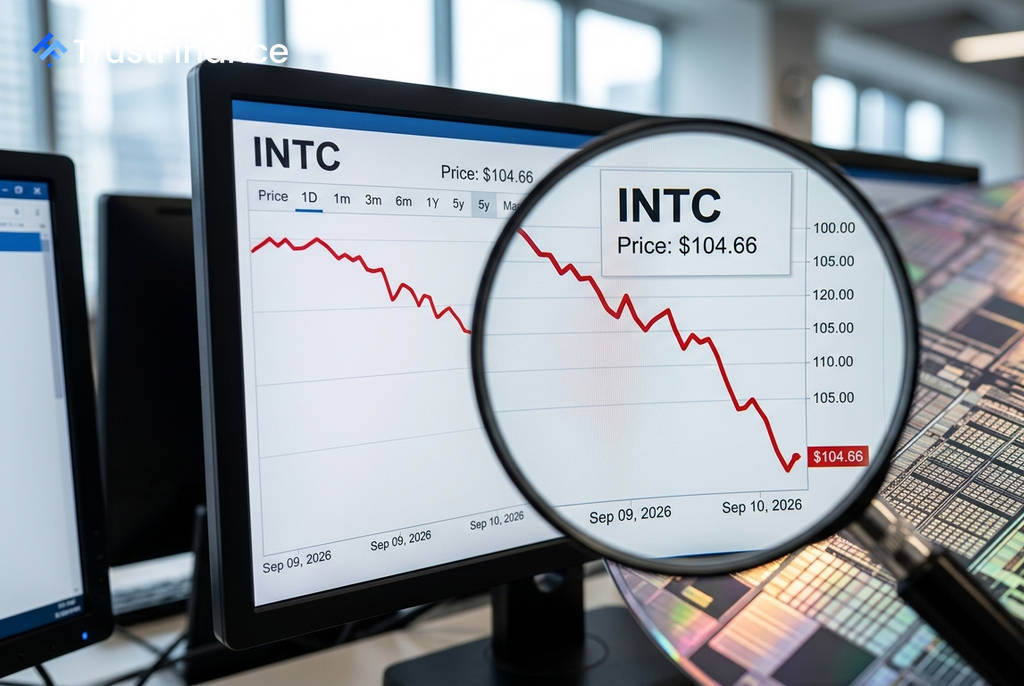
A fair-value model from Investing.com indicates that Intel Corporation (INTC) shares are substantially overvalued, implying a potential downside of 43.9%. The analysis suggests the semiconductor giant's current stock price has outrun its fundamental value, already reflecting a successful corporate turnaround that has yet to be fully realized.
Valuation Headwinds
According to the model, Intel's fair value is estimated at $59.59, a stark contrast to its pre-market trading price of $104.66 on September 10, 2026. This valuation gap highlights the premium investors are currently paying for the company's future earnings potential.
This demanding setup is further evidenced by key valuation metrics:
- Forward P/E Ratio: The stock trades at a lofty 70.0x forward earnings, indicating high expectations for future profit growth.
- Trailing P/E Ratio: The trailing P/E stands at -49.4x, reflecting the company's recent negative earnings and the significant recovery needed to justify its current price.
The Turnaround Bet
 Ad
While the valuation appears stretched, Intel's recovery narrative is supported by some positive indicators. The company has posted recent revenue growth of 7.5%, and the consensus among analysts points to a potential upside of +8.6%. However, even this modest analyst target pales in comparison to the downside risk highlighted by the fair-value model.
The market appears to be pricing in exceptional execution on Intel's ambitious plans in manufacturing and artificial intelligence. This leaves little room for error, as the current valuation already accounts for a major rebound in earnings and operational efficiency.
Cash Flow and Execution Risk
The company's financial position underscores the risks associated with its capital-intensive expansion. Intel’s free cash flow (FCF) yield is just 0.5%, providing minimal cash-flow support for the stock's current price if the turnaround takes longer than anticipated. Furthermore, its debt-to-equity ratio stood at a manageable but notable 57.7% as of June 30, 2026.
This creates an asymmetric risk profile for investors. While modest execution may be enough to sustain the current price, any significant disappointments could expose the stock to a sharp correction toward its much lower intrinsic value estimate.
Read next
More on Stocks
FTC Orders Walmart, Uber, Delta to Disclose Data on Personalized Pricing
The U.S. Federal Trade Commission is demanding nine major companies, including leading retail, travel, and gig economy firms, to provide information on how they use consumer data for setting individual prices and wages.

Google Launches Gemini 4 Carbon AI Model to Bolster Cybersecurity Capabilities
Alphabet's Google has unveiled Gemini 4 Carbon, its latest AI model specifically designed for advanced cybersecurity tasks like vulnerability detection and secure code generation. The launch escalates competition with rivals OpenAI and Anthropic in the enterprise AI market.

Oracle Shares Surge After Unveiling $225 Billion Revenue Target for 2030
Oracle stock rose sharply after the company presented a long-term financial outlook targeting at least $225 billion in annual revenue by fiscal 2030, driven by its expanding AI infrastructure business.

DOJ Scrutinizes Nvidia's $12.9B Hugging Face Deal Amid Broader Antitrust Probe, Sources Say
The U.S. Department of Justice is reportedly examining Nvidia's planned $12.93 billion acquisition of AI platform Hugging Face as part of a wider, ongoing antitrust investigation into the chipmaker's market conduct.