
Story
Hyperscalers' $409 Billion AI Spending Spree Fuels Wall Street Debate on Growth Cycle
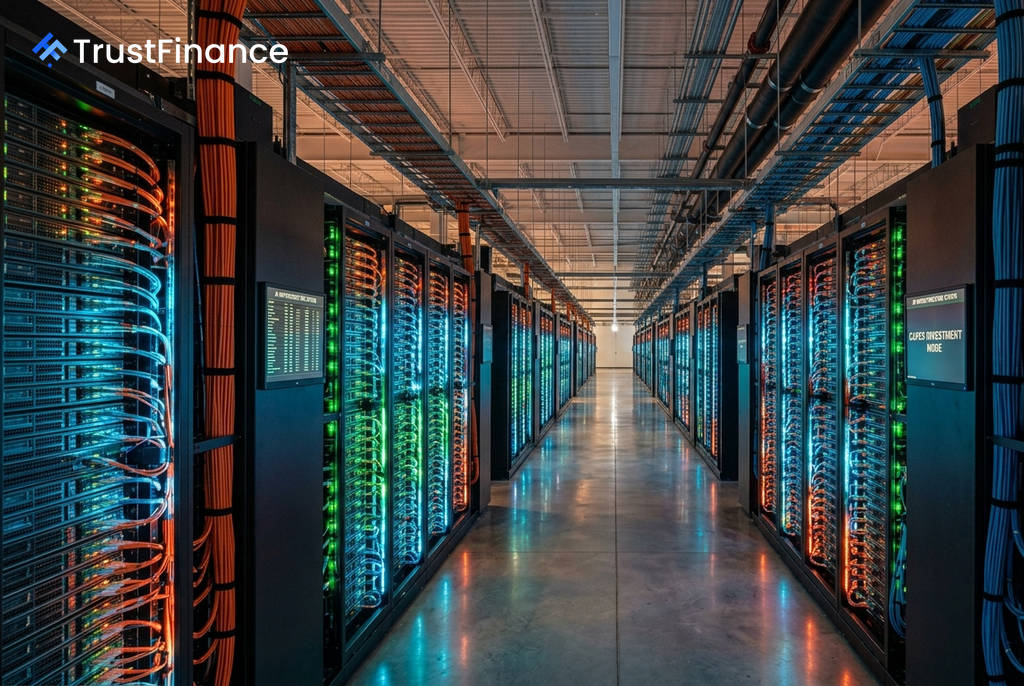
A torrent of capital spending from the world's largest technology companies is fueling a critical debate on Wall Street over the maturity of the artificial intelligence investment cycle. The four major hyperscalers—Microsoft, Amazon, Google, and Meta—are now collectively spending approximately $409 billion on capital expenditures (CapEx) in their latest fiscal years, a staggering 2.6x increase from $157 billion just two years prior.
The Investment and Return Disconnect
The scale of the investment is reshaping the companies' financial profiles. Microsoft and Meta have seen their CapEx-to-revenue ratios climb to 35%, up from 18% and 20% respectively, according to an analysis by Investing.com. This aggressive spending is pressuring cash flow, a key metric for investors.
- Amazon (AMZN): Free cash flow (FCF) has fallen 76% over two years, from $32.2 billion to $7.7 billion, while annual CapEx has reached $131.8 billion.
- Microsoft (MSFT): FCF has declined 9.6% to $67.0 billion from $74.1 billion.
- Alphabet (GOOGL) & Meta (META): Both have managed modest FCF growth of 5.4% and 4.6%, respectively, despite more than doubling their capital outlays.
The Case for 'Early Innings'
Proponents of the bull case argue that the AI buildout has a long runway. A recent CGI survey found that while many organizations are experimenting with AI, only 36% have an enterprise-wide strategy in place, suggesting the market is far from saturated. Microsoft CEO Satya Nadella stated on a recent earnings call that the industry is in the "beginning phases of AI diffusion."
Data from the technology supply chain supports this view. Microsoft's Azure cloud platform is growing at a 37-38% constant currency clip, while NVIDIA reported 65.5% revenue growth in its latest fiscal year. The physical infrastructure is still expanding rapidly, evidenced by major data center construction contracts and planned IPOs.
 Ad
'Middle Innings' Caution Emerges
Skepticism is rooted in the widening gap between spending and immediate returns. The sharp decline in Amazon's free cash flow highlights the core concern: investment is proceeding at a breakneck pace, while revenue growth and cash generation have not yet accelerated to match.
Furthermore, the emergence of massive third-party financing structures signals a new phase of risk management. NVIDIA recently established a $500 billion compute financing platform with major investment firms, backstopping up to $125 billion of the deals itself. Broadcom announced a similar vehicle. While these moves show conviction, Wolfe Research noted they also function as reinsurance, implying that industry leaders recognize the risk of overbuilding capacity ahead of proven demand.
What It Means for Investors
The evidence suggests the AI market is entering a transitional phase, best described as the 'late early innings.' The technological shift is undeniable, but the financial questions are becoming more urgent. For investors, the focus may shift from 'picks-and-shovels' suppliers, whose stocks have already seen significant gains, to the hyperscalers themselves.
The central question is no longer whether AI is a transformative technology, but which companies can convert their unprecedented capital expenditures into sustainable, compounding returns. Monitoring free cash flow and return on investment will be critical to separating long-term winners from those caught in a cycle of overbuilding.
Read next
More on Stocks
FTC Orders Walmart, Uber, Delta to Disclose Data on Personalized Pricing
The U.S. Federal Trade Commission is demanding nine major companies, including leading retail, travel, and gig economy firms, to provide information on how they use consumer data for setting individual prices and wages.

Google Launches Gemini 4 Carbon AI Model to Bolster Cybersecurity Capabilities
Alphabet's Google has unveiled Gemini 4 Carbon, its latest AI model specifically designed for advanced cybersecurity tasks like vulnerability detection and secure code generation. The launch escalates competition with rivals OpenAI and Anthropic in the enterprise AI market.

Oracle Shares Surge After Unveiling $225 Billion Revenue Target for 2030
Oracle stock rose sharply after the company presented a long-term financial outlook targeting at least $225 billion in annual revenue by fiscal 2030, driven by its expanding AI infrastructure business.

DOJ Scrutinizes Nvidia's $12.9B Hugging Face Deal Amid Broader Antitrust Probe, Sources Say
The U.S. Department of Justice is reportedly examining Nvidia's planned $12.93 billion acquisition of AI platform Hugging Face as part of a wider, ongoing antitrust investigation into the chipmaker's market conduct.