
Story
HP Stock Tumbles as Tariff Refunds and Weak PC Demand Undercut Earnings Beat
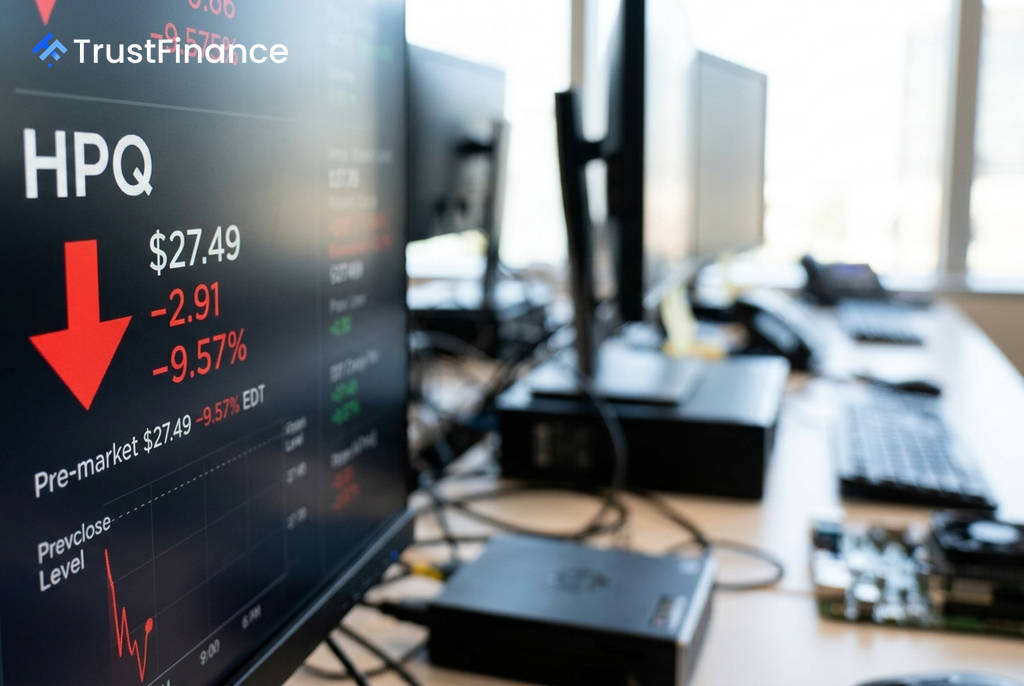
HP Inc. (HPQ) shares slid nearly 10.0% in pre-market trading, as investors looked past a headline earnings beat to focus on weakening fundamentals in the company's core PC business and the impact of one-time items on its financial results.
A Deceptive Earnings Beat
HP reported fiscal third-quarter revenue of $15.7 billion, a 12.5% year-over-year increase that significantly surpassed the consensus estimate of $14.34 billion. Adjusted earnings per share (EPS) of $0.83 also came in well ahead of the expected $0.66.
However, a closer look at the results revealed several points of concern for the market. The company's performance was boosted by a non-recurring $0.11-per-share benefit from tariff refunds. Furthermore, the strong revenue growth was driven by pricing and a richer product mix, masking a significant 16% year-over-year decline in PC unit volumes, indicating a contraction in underlying consumer demand.
Weak Guidance and Margin Pressure
The company's forward-looking guidance also failed to reassure investors. For the fourth quarter, HP projected an adjusted EPS range of $0.69 to $0.79, which nominally brackets the $0.67 consensus. But this forecast includes another estimated $0.08-per-share benefit from tariff refunds; excluding this one-time gain pulls the midpoint of the underlying guidance below market expectations.
 Ad
Adding to the concerns, HP's Personal Systems operating margin compressed to 4.6% due to rising memory and storage costs. Management acknowledged this trend could persist, with a potential bottom not expected until the fourth quarter. This margin pressure suggests profitability challenges in its largest segment.
Market Context
HP’s sharp decline occurred even as the broader market showed strength, with the S&P 500 and Nasdaq both trading higher in the pre-market session. The stock's weakness stood in contrast to general optimism in the technology sector, which was lifted by strong results from a major AI chipmaker.
For investors, the combination of factors proved decisive. The reliance on one-time tariff tailwinds, shrinking unit demand, compressing margins, and a weaker-than-apparent forward outlook overshadowed the surface-level earnings beat, prompting a significant sell-off in the company's shares.
Read next
More on Stocks
FTC Orders Walmart, Uber, Delta to Disclose Data on Personalized Pricing
The U.S. Federal Trade Commission is demanding nine major companies, including leading retail, travel, and gig economy firms, to provide information on how they use consumer data for setting individual prices and wages.

Google Launches Gemini 4 Carbon AI Model to Bolster Cybersecurity Capabilities
Alphabet's Google has unveiled Gemini 4 Carbon, its latest AI model specifically designed for advanced cybersecurity tasks like vulnerability detection and secure code generation. The launch escalates competition with rivals OpenAI and Anthropic in the enterprise AI market.

Oracle Shares Surge After Unveiling $225 Billion Revenue Target for 2030
Oracle stock rose sharply after the company presented a long-term financial outlook targeting at least $225 billion in annual revenue by fiscal 2030, driven by its expanding AI infrastructure business.

DOJ Scrutinizes Nvidia's $12.9B Hugging Face Deal Amid Broader Antitrust Probe, Sources Say
The U.S. Department of Justice is reportedly examining Nvidia's planned $12.93 billion acquisition of AI platform Hugging Face as part of a wider, ongoing antitrust investigation into the chipmaker's market conduct.