
Story
Home Depot vs. Lowe’s: A Tale of Scale vs. Value Ahead of Earnings
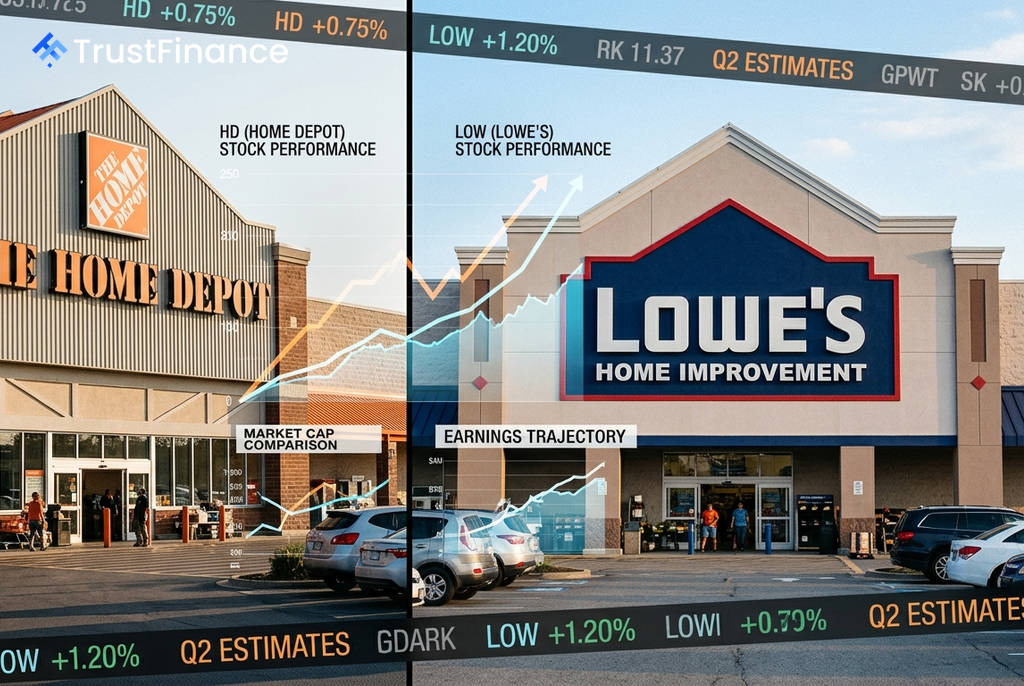
Home Depot (NYSE: HD) and Lowe’s (NYSE: LOW) present investors with a classic choice between market dominance and valuation appeal. While both home improvement retailers trade at a premium to some model-based fair value estimates, Lowe’s offers a more compelling case on key financial metrics, whereas Home Depot's strategic focus on the professional market provides a powerful competitive moat.
Valuation and Cash Flow
On nearly every key valuation multiple, Lowe's appears to be the more attractively priced stock. Lowe’s trades at a forward price-to-earnings (P/E) ratio of 17.9x compared to Home Depot's 23.7x, according to data from Investing.com. This discount extends to other metrics, with Lowe's also trading at a lower EV/EBITDA multiple.
A crucial differentiator is free cash flow (FCF) generation. Lowe's boasts a robust FCF yield of 6.2%, significantly higher than Home Depot’s 4.1%. This indicates that investors in Lowe's receive more cash per dollar of share price, providing the company with greater flexibility for shareholder returns and reinvestment.
Diverging Shareholder Return Strategies
The two companies offer distinct profiles for income-oriented investors. Home Depot is a mature dividend payer with a higher current yield of 2.7%, but its dividend growth has recently slowed to just 1.3%. With a payout ratio of approximately 65% of both net income and free cash flow, there is less room for aggressive future increases.
In contrast, Lowe’s is a dividend growth story. While its current yield is slightly lower at 2.3%, the company has compounded its dividend at an impressive 14.9% annually over the last five years. A conservative payout ratio of around 40% of net income suggests Lowe’s has substantial capacity to continue raising its dividend at a brisk pace.
 Ad
Strategic Focus and Market Position
Home Depot's primary advantage is its immense scale and its strategic pivot toward the professional contractor. The company is nearly double the size of Lowe's by revenue and is aggressively targeting what it estimates to be a $700 billion total addressable market for professionals. This segment provides a more stable, recurring revenue stream that is less sensitive to consumer sentiment.
Lowe’s has historically focused more on the do-it-yourself (DIY) customer, a segment more exposed to economic cycles and interest rate fluctuations. However, both companies are poised to benefit from long-term trends in the housing market, including an aging U.S. housing stock that necessitates repair and remodeling activity. Recent data showing a 1% increase in roofing shingle shipments, reversing a prior decline, serves as a positive leading indicator for the sector, as noted by D.A. Davidson.
Analyst Outlook
Wall Street analysts currently see significantly more upside in Lowe's. The consensus analyst price target implies a potential upside of 23.4% for Lowe's, compared to just 7.6% for Home Depot. Both companies are scheduled to report their latest quarterly earnings this week, providing a key catalyst that could reshape investor sentiment and valuations for both retailers.
Read next
More on Stocks
FTC Orders Walmart, Uber, Delta to Disclose Data on Personalized Pricing
The U.S. Federal Trade Commission is demanding nine major companies, including leading retail, travel, and gig economy firms, to provide information on how they use consumer data for setting individual prices and wages.

Google Launches Gemini 4 Carbon AI Model to Bolster Cybersecurity Capabilities
Alphabet's Google has unveiled Gemini 4 Carbon, its latest AI model specifically designed for advanced cybersecurity tasks like vulnerability detection and secure code generation. The launch escalates competition with rivals OpenAI and Anthropic in the enterprise AI market.

Oracle Shares Surge After Unveiling $225 Billion Revenue Target for 2030
Oracle stock rose sharply after the company presented a long-term financial outlook targeting at least $225 billion in annual revenue by fiscal 2030, driven by its expanding AI infrastructure business.

DOJ Scrutinizes Nvidia's $12.9B Hugging Face Deal Amid Broader Antitrust Probe, Sources Say
The U.S. Department of Justice is reportedly examining Nvidia's planned $12.93 billion acquisition of AI platform Hugging Face as part of a wider, ongoing antitrust investigation into the chipmaker's market conduct.