
Story
Goldman Sachs: China Entering 'Go Global 3.0' Export Era Driven by AI and Tech
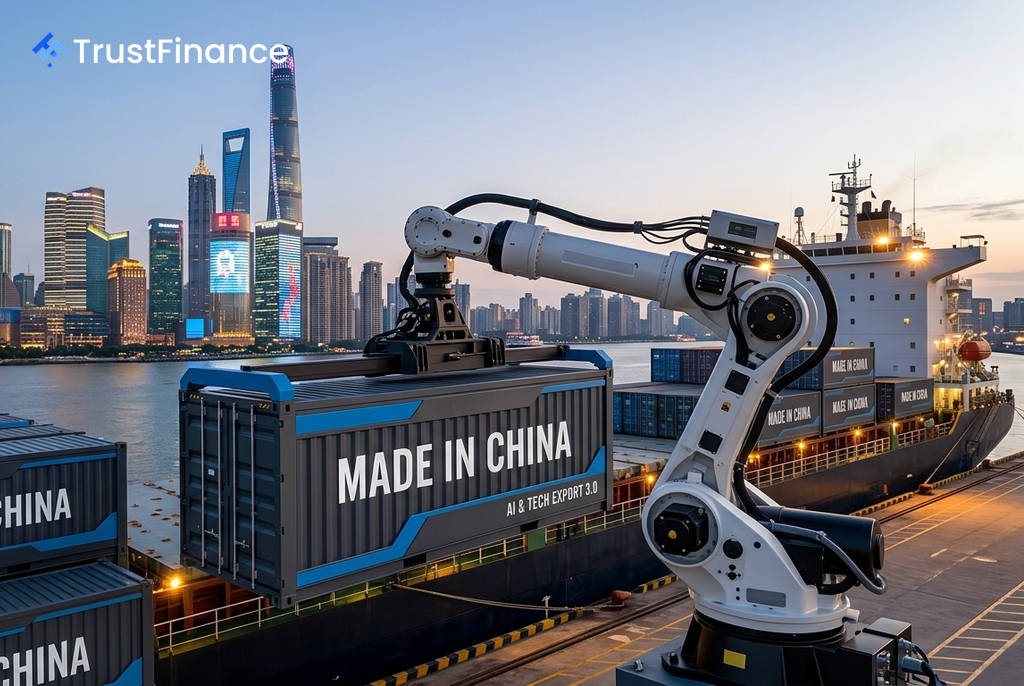
China is entering a new era of exports centered on AI-enabled and technology-led industrial products, a phase investment bank Goldman Sachs has termed "Go Global 3.0." This marks a significant shift in the country's export profile, moving into sophisticated sectors such as AI data center infrastructure, robotics, and automation.
In a recent analysis, Goldman Sachs identified 11 key product-based export opportunities for China. The bank estimates these segments have global total addressable markets (TAMs) ranging from $12 billion to $212 billion by 2030, highlighting substantial growth potential for leading Chinese industrial firms.
Four Archetypes of Growth
Goldman Sachs categorized these opportunities into four distinct archetypes to frame the competitive landscape for investors:
- Bottleneck Solvers: These companies are expected to see the largest market share gains and margin improvements between 2026 and 2030, driven by favorable supply and demand dynamics. Goldman maintains Buy ratings on Sieyuan, Kstar, and Yingliu within this group.
- Technology Upgraders: Firms in this category derive their primary competitive advantage from rapid engineering and technological iteration. The bank holds a Buy rating on Envicool in this segment.
- Established Global: This group, which includes energy storage and humanoid robot manufacturers, faces near-term challenges related to market access. They must navigate complex international regulatory, safety, and environmental standards. Goldman rates Sungrow as Neutral.
- Idiosyncratic Opportunities: Chinese industrial robotics and automation firms like Inovance and Estun fall here. Goldman projects a slower initial international expansion but notes their strong product competitiveness, R&D speed, and cost advantages could drive long-term success.
 Ad
Competitive Landscape and Outlook
According to the report, the long-term success of these Chinese exporters beyond 2030 will hinge on the persistence of supply-demand gaps and their ability to meet the stringent operational standards of global clients. Goldman Sachs also noted a key advantage still held by Western competitors: providing localized aftermarket support and lifecycle services.
While some companies like electrical relay component leader Hongfa have demonstrated proven success and earned a Buy rating from the bank, others will face significant hurdles. Navigating international compliance and competing on service, not just price and technology, will be critical for Chinese firms to solidify their position in this new global export phase.
Read next
More on Stocks
FTC Orders Walmart, Uber, Delta to Disclose Data on Personalized Pricing
The U.S. Federal Trade Commission is demanding nine major companies, including leading retail, travel, and gig economy firms, to provide information on how they use consumer data for setting individual prices and wages.

Google Launches Gemini 4 Carbon AI Model to Bolster Cybersecurity Capabilities
Alphabet's Google has unveiled Gemini 4 Carbon, its latest AI model specifically designed for advanced cybersecurity tasks like vulnerability detection and secure code generation. The launch escalates competition with rivals OpenAI and Anthropic in the enterprise AI market.

Oracle Shares Surge After Unveiling $225 Billion Revenue Target for 2030
Oracle stock rose sharply after the company presented a long-term financial outlook targeting at least $225 billion in annual revenue by fiscal 2030, driven by its expanding AI infrastructure business.

DOJ Scrutinizes Nvidia's $12.9B Hugging Face Deal Amid Broader Antitrust Probe, Sources Say
The U.S. Department of Justice is reportedly examining Nvidia's planned $12.93 billion acquisition of AI platform Hugging Face as part of a wider, ongoing antitrust investigation into the chipmaker's market conduct.