
Story
Gold Price Stalls Below Key $4,160 Resistance Amid Bearish Technical Signals
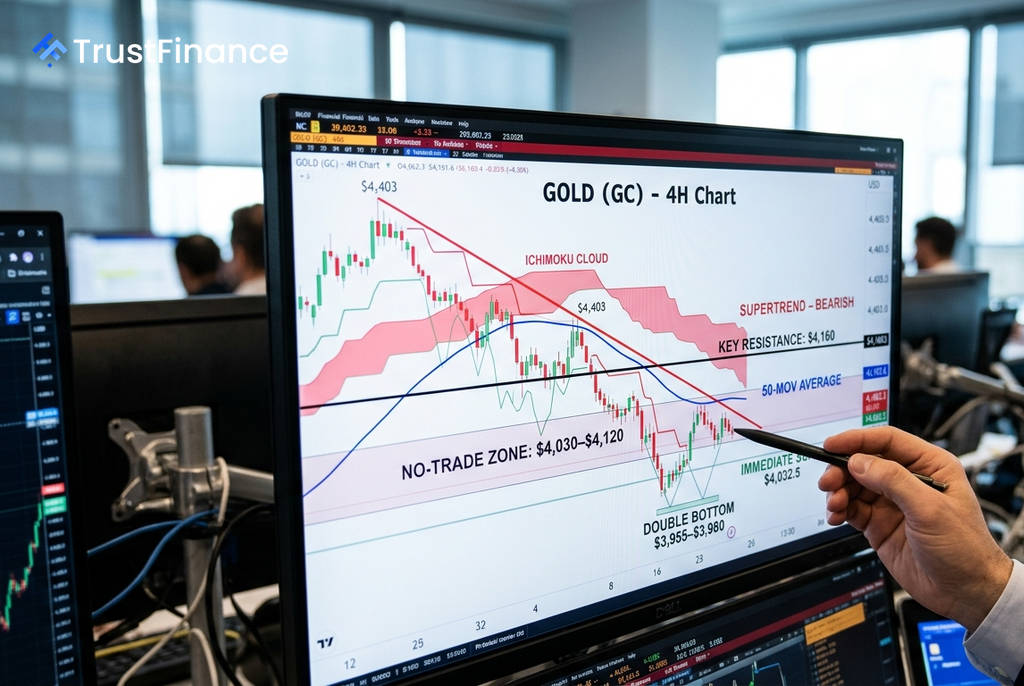
Gold futures are locked in a tight trading range, with the precious metal struggling to overcome significant technical resistance around $4,160 per ounce. Technical analysis suggests a prevailing bearish trend, putting key support levels under pressure as traders await a decisive breakout.
Bearish Indicators Dominate
According to a technical analysis by Investing.com on Monday, gold's price on the 4-hour chart is positioned below several key indicators, signaling a dominant downtrend. As of early trading, gold (GC) was quoted at $4,062.3, trapped between recent support and overhead resistance.
The price remains below its 50-period moving average ($4,102.6), the Ichimoku Cloud, and the SuperTrend indicator ($4,161.6), all of which are acting as technical ceilings. This market structure is further defined by a pattern of lower highs since mid-June, reinforcing the negative sentiment.
Key Price Levels in Focus
The immediate outlook for gold is framed by a clear battle between support and resistance zones. Market participants are closely monitoring these levels for signs of the next directional move.
 Ad
- Key Resistance: The most critical hurdle for bulls is the $4,160–$4,161.6 zone. A sustained break above this level would be required to challenge the bearish thesis.
- Immediate Support: The first line of defense is located around the $4,030 mark.
- Critical Support: A more significant support base lies in the $3,955–$3,980 area, which has previously repelled sellers. A failure to hold this zone could lead to an acceleration of the downtrend.
Market Outlook and Scenarios
The current price action is confined to what the source analysis describes as a choppy range between $4,030 and $4,120, offering poor risk-reward for new positions. The bearish scenario remains favored as long as gold fails to reclaim the $4,160 resistance level.
Conversely, a bullish reversal would require a decisive 4-hour close above $4,161.6, according to the analysis. However, it also cautions investors about the high risk of a "bull trap"—a brief spike higher that quickly reverses—until a new uptrend is firmly established.