
Story
GM and Toyota: A Tale of Two Financials Despite Close Sales Race
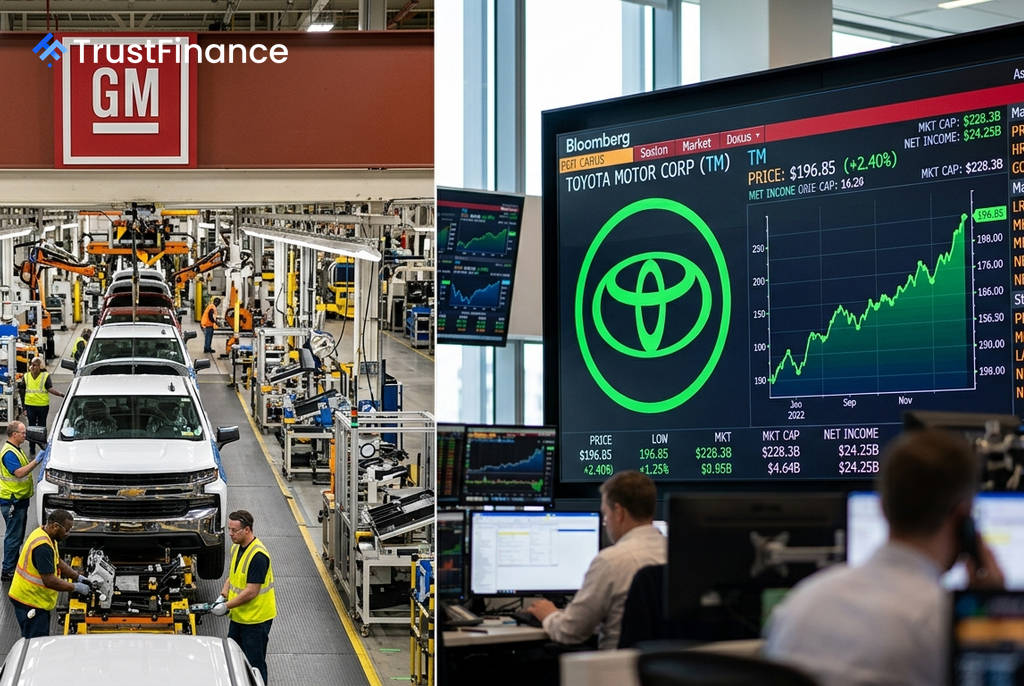
General Motors and Toyota are locked in a perennial battle for the top spot in U.S. auto sales, but their closely watched unit counts mask a profound financial disparity. A deeper look at the companies' fundamentals reveals two automakers operating in vastly different economic realities, with Toyota demonstrating significantly stronger profitability and a more robust balance sheet.
The Financial Divide
The gap between the two auto giants is stark. As of a recent market close, Toyota's market capitalization stood at $228.3 billion, roughly three times GM's $75.6 billion. This valuation difference is rooted in sharply contrasting performance metrics from their most recent fiscal years:
- Net Income: Toyota generated $24.25 billion, nearly eight times the $3.18 billion reported by GM.
- Revenue: Toyota's revenue was $319.4 billion, compared to GM's $185.0 billion.
- Profit Margins: Toyota achieved a net income margin of 7.6% and a gross margin of 16.7%. In contrast, GM's margins were significantly thinner at 1.5% and 10.7%, respectively.
- Balance Sheet: GM carries a debt-to-equity ratio of 207.7%, substantially higher than Toyota's 117.8%.
Asymmetric Pressures and Tariff Headwinds
A key factor widening this financial gap is the current U.S. tariff structure. GM faces a 25% duty on vehicles and parts from its critical supply hubs in Mexico and Canada. The company projects these tariffs will cost between $2.5 billion and $3.5 billion this year, a figure that could represent over 20% of its operating profit.
 Ad
Toyota, meanwhile, operates under a lighter 15% tariff on its exports to the U.S. Beyond tariffs, GM is navigating what its CFO has called an "extraordinary" transition period. The company is absorbing approximately $7.5 billion in EV restructuring charges and simultaneously managing a new truck platform launch, the conversion of its Orion assembly plant, and a new engine program.
Investor Outlook and Execution Risk
Despite the challenges, some analysts see a path forward for GM. TD Cowen recently reiterated a Buy rating, projecting that GM's software and services division could account for 30% of its EBIT by 2032. The company's current truck lineup is performing well on pricing, and a recently secured $4.5 billion purchasing facility aims to protect against future supply chain disruptions.
However, this recovery narrative is contingent on flawless execution during a period management has labeled complex. Valuation models suggest GM's stock may be overvalued, with its trailing P/E ratio distorted by low earnings. Toyota, while facing its own headwinds like a recent recall of 508,354 Camry Hybrids and currency pressures, is seen by analysts as undervalued, with a more stable financial foundation to navigate market turbulence.
Read next
More on Stocks
FTC Orders Walmart, Uber, Delta to Disclose Data on Personalized Pricing
The U.S. Federal Trade Commission is demanding nine major companies, including leading retail, travel, and gig economy firms, to provide information on how they use consumer data for setting individual prices and wages.

Google Launches Gemini 4 Carbon AI Model to Bolster Cybersecurity Capabilities
Alphabet's Google has unveiled Gemini 4 Carbon, its latest AI model specifically designed for advanced cybersecurity tasks like vulnerability detection and secure code generation. The launch escalates competition with rivals OpenAI and Anthropic in the enterprise AI market.

Oracle Shares Surge After Unveiling $225 Billion Revenue Target for 2030
Oracle stock rose sharply after the company presented a long-term financial outlook targeting at least $225 billion in annual revenue by fiscal 2030, driven by its expanding AI infrastructure business.

DOJ Scrutinizes Nvidia's $12.9B Hugging Face Deal Amid Broader Antitrust Probe, Sources Say
The U.S. Department of Justice is reportedly examining Nvidia's planned $12.93 billion acquisition of AI platform Hugging Face as part of a wider, ongoing antitrust investigation into the chipmaker's market conduct.