
Story
Global Bond Yields Hit Multi-Decade Highs, Weighing on Equity Markets
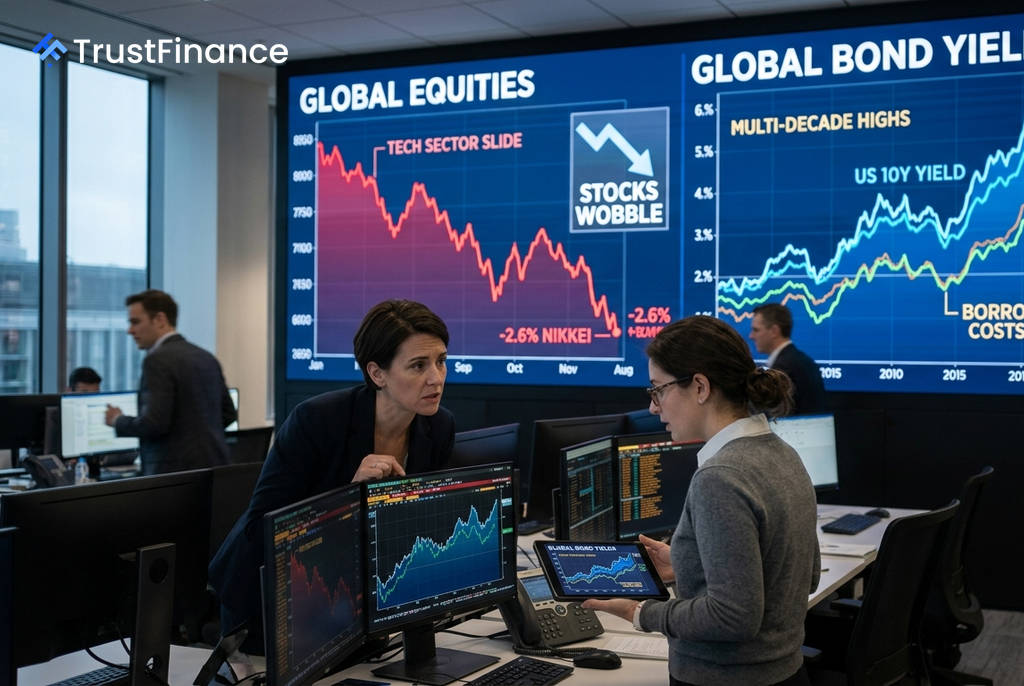
A global bond market selloff pushed government borrowing costs to multi-decade highs on Wednesday, as investor concerns over swelling sovereign debt and persistent inflation triggered a risk-off sentiment that spread to equity markets. The yield on the U.S. long bond reached its highest level in nearly 20 years, contributing to significant declines in Asian stock indices.
Soaring Yields Rattle Markets
The benchmark yield on the U.S. 30-year Treasury bond hit 5.3371% on Tuesday, its highest in almost two decades, before steadying around 5.28% in Asian trading, according to Reuters. The selloff was global, with German 10-year and 30-year bund yields climbing to their highest levels since 2011. The French 30-year yield has risen by nearly 50 basis points since the end of June, while Japan’s 10-year yield is approaching 3%.
Analysts attribute the sharp rise in borrowing costs to worries about persistent inflation, underscored by Brent crude futures holding above $90 a barrel, and a heavy supply of new government debt. "The marginal investor in bonds... is becoming a bit more price sensitive at a time where there’s a lot of debt issuance occurring," said ANZ senior rates strategist Jack Chambers.
Equities Under Pressure
The surge in bond yields, which increases borrowing costs for corporations and makes fixed-income assets more attractive relative to stocks, sent equity markets lower. The pressure was particularly acute in Asia, following losses on Wall Street.
 Ad
- MSCI’s broadest index of Asia-Pacific shares outside Japan fell 1.7%.
- Japan’s Nikkei dropped 2.6%.
- U.S. and European stock futures slipped approximately 0.1%.
Technology and semiconductor stocks were among the hardest hit, tracking overnight declines in their U.S. counterparts.
Investor Focus Shifts to Central Banks and Debt Supply
Investors are growing increasingly concerned about governments' ability to manage their finances. "Investors are no longer taking on faith that (government) spending gets brought under control. Indeed, they’re pricing the risk that it doesn’t," said Nigel Green, CEO of financial advisory deVere Group.
Market participants are now closely watching for several upcoming events for further direction. These include the release of minutes from the U.S. Federal Reserve's July policy meeting, a U.S. Treasury auction of $16 billion in 20-year bonds, and key U.K. inflation data. Earnings reports from major U.S. retailers such as Lowe’s and Target are also on the docket.
Read next
More on Stocks
FTC Orders Walmart, Uber, Delta to Disclose Data on Personalized Pricing
The U.S. Federal Trade Commission is demanding nine major companies, including leading retail, travel, and gig economy firms, to provide information on how they use consumer data for setting individual prices and wages.

Google Launches Gemini 4 Carbon AI Model to Bolster Cybersecurity Capabilities
Alphabet's Google has unveiled Gemini 4 Carbon, its latest AI model specifically designed for advanced cybersecurity tasks like vulnerability detection and secure code generation. The launch escalates competition with rivals OpenAI and Anthropic in the enterprise AI market.

Oracle Shares Surge After Unveiling $225 Billion Revenue Target for 2030
Oracle stock rose sharply after the company presented a long-term financial outlook targeting at least $225 billion in annual revenue by fiscal 2030, driven by its expanding AI infrastructure business.

DOJ Scrutinizes Nvidia's $12.9B Hugging Face Deal Amid Broader Antitrust Probe, Sources Say
The U.S. Department of Justice is reportedly examining Nvidia's planned $12.93 billion acquisition of AI platform Hugging Face as part of a wider, ongoing antitrust investigation into the chipmaker's market conduct.