
Story
FTSE 100 Slips as U.S.-Iran Tensions and Weak UK Retail Data Weigh on Sentiment
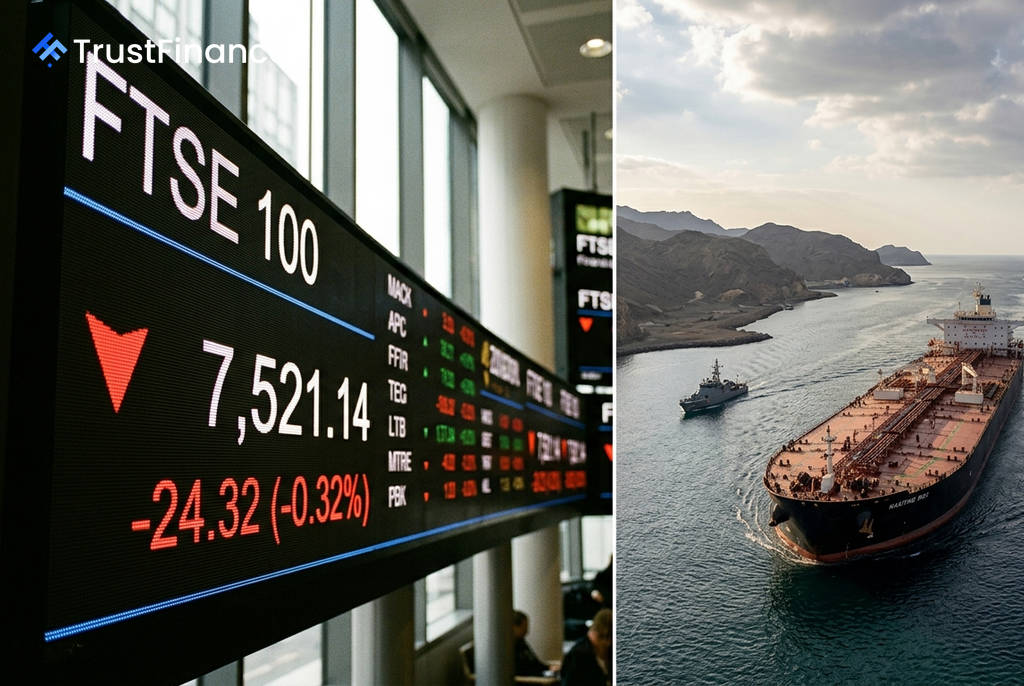
The UK's FTSE 100 index fell into negative territory on Tuesday, as investor sentiment was dampened by a combination of renewed U.S.-Iran tensions and fresh data indicating a significant slowdown in British retail sales.
Market Snapshot
By 07:23 GMT, the FTSE 100 was down 0.08%, according to data from Investing.com. The negative mood was reflected across Europe, with Germany’s DAX and France’s CAC 40 slipping by 0.06% and 0.07%, respectively. The British pound was flat against the dollar at $1.3501.
Geopolitical concerns directly impacted energy markets, with Brent crude, the international oil benchmark, rising 2.15% to $89.62 a barrel. The U.S. benchmark, West Texas Intermediate (WTI), climbed 2.24% to $83.95.
Geopolitical Headwinds
Market caution was fueled by reports of heightened tensions between Washington and Tehran. The Washington Post reported that U.S. President Donald Trump was moved via a decoy operation after the NATO summit on July 8 due to what a U.S. official described as a "credible threat" from Iran. This followed increasingly sharp rhetoric from both nations regarding control of the Strait of Hormuz, a critical chokepoint for global oil shipments.
 Ad
Iran’s Revolutionary Guard Corps has stated the waterway would remain a "theatre of war" until its conditions are met, while President Trump asserted that the U.S. Navy has "100 per cent control" of the strait. The uncertainty is prompting a risk-off sentiment among investors.
UK Consumer Spending Falters
A bleak domestic economic picture added to the downbeat mood. UK retail sales growth slowed sharply in July, according to the latest BRC-KPMG data.
- Total sales grew just 1.3% year-on-year, well below the 12-month average of 1.8%.
- Non-food sales contracted by 0.7% as consumers cut back on discretionary purchases.
- Food sales provided a bright spot, rising 3.8%, partly supported by the end of the World Cup.
Helen Dickinson, chief executive of the British Retail Consortium, stated that "household budgets remain stretched" and that consumer demand "has struggled in the heat." Separately, IGD chief executive Sarah Bradbury warned that pressures from Middle East conflict and hot weather are "building across the food supply chain," which risks leading to "higher food costs" into the autumn.
Read next
More on Stocks
FTC Orders Walmart, Uber, Delta to Disclose Data on Personalized Pricing
The U.S. Federal Trade Commission is demanding nine major companies, including leading retail, travel, and gig economy firms, to provide information on how they use consumer data for setting individual prices and wages.

Google Launches Gemini 4 Carbon AI Model to Bolster Cybersecurity Capabilities
Alphabet's Google has unveiled Gemini 4 Carbon, its latest AI model specifically designed for advanced cybersecurity tasks like vulnerability detection and secure code generation. The launch escalates competition with rivals OpenAI and Anthropic in the enterprise AI market.

Oracle Shares Surge After Unveiling $225 Billion Revenue Target for 2030
Oracle stock rose sharply after the company presented a long-term financial outlook targeting at least $225 billion in annual revenue by fiscal 2030, driven by its expanding AI infrastructure business.

DOJ Scrutinizes Nvidia's $12.9B Hugging Face Deal Amid Broader Antitrust Probe, Sources Say
The U.S. Department of Justice is reportedly examining Nvidia's planned $12.93 billion acquisition of AI platform Hugging Face as part of a wider, ongoing antitrust investigation into the chipmaker's market conduct.