
Story
FTEC Emerges as Top Value Pick Among Major Tech ETFs, Analysis Shows
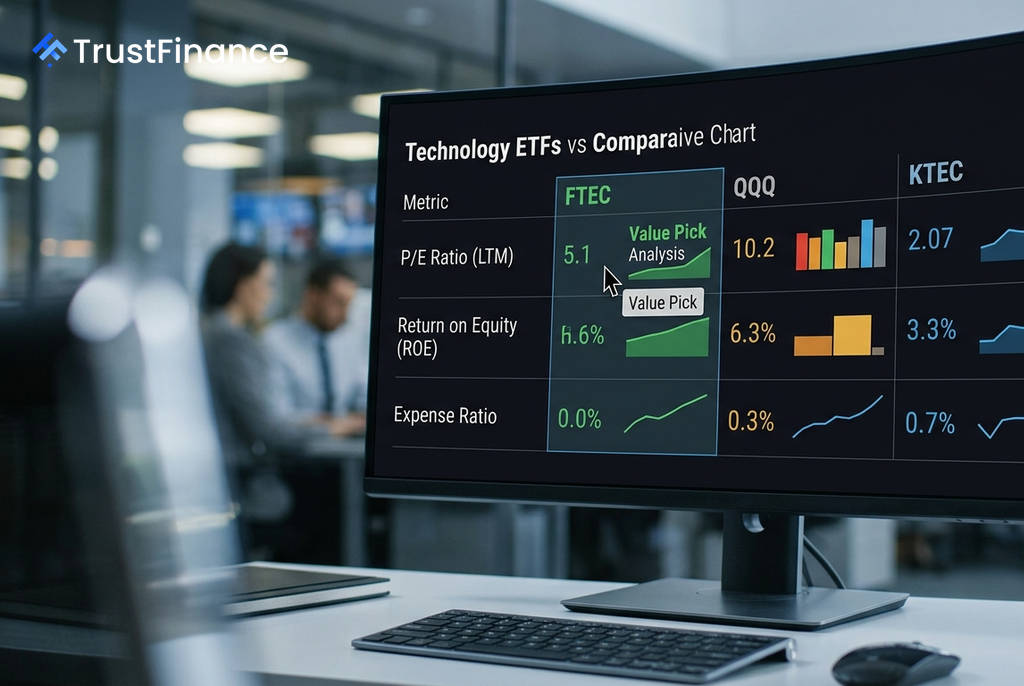
The Fidelity MSCI Information Technology ETF (FTEC) offers a leading combination of value and quality metrics among major U.S. technology funds, according to an analysis by Investing.com. The fund stands out for its low costs, competitive valuation, and high return on equity, positioning it as a notable option for value-conscious investors seeking exposure to the tech sector.
FTEC's Value Proposition
Based on data from August 13, 2026, FTEC presents a balanced profile for investors focused on quality at a reasonable price. The analysis highlights several key metrics:
- Valuation: A price-to-earnings (P/E) ratio of 21.86, among the lowest for broad U.S. tech ETFs.
- Profitability: A return on equity (ROE) of 44.0%, indicating strong profitability among its holdings.
- Cost: A rock-bottom expense ratio of 0.08%, significantly lower than many of its peers.
FTEC tracks the MSCI US IMI Information Technology index, providing diversified exposure to 286 holdings. This combination of high ROE at a low cost and competitive P/E makes it a standout, according to the source's comparison.
Alternative Approaches to Tech Value
 Ad
The analysis also identifies distinct options for investors with different risk appetites and diversification needs. The Invesco QQQ Trust (QQQ), which tracks the Nasdaq-100, is noted for its low price-to-sales (P/S) ratio of 5.42. While not a pure-tech fund, it offers broader exposure to innovative companies at a reasonable 0.18% expense ratio, albeit with a lower ROE of 38.6%.
For investors seeking deep value with higher risk, the KraneShares Hang Seng TECH Index ETF (KTEC) trades at a P/S ratio of just 1.01 and is 32.5% below its 52-week high. However, this fund invests in Chinese technology companies and carries significant geopolitical and regulatory risk, reflected in its one-year return of -22.4%. The source positions KTEC as a contrarian bet rather than a core portfolio holding.
Key Investor Considerations
High expense ratios can significantly erode long-term returns, a factor highlighted in the case of the iShares U.S. Technology ETF (IYW). Its 0.38% expense ratio is nearly five times that of FTEC, which can create a meaningful performance drag over time despite similar valuation metrics.
Meanwhile, thematic funds like the iShares AI Innovation & Tech ETF (BAI) offer concentrated bets on specific trends. While BAI showed the strongest one-year return at +44.1%, its high 0.55% expense ratio and concentrated portfolio of 55 holdings make it more suitable as a smaller, satellite position for most investors, the analysis suggests.
Read next
More on Stocks
FTC Orders Walmart, Uber, Delta to Disclose Data on Personalized Pricing
The U.S. Federal Trade Commission is demanding nine major companies, including leading retail, travel, and gig economy firms, to provide information on how they use consumer data for setting individual prices and wages.

Google Launches Gemini 4 Carbon AI Model to Bolster Cybersecurity Capabilities
Alphabet's Google has unveiled Gemini 4 Carbon, its latest AI model specifically designed for advanced cybersecurity tasks like vulnerability detection and secure code generation. The launch escalates competition with rivals OpenAI and Anthropic in the enterprise AI market.

Oracle Shares Surge After Unveiling $225 Billion Revenue Target for 2030
Oracle stock rose sharply after the company presented a long-term financial outlook targeting at least $225 billion in annual revenue by fiscal 2030, driven by its expanding AI infrastructure business.

DOJ Scrutinizes Nvidia's $12.9B Hugging Face Deal Amid Broader Antitrust Probe, Sources Say
The U.S. Department of Justice is reportedly examining Nvidia's planned $12.93 billion acquisition of AI platform Hugging Face as part of a wider, ongoing antitrust investigation into the chipmaker's market conduct.