
Story
Floating-Rate and Ultra-Short Bond ETFs Outperform as Yields Rise
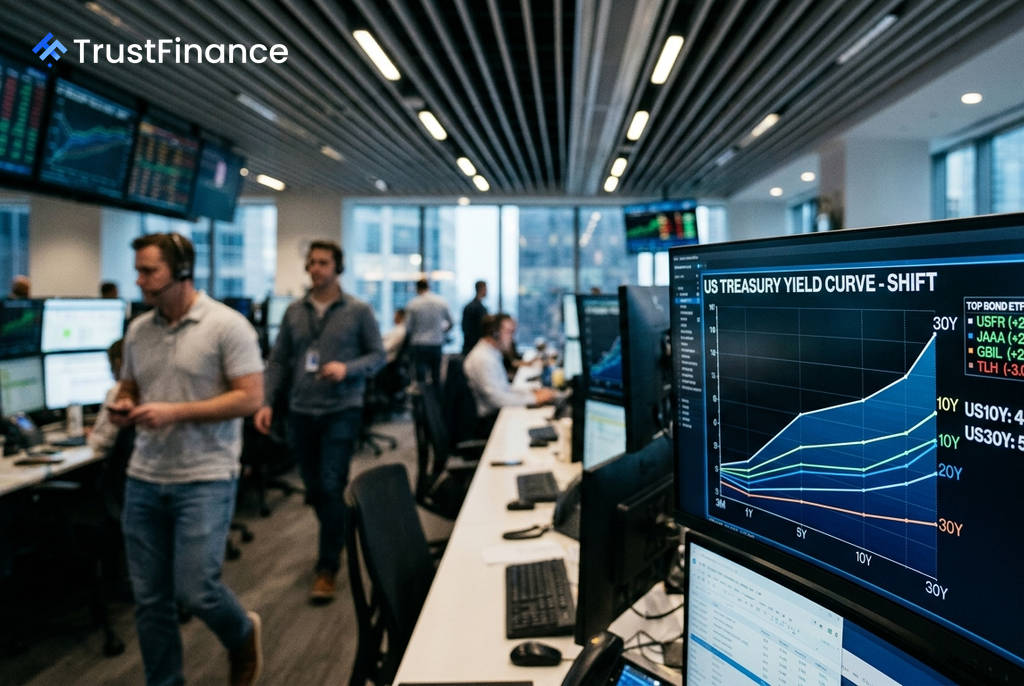
A sharp rise in government bond yields is creating a stark divergence in the fixed-income market, punishing investors in long-duration funds while rewarding those holding floating-rate and ultra-short-term debt. As yields on long-term Treasuries are pushed higher, exchange-traded funds (ETFs) with minimal sensitivity to interest rate changes have demonstrated resilience and are posting positive returns year-to-date in 2026.
The Duration Dilemma
The fundamental principle of bond investing—that prices move inversely to yields—is currently on full display. The impact is most severe for bonds with longer maturities, a concept measured by duration. According to Investing.com data, a 1% increase in the 10-year Treasury yield can trigger a price decline of 15-20% for a 20-year bond ETF.
This dynamic is reflected in the performance of long-duration funds. The iShares 10-20 Year Treasury Bond ETF (TLH), for example, has fallen -3.0% year-to-date. In contrast, ETFs designed to mitigate duration risk are proving to be effective havens for fixed-income investors.
Floating-Rate Funds Lead the Way
Floating-rate ETFs have emerged as a primary beneficiary of the current rate environment. These funds hold debt instruments whose coupon payments reset periodically based on a benchmark rate, allowing their income to rise alongside prevailing market rates. This mechanism keeps the fund's price relatively stable near its par value.
 Ad
Key performers in this category, based on Investing.com screener data, include:
- WisdomTree Floating Rate Treasury ETF (USFR) and iShares Treasury Floating Rate Bond ETF (TFLO): Both offer a yield of 3.8% with no credit risk, as they invest exclusively in U.S. government floating-rate notes.
- Janus Henderson AAA CLO ETF (JAAA): This fund provides a higher yield of 4.7% by investing in AAA-rated collateralized loan obligations (CLOs), and has returned +2.80% year-to-date.
- VanEck IG Floating Rate ETF (FLTR): Focusing on investment-grade corporate debt, this ETF yields 4.2% and has gained +2.82% in 2026.
Ultra-Short and Higher-Yield Options
For investors seeking cash-like stability with an income component, ultra-short duration ETFs offer another alternative. These funds, which hold debt with maturities of one year or less, function as a liquid alternative to money market funds. The Goldman Sachs Access Treasury 0-1 Year ETF (GBIL), for instance, yields 3.7% by holding Treasury bills.
Investors willing to accept more credit risk for higher income can look to the senior loan market. The Invesco Senior Loan ETF (BKLN) currently yields 6.3% by holding floating-rate loans made to corporations. However, the source data indicates its Relative Strength Index (RSI) is at 80, a level that technical analysts often consider to be in "overbought" territory, suggesting potential for a near-term consolidation.
Read next
More on Stocks
FTC Orders Walmart, Uber, Delta to Disclose Data on Personalized Pricing
The U.S. Federal Trade Commission is demanding nine major companies, including leading retail, travel, and gig economy firms, to provide information on how they use consumer data for setting individual prices and wages.

Google Launches Gemini 4 Carbon AI Model to Bolster Cybersecurity Capabilities
Alphabet's Google has unveiled Gemini 4 Carbon, its latest AI model specifically designed for advanced cybersecurity tasks like vulnerability detection and secure code generation. The launch escalates competition with rivals OpenAI and Anthropic in the enterprise AI market.

Oracle Shares Surge After Unveiling $225 Billion Revenue Target for 2030
Oracle stock rose sharply after the company presented a long-term financial outlook targeting at least $225 billion in annual revenue by fiscal 2030, driven by its expanding AI infrastructure business.

DOJ Scrutinizes Nvidia's $12.9B Hugging Face Deal Amid Broader Antitrust Probe, Sources Say
The U.S. Department of Justice is reportedly examining Nvidia's planned $12.93 billion acquisition of AI platform Hugging Face as part of a wider, ongoing antitrust investigation into the chipmaker's market conduct.