
Story
Ferrari's Financials Mirror Luxury Conglomerate, Not Automaker
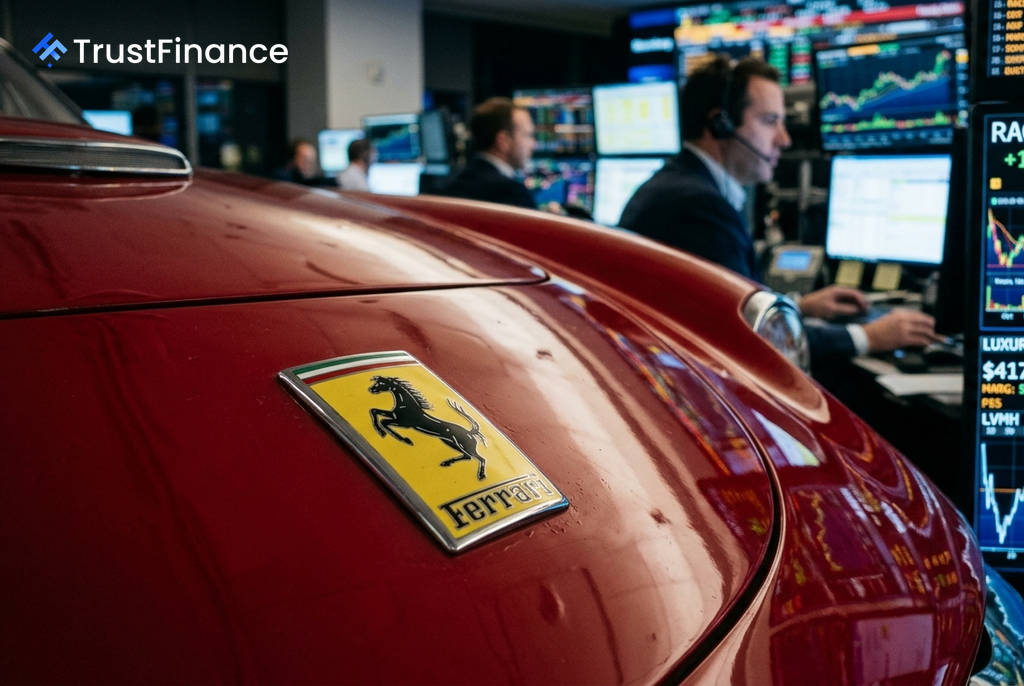
Ferrari's (RACE) market valuation and core financial metrics increasingly suggest that investors are pricing the company as a luxury goods powerhouse rather than a traditional automaker. The Italian firm's high-margin business model, capital return strategy, and valuation multiples diverge sharply from automotive industry standards and align more closely with those of premier luxury conglomerates.
A Luxury Goods Valuation
Ferrari's valuation reflects a significant premium over its automotive peers. The company trades at a price-to-earnings (P/E) ratio of 41.9x and a price-to-book ratio of 18.7x, figures that are standard for a luxury brand but far exceed the typical 6-12x P/E ratio seen among traditional automakers.
With a market capitalization of approximately $80 billion on $8.39 billion in revenue for fiscal year 2025, the market appears to value Ferrari based on brand equity and scarcity rather than vehicle production volume. According to Investing.com's analysis, the stock's closing price of $417.93 on September 3, 2026, was already 14.7% above its Fair Value estimate of $356.50, indicating investors are paying a full luxury premium.
The Margin of Scarcity
Operationally, Ferrari's profitability metrics set it apart from any car manufacturer. The company reported a gross margin of 51.7% in fiscal year 2025, a figure more comparable to brands like Hermès or LVMH than to the 14-20% margins typical for even the most efficient large-scale automakers.
 Ad
This high margin is supported by a strategy of deliberate production caps. By limiting the number of vehicles it produces, Ferrari creates artificial scarcity, which enhances the brand's exclusivity and pricing power. This approach treats the automobile as a luxury asset, similar to a limited-edition timepiece or a couture handbag, where scarcity itself is a key component of the product's value.
Capital Strategy of a Holding Company
Ferrari's capital management further reinforces its identity as an asset-light, high-return business. The company's financial performance includes:
- A Return on Equity (ROE) of 45.4%
- A Return on Invested Capital (ROIC) of 25.2%
- Free cash flow that nearly doubled from $1.06 billion in 2021 to $2.19 billion in 2025.
These metrics are more characteristic of a financial services firm than a capital-intensive manufacturer. Furthermore, Ferrari is executing a €3.5 billion share repurchase program through 2030, funded entirely from available cash. Such a large-scale, systematic capital return program is the hallmark of a mature, cash-generative company focused on balance sheet management, not an automaker racing to fund its next vehicle platform development cycle.
Read next
More on Stocks
FTC Orders Walmart, Uber, Delta to Disclose Data on Personalized Pricing
The U.S. Federal Trade Commission is demanding nine major companies, including leading retail, travel, and gig economy firms, to provide information on how they use consumer data for setting individual prices and wages.

Google Launches Gemini 4 Carbon AI Model to Bolster Cybersecurity Capabilities
Alphabet's Google has unveiled Gemini 4 Carbon, its latest AI model specifically designed for advanced cybersecurity tasks like vulnerability detection and secure code generation. The launch escalates competition with rivals OpenAI and Anthropic in the enterprise AI market.

Oracle Shares Surge After Unveiling $225 Billion Revenue Target for 2030
Oracle stock rose sharply after the company presented a long-term financial outlook targeting at least $225 billion in annual revenue by fiscal 2030, driven by its expanding AI infrastructure business.

DOJ Scrutinizes Nvidia's $12.9B Hugging Face Deal Amid Broader Antitrust Probe, Sources Say
The U.S. Department of Justice is reportedly examining Nvidia's planned $12.93 billion acquisition of AI platform Hugging Face as part of a wider, ongoing antitrust investigation into the chipmaker's market conduct.