
Story
Fed, Yen Risks Revive ‘Sell America’ Trade in Forex and Rates Markets
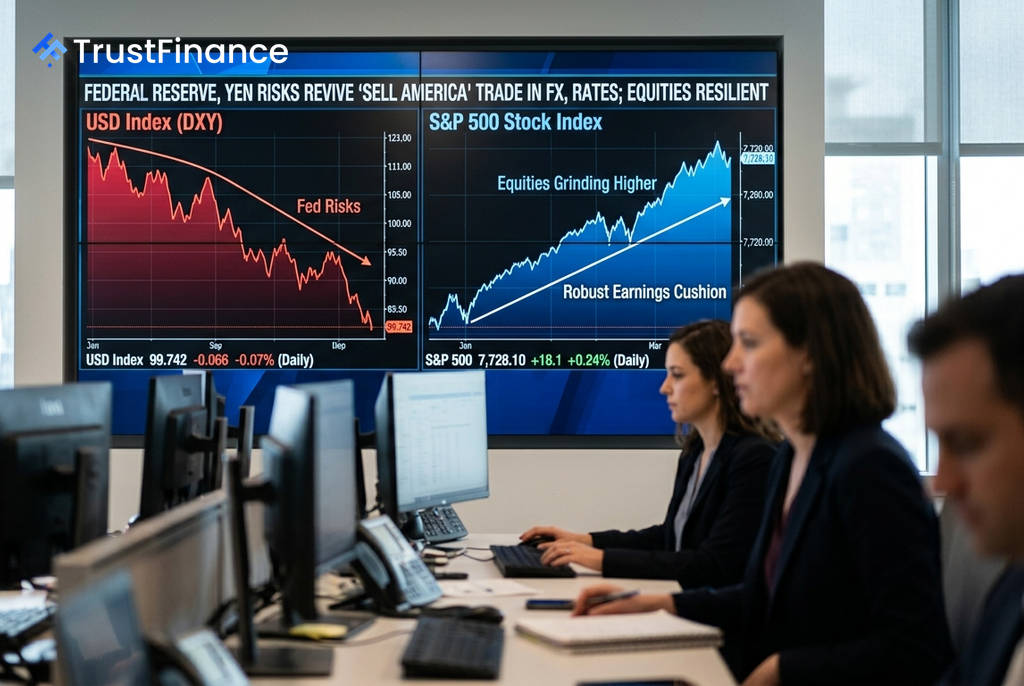
The “Sell America” narrative is re-emerging in currency and rates markets, fueled by uncertainty over the Federal Reserve's policy path and the potential for an unwind of the Japanese yen carry trade, according to strategists at Barclays. Despite these pressures, a strong earnings season has so far insulated U.S. and global equities, which have continued to reach new highs.
Divergence in US Markets
Analysts led by Emmanuel Cau at Barclays noted in a weekly commentary that while the bearish sentiment is being felt in some asset classes, it has not yet triggered a full-scale regime shift. The theme is most apparent in the simultaneous rise in long-end Treasury yields and a weaker U.S. dollar since the last Federal Open Market Committee (FOMC) meeting.
"It is difficult to disentangle how much of this reflects renewed concerns around Fed credibility versus a broader re-emergence of the 'Sell America' narrative," the strategists wrote. Barclays added that the recent rebound in gold alongside dollar weakness is consistent with a partial revival of this trade.
Fed and Yen Drive Uncertainty
The complex market dynamics are being driven by several overlapping macro forces. On the policy front, markets are still pricing in one more Fed rate hike by year-end, even as financial conditions have tightened. However, Barclays suggested that easing oil prices and moderate unit labor cost trends reduce the urgency for further tightening.
 Ad
A second key factor is the Japanese yen. Barclays highlighted that Japanese government bond (JGB) yields are now significantly above levels seen during the 2024 carry unwind. The bank also pointed to record yen shorts and large carry trade positions as a structural source of potential volatility for both currency and rates markets.
Equities Defy the Narrative
In contrast to the pressure on the dollar and Treasuries, equity markets have remained resilient. Barclays' own flow data shows little evidence of a significant rotation out of U.S. stocks and into other regions, a pattern that was observed last year.
The bank credits a "higher and broader" Q2 earnings season as the primary pillar of support for stocks. While strategists remain constructive on equities, they warned that risks remain, including elevated investor positioning and historically weak pre-midterm seasonality. A stronger-than-expected jobs report or CPI print could quickly revive concerns that the Fed is behind the curve, potentially increasing market volatility.
Read next
More on Stocks
FTC Orders Walmart, Uber, Delta to Disclose Data on Personalized Pricing
The U.S. Federal Trade Commission is demanding nine major companies, including leading retail, travel, and gig economy firms, to provide information on how they use consumer data for setting individual prices and wages.

Google Launches Gemini 4 Carbon AI Model to Bolster Cybersecurity Capabilities
Alphabet's Google has unveiled Gemini 4 Carbon, its latest AI model specifically designed for advanced cybersecurity tasks like vulnerability detection and secure code generation. The launch escalates competition with rivals OpenAI and Anthropic in the enterprise AI market.

Oracle Shares Surge After Unveiling $225 Billion Revenue Target for 2030
Oracle stock rose sharply after the company presented a long-term financial outlook targeting at least $225 billion in annual revenue by fiscal 2030, driven by its expanding AI infrastructure business.

DOJ Scrutinizes Nvidia's $12.9B Hugging Face Deal Amid Broader Antitrust Probe, Sources Say
The U.S. Department of Justice is reportedly examining Nvidia's planned $12.93 billion acquisition of AI platform Hugging Face as part of a wider, ongoing antitrust investigation into the chipmaker's market conduct.