
Story
European Stocks Post Worst Week Since July on Oil and Bond Pressures
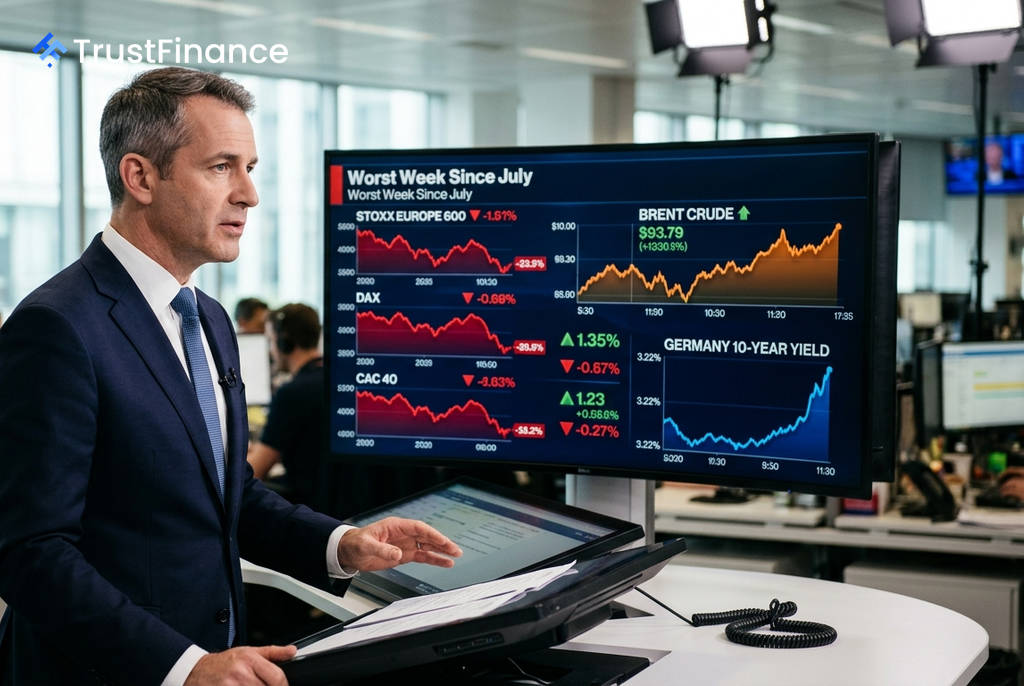
European equities capped their worst week in nearly two months, as a surge in oil prices and rising government bond yields reversed recent market gains. The pan-European STOXX 600 index finished the week down 1.14%, marking its most significant five-day decline since July 6, according to market data.
While the benchmark index was flat on the day, the weekly performance reflects a sharp downturn in sentiment. On a national level, Germany’s DAX and France’s CAC 40 were little changed Friday, while the UK's FTSE 100 edged up 0.1%.
Geopolitical Tensions Fuel Oil Surge
The primary catalyst for market weakness was a sharp rise in energy prices driven by geopolitical factors. Threats of new U.S. sanctions on Iran sparked fears of a prolonged disruption to global crude supplies, pushing Brent crude futures to a one-month high.
- Brent crude settled at $93.12 a barrel, capping a weekly gain of more than 5%.
- The price spike reflects growing concerns about constrained tanker traffic through the Strait of Hormuz, a critical chokepoint for seaborne oil and gas shipments.
Bond Rout and Hawkish Central Banks
 Ad
Investor anxiety was compounded by significant volatility in fixed-income markets. A global bond selloff early in the week pushed yields on benchmark government debt to multi-year highs, compressing the equity risk premium and making stocks less attractive.
Germany's 10-year Bund yield touched 3.22%, its highest level since 2011, while the U.S. 30-year Treasury yield climbed past 5.33%. This move was reinforced by hawkish signals from major central banks. Minutes from the Federal Reserve’s July meeting and comments from ECB Chief Economist Philip Lane, who called Eurozone inflation near 3% "unacceptable," have led markets to price in a higher probability of further interest rate hikes.
Market Outlook
The week's selloff marks a stark reversal from the optimism that followed a strong second-quarter earnings season. With corporate results now largely in the past and inflationary pressures re-emerging, investors are confronting a challenging stagflationary backdrop. The combination of elevated energy costs and tightening monetary policy leaves European markets vulnerable to further headwinds heading into the autumn.
Read next
More on Stocks
FTC Orders Walmart, Uber, Delta to Disclose Data on Personalized Pricing
The U.S. Federal Trade Commission is demanding nine major companies, including leading retail, travel, and gig economy firms, to provide information on how they use consumer data for setting individual prices and wages.

Google Launches Gemini 4 Carbon AI Model to Bolster Cybersecurity Capabilities
Alphabet's Google has unveiled Gemini 4 Carbon, its latest AI model specifically designed for advanced cybersecurity tasks like vulnerability detection and secure code generation. The launch escalates competition with rivals OpenAI and Anthropic in the enterprise AI market.

Oracle Shares Surge After Unveiling $225 Billion Revenue Target for 2030
Oracle stock rose sharply after the company presented a long-term financial outlook targeting at least $225 billion in annual revenue by fiscal 2030, driven by its expanding AI infrastructure business.

DOJ Scrutinizes Nvidia's $12.9B Hugging Face Deal Amid Broader Antitrust Probe, Sources Say
The U.S. Department of Justice is reportedly examining Nvidia's planned $12.93 billion acquisition of AI platform Hugging Face as part of a wider, ongoing antitrust investigation into the chipmaker's market conduct.