
Story
Emerging Market Tech Stocks Hit by Extreme Volatility After AI Rally
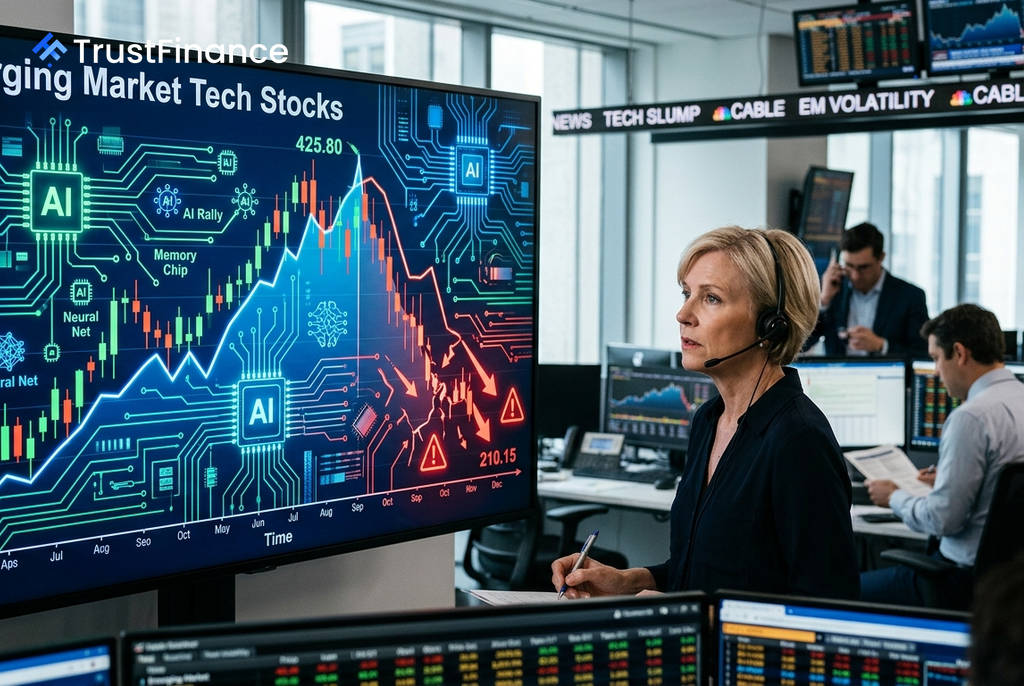
A surge in investor enthusiasm for artificial intelligence hardware has given way to extreme volatility in key emerging markets, as the tech-heavy indexes of South Korea and Taiwan face a sharp correction after a period of supercharged growth. The reversal has prompted significant capital flight and forced a reassessment of the risks associated with the sector's new dominance in EM benchmarks.
The Boom and the Backlash
The global AI boom shifted investor focus from U.S. technology giants to the South Korean and Taiwanese firms that dominate the high-tech memory chip sector. This pivot initially paid off, with South Korea’s KOSPI index doubling in value on the back of soaring shares in companies like Samsung Electronics and SK Hynix.
However, the rally came to an abrupt halt in late June. According to a Reuters report, a wave of profit-taking and concern over the rapid ascent led to a sharp downturn.
- South Korea's KOSPI index plunged 40% in just six weeks.
- Taiwan's TSMC, the largest company in the emerging markets universe, fell nearly 14%.
- Volatility in South Korea's market surged past peaks seen during the COVID-19 pandemic and has even outpaced that of bitcoin this year.
Investor Caution and Capital Outflows
 Ad
The severe market swings have unnerved institutional investors. "The clients that we speak to, the institutional clients, are struggling with the level of volatility in Korea at the moment," said William Bratton, head of cash equity research for APAC at BNP Paribas, in comments to Reuters. He noted that for some, the potential earnings story is "not worth pursuing at this point."
This sentiment is reflected in capital flows. Citing JPMorgan data, the report noted that South Korea and Taiwan saw outflows of over $100 billion and $44 billion respectively. LSEG data showed that international investors pulled money from Asia-ex China markets in the first half of the year at the fastest pace in any six-month period since at least 2010.
Concentration Risk Redefined
The recent turbulence highlights a structural shift in emerging markets, which are no longer seen as a simple tool for diversification. The MSCI EM benchmark is now highly concentrated, with just nine companies—primarily tech firms in Taiwan, South Korea, and China—accounting for more than 40% of the index.
"What we’re seeing is that emerging markets... are not really a source of diversification anymore," MSCI's research head Ashley Lester told Reuters. "They’re right in the centre of the AI boom." This concentration was a key factor in the sell-off, as fund rules designed to limit exposure to single stocks likely triggered investors to cash in on massive 12-month gains, which reached 500% for Samsung and 1,100% for SK Hynix.
Read next
More on Stocks
FTC Orders Walmart, Uber, Delta to Disclose Data on Personalized Pricing
The U.S. Federal Trade Commission is demanding nine major companies, including leading retail, travel, and gig economy firms, to provide information on how they use consumer data for setting individual prices and wages.

Google Launches Gemini 4 Carbon AI Model to Bolster Cybersecurity Capabilities
Alphabet's Google has unveiled Gemini 4 Carbon, its latest AI model specifically designed for advanced cybersecurity tasks like vulnerability detection and secure code generation. The launch escalates competition with rivals OpenAI and Anthropic in the enterprise AI market.

Oracle Shares Surge After Unveiling $225 Billion Revenue Target for 2030
Oracle stock rose sharply after the company presented a long-term financial outlook targeting at least $225 billion in annual revenue by fiscal 2030, driven by its expanding AI infrastructure business.

DOJ Scrutinizes Nvidia's $12.9B Hugging Face Deal Amid Broader Antitrust Probe, Sources Say
The U.S. Department of Justice is reportedly examining Nvidia's planned $12.93 billion acquisition of AI platform Hugging Face as part of a wider, ongoing antitrust investigation into the chipmaker's market conduct.