
Story
CrowdStrike and Palo Alto Networks Offer Investors a Choice Between Growth and Profitability
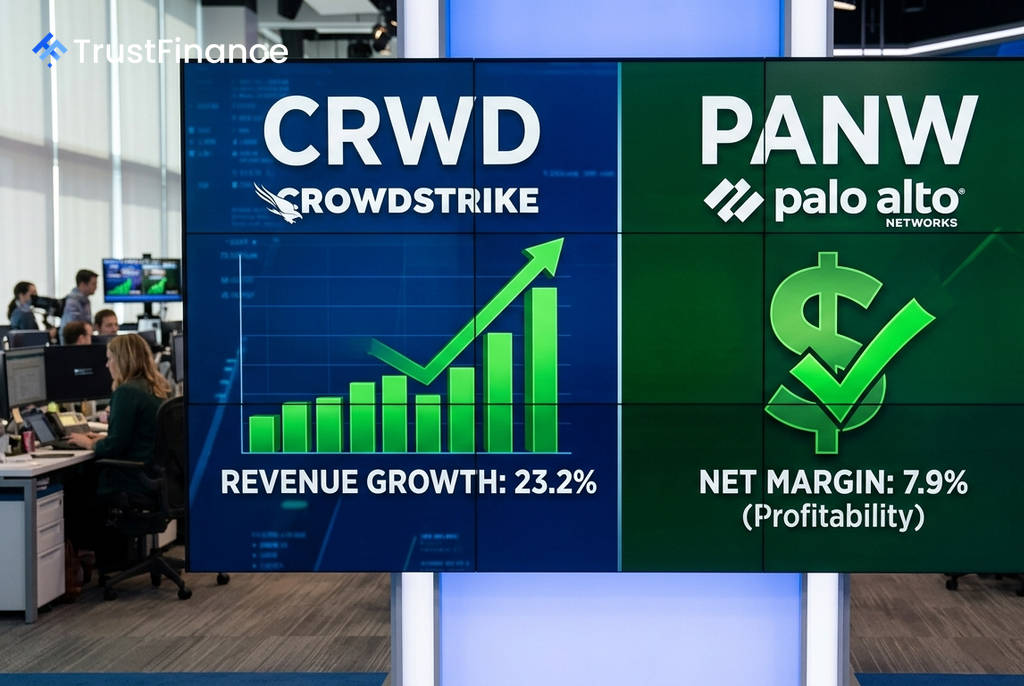
CrowdStrike and Palo Alto Networks, two titans of the cybersecurity industry, both trade at significant premiums but present investors with a distinct choice: paying for rapid, yet-unprofitable growth or for a more mature, profitable business model. An analysis by Investing.com highlights the fundamental trade-offs between the two companies across valuation, growth, and financial health.
The Valuation Divide
Both companies are considered overvalued based on fair value estimates, with Palo Alto Networks (PANW) trading 34.4% above its estimated fair value and CrowdStrike (CRWD) trading 29.9% above its own, according to the source. However, their valuation multiples tell a more nuanced story.
Palo Alto Networks appears more conservatively valued on traditional metrics.
- Forward P/E Ratio: PANW at 98.6x vs. CRWD at 152.0x.
- EV/EBITDA: PANW at 193.1x vs. CRWD at a significantly higher 3201.9x.
Despite its higher multiples, Wall Street analysts see more near-term potential in CrowdStrike, projecting an 11.0% upside to its target price, compared to just 1.3% for Palo Alto Networks.
A Clear Split on Growth and Profitability
The core difference between the two firms lies in their strategic focus. CrowdStrike is a high-growth story, with revenue expanding at a rate of 23.2%, while Palo Alto has a more moderate but still strong growth rate of 19.5%.
 Ad
This pursuit of growth comes at a cost for CrowdStrike, which currently operates with a negative net margin of -0.6% and negative returns on equity and assets. In contrast, Palo Alto Networks has successfully translated its scale into earnings, boasting a net margin of 7.9%, a return on equity of 4.8%, and a return on assets of 2.5%.
Balance Sheet and Cash Flow
An examination of their financial health reveals different strengths. Palo Alto Networks carries less leverage, with a debt-to-equity ratio of 7.7% compared to CrowdStrike's 17.7%.
CrowdStrike, however, maintains better short-term liquidity, evidenced by a current ratio of 1.5x versus Palo Alto's 0.9x. When it comes to generating cash, Palo Alto has the edge with a free cash flow yield of 1.3%, outpacing CrowdStrike's 0.8%, indicating it produces more cash relative to its valuation.
The Investor's Dilemma
The comparison presents a classic investment choice. Palo Alto Networks offers a proven business model with established profitability, stronger cash generation, and more attractive valuation multiples, representing a more conservative play on the cybersecurity sector's growth.
CrowdStrike is the higher-risk, higher-reward option. Investors are betting that its superior revenue growth will eventually translate into sustainable profits, a thesis supported by more optimistic analyst price targets. The decision hinges on an investor's preference for proven execution versus high-growth potential.
Read next
More on Stocks
FTC Orders Walmart, Uber, Delta to Disclose Data on Personalized Pricing
The U.S. Federal Trade Commission is demanding nine major companies, including leading retail, travel, and gig economy firms, to provide information on how they use consumer data for setting individual prices and wages.

Google Launches Gemini 4 Carbon AI Model to Bolster Cybersecurity Capabilities
Alphabet's Google has unveiled Gemini 4 Carbon, its latest AI model specifically designed for advanced cybersecurity tasks like vulnerability detection and secure code generation. The launch escalates competition with rivals OpenAI and Anthropic in the enterprise AI market.

Oracle Shares Surge After Unveiling $225 Billion Revenue Target for 2030
Oracle stock rose sharply after the company presented a long-term financial outlook targeting at least $225 billion in annual revenue by fiscal 2030, driven by its expanding AI infrastructure business.

DOJ Scrutinizes Nvidia's $12.9B Hugging Face Deal Amid Broader Antitrust Probe, Sources Say
The U.S. Department of Justice is reportedly examining Nvidia's planned $12.93 billion acquisition of AI platform Hugging Face as part of a wider, ongoing antitrust investigation into the chipmaker's market conduct.