
Story
Citadel Acquires $4B Portfolio, Halting Forced Sell-Off in Bitcoin Mining Stocks
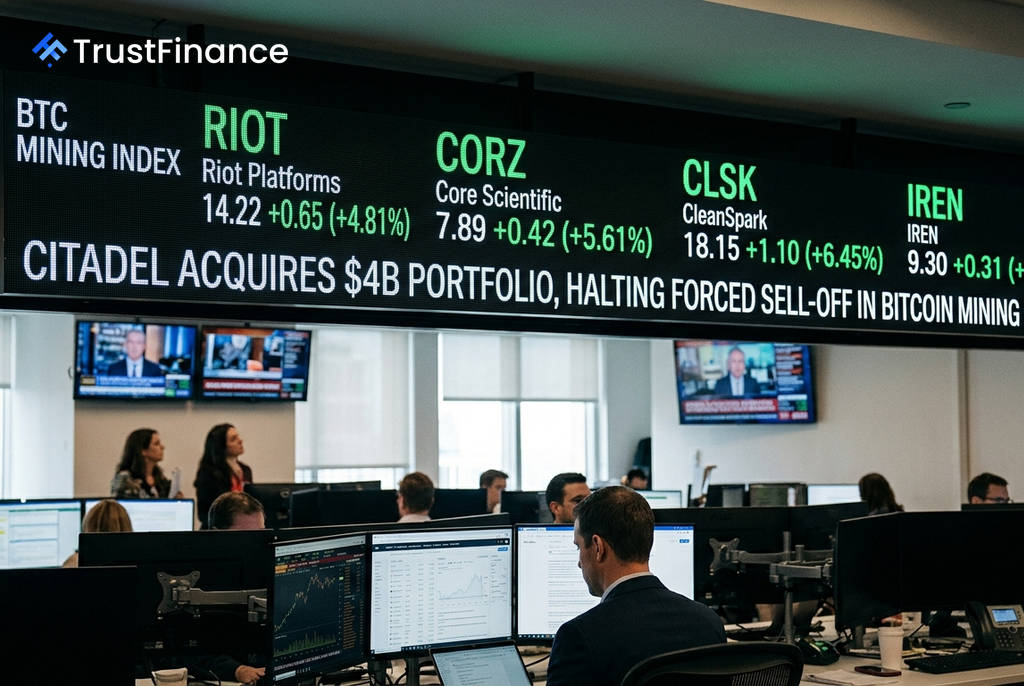
Citadel LLC has acquired a more than $4 billion portfolio from the collapsed hedge fund Situational Awareness, a move that has effectively ended a liquidity-driven sell-off in Bitcoin mining stocks. Citadel founder Ken Griffin confirmed that his firm has successfully resolved over 80% of the risk it assumed, signaling that the market shock has substantially subsided, according to a report from Investing.com on August 22, 2026.
The Collapse of a Leveraged Bet
The crisis originated with Situational Awareness, a hedge fund led by former OpenAI researcher Leopold Aschenbrenner. The fund suffered a catastrophic 67% loss in July after its heavily leveraged positions in artificial intelligence and semiconductor stocks declined sharply.
This downturn created immense pressure on the fund to raise cash, forcing it to liquidate its holdings. Citadel stepped in to acquire the majority of the fund's stock portfolio through nearly 100 block trades, preventing a more prolonged and disorderly market impact.
A Closer Look at the Holdings
Filings from June 30 revealed the extent of the fund's concentrated positions. Situational Awareness held $20.24 billion in long positions across 26 investments, with a significant $1.99 billion allocated to Bitcoin mining and related assets. The fund's largest mining stock holdings included:
 Ad
- Core Scientific (CORZ): $666 million
- Riot Platforms (RIOT): $468 million
- IREN (IREN): $433 million
- CleanSpark (CLSK): $179 million
The fund had aggressively increased its exposure to the sector, growing its mining positions by 79% in the second quarter. Its stake in Riot Platforms alone had surged by 229%, reflecting a high-conviction bet that the rising demand for AI would increase the value of power and data center infrastructure.
A Return to Fundamentals
With the source of the forced selling now removed, market focus is expected to shift back to the underlying fundamentals of the mining companies. The non-fundamental pressure on their stock prices has been alleviated, allowing investors to re-evaluate their operational performance, balance sheets, and strategic pivots toward high-performance computing (HPC) and AI data centers.
While challenges such as electricity costs and network difficulty remain key factors, the industry's most volatile phase appears to be over. The resolution of this liquidity crisis is expected to lead to stock prices that more accurately reflect the intrinsic value and long-term prospects of the companies in the sector.
Read next
More on Stocks
FTC Orders Walmart, Uber, Delta to Disclose Data on Personalized Pricing
The U.S. Federal Trade Commission is demanding nine major companies, including leading retail, travel, and gig economy firms, to provide information on how they use consumer data for setting individual prices and wages.

Google Launches Gemini 4 Carbon AI Model to Bolster Cybersecurity Capabilities
Alphabet's Google has unveiled Gemini 4 Carbon, its latest AI model specifically designed for advanced cybersecurity tasks like vulnerability detection and secure code generation. The launch escalates competition with rivals OpenAI and Anthropic in the enterprise AI market.

Oracle Shares Surge After Unveiling $225 Billion Revenue Target for 2030
Oracle stock rose sharply after the company presented a long-term financial outlook targeting at least $225 billion in annual revenue by fiscal 2030, driven by its expanding AI infrastructure business.

DOJ Scrutinizes Nvidia's $12.9B Hugging Face Deal Amid Broader Antitrust Probe, Sources Say
The U.S. Department of Justice is reportedly examining Nvidia's planned $12.93 billion acquisition of AI platform Hugging Face as part of a wider, ongoing antitrust investigation into the chipmaker's market conduct.