
Story
Chinese Retail and Auto Stocks Rise on New Government Consumption Stimulus Plan
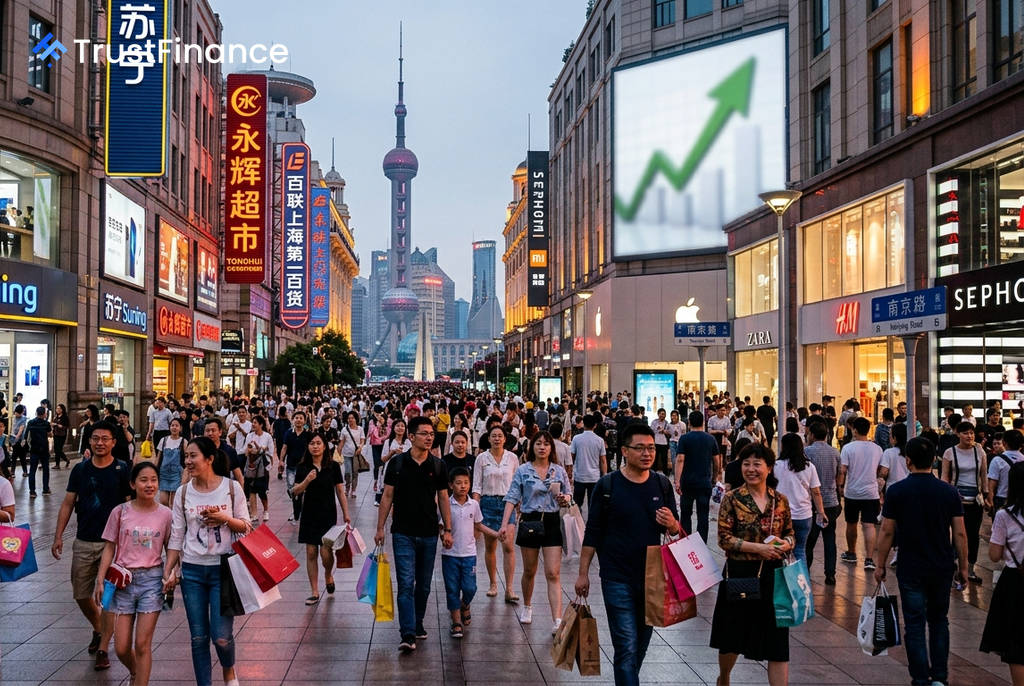
Chinese retail and automaker stocks rallied on Tuesday after Beijing introduced a comprehensive new plan to stimulate domestic demand, setting a target to significantly expand consumer goods sales by 2030. The move strengthens investor expectations that policymakers will provide further support for China's relatively subdued economic recovery.
Beijing's New Consumption Blueprint
On Monday, seven government departments, including the Ministry of Commerce and the National Development and Reform Commission, jointly issued an implementation guideline aimed at expanding consumer spending. The plan's central goal is to increase total retail sales of consumer goods to approximately 60 trillion yuan ($8.85 trillion) by the year 2030.
The guideline also focuses on developing high-growth sectors, with a target of creating 10-trillion-yuan markets for green, smart, and health-related consumption. The measures explicitly call for greater support for durable goods, particularly automobiles and smart-home products, and encourage vehicle trade-in programs.
Market Responds to Stimulus Hopes
Investors reacted positively to the news, sending shares of consumer-facing companies higher even as the broader market lagged. The Shanghai Composite index was down 0.1% during the session.
 Ad
Key stock movements included:
- Supermarket operator Yonghui Superstores (SS:601933) was a standout performer, with its shares jumping 6.2%.
- Department store chain Shanghai Bailian (SS:600827) rose 2.73%.
- Automakers also advanced, with BYD's (HK:1211) Hong Kong-listed shares climbing 2.5% and SAIC Motor (SS:600104) gaining 1.3%.
Context for the Policy Push
The measures arrive as China's consumer recovery remains relatively muted, prompting authorities to seek new avenues for boosting domestic demand. This guideline builds upon a broader consumption-focused strategy, including a five-year plan announced in July that featured the same 2030 retail sales target.
The policy's targeted approach is expected to directly benefit companies in specific sectors. Retailers like Yonghui and Shanghai Bailian are exposed to everyday and discretionary spending, while automakers like BYD and SAIC could see a direct impact from measures supporting vehicle purchases.
Read next
More on Stocks
FTC Orders Walmart, Uber, Delta to Disclose Data on Personalized Pricing
The U.S. Federal Trade Commission is demanding nine major companies, including leading retail, travel, and gig economy firms, to provide information on how they use consumer data for setting individual prices and wages.

Google Launches Gemini 4 Carbon AI Model to Bolster Cybersecurity Capabilities
Alphabet's Google has unveiled Gemini 4 Carbon, its latest AI model specifically designed for advanced cybersecurity tasks like vulnerability detection and secure code generation. The launch escalates competition with rivals OpenAI and Anthropic in the enterprise AI market.

Oracle Shares Surge After Unveiling $225 Billion Revenue Target for 2030
Oracle stock rose sharply after the company presented a long-term financial outlook targeting at least $225 billion in annual revenue by fiscal 2030, driven by its expanding AI infrastructure business.

DOJ Scrutinizes Nvidia's $12.9B Hugging Face Deal Amid Broader Antitrust Probe, Sources Say
The U.S. Department of Justice is reportedly examining Nvidia's planned $12.93 billion acquisition of AI platform Hugging Face as part of a wider, ongoing antitrust investigation into the chipmaker's market conduct.