
Story
Canadian Retaliatory Tariffs to Hit GM, Ford, and Stellantis With Billions in Costs
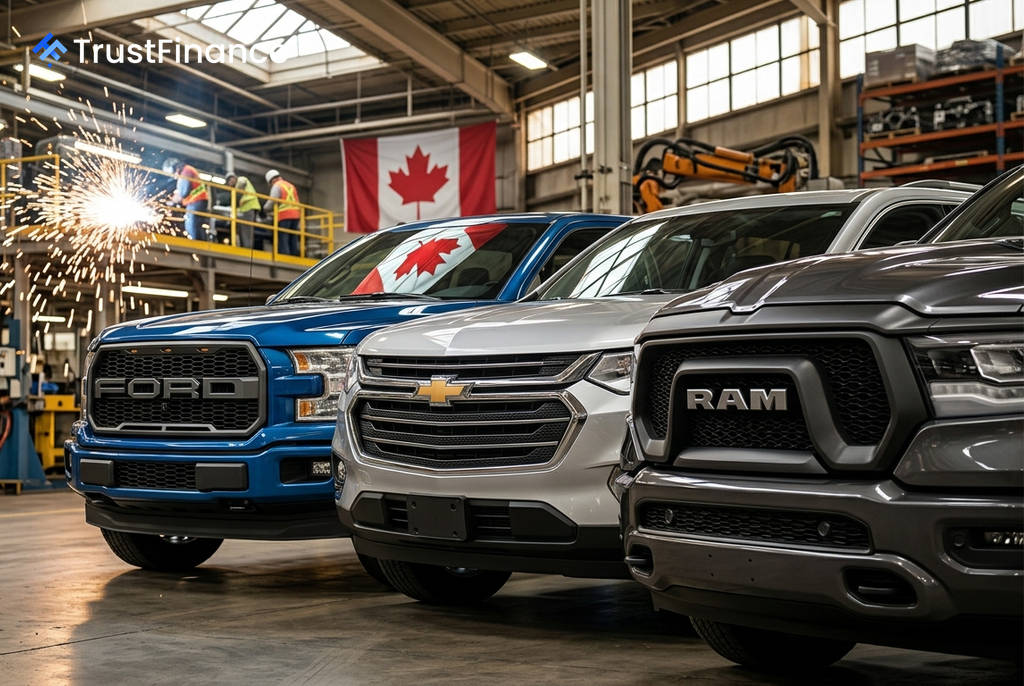
Canada's planned retaliatory tariffs, set to take effect September 8, are poised to significantly impact Detroit's "Big Three" automakers, threatening to add billions in costs and squeeze already thin margins for Ford, General Motors, and Stellantis. The move is a dollar-for-dollar response to U.S. tariffs and targets the highly integrated North American auto supply chain, where parts and vehicles frequently cross the border during production.
Detroit Automakers Brace for Financial Hit
The financial pressure from the escalating trade dispute varies by company, but all three face substantial new costs. The compounding nature of the tariffs, applied at multiple stages of production, amplifies the financial damage.
- Ford Motor (F) is considered the most exposed of the group. The company's significant manufacturing footprint in Ontario, including its Oakville Assembly plant, makes it a direct target for Canadian counter-tariffs. Ford is already operating with a -4.4% net margin and a high 461% debt-to-equity ratio, giving it little room to absorb the estimated ~$1 billion net tariff hit for 2026.
- General Motors (GM) faces between $2.5 billion and $3.5 billion in gross tariff expenses this year, which could erode more than 20% of its operating profit. While GM raised its full-year guidance after a strong first half, it still anticipates approximately $900 million in tariff costs for the remainder of the year.
- Stellantis (STLA) is confronting the tariff headwinds from a weakened position. The company's stock has fallen 53.8% year-to-date and is trading near its 52-week low amid analyst downgrades and concerns over high inventory. While its direct Canadian manufacturing exposure is less than its rivals, the tariffs compound its existing operational and market challenges.
 Ad
Broader Market Context and Outlook
The trade dispute creates a structural disadvantage for U.S. automakers, which face duties of roughly 25% on imports from Canada and Mexico. In contrast, competitors from Japan, Korea, and Europe exporting to the U.S. are subject to a flat 15% tariff. This 10-percentage-point gap pressures the cost base of the Detroit-based manufacturers.
Investor concern is already reflected in the market, with the S&P 500 Automobiles index down approximately 19% year-to-date. With trade negotiations between the U.S. and Canada having collapsed on August 22 and no new talks planned, a resolution does not appear imminent. U.S. Trade Representative Jamieson Greer stated the U.S. is "moving forward" in response to the Canadian retaliation, signaling a hardening of positions that could prolong the financial strain on the auto sector.
Read next
More on Stocks
FTC Orders Walmart, Uber, Delta to Disclose Data on Personalized Pricing
The U.S. Federal Trade Commission is demanding nine major companies, including leading retail, travel, and gig economy firms, to provide information on how they use consumer data for setting individual prices and wages.

Google Launches Gemini 4 Carbon AI Model to Bolster Cybersecurity Capabilities
Alphabet's Google has unveiled Gemini 4 Carbon, its latest AI model specifically designed for advanced cybersecurity tasks like vulnerability detection and secure code generation. The launch escalates competition with rivals OpenAI and Anthropic in the enterprise AI market.

Oracle Shares Surge After Unveiling $225 Billion Revenue Target for 2030
Oracle stock rose sharply after the company presented a long-term financial outlook targeting at least $225 billion in annual revenue by fiscal 2030, driven by its expanding AI infrastructure business.

DOJ Scrutinizes Nvidia's $12.9B Hugging Face Deal Amid Broader Antitrust Probe, Sources Say
The U.S. Department of Justice is reportedly examining Nvidia's planned $12.93 billion acquisition of AI platform Hugging Face as part of a wider, ongoing antitrust investigation into the chipmaker's market conduct.