
Story
Canadian Banks, Utilities Seen as Havens Amid U.S. Tariff Threat
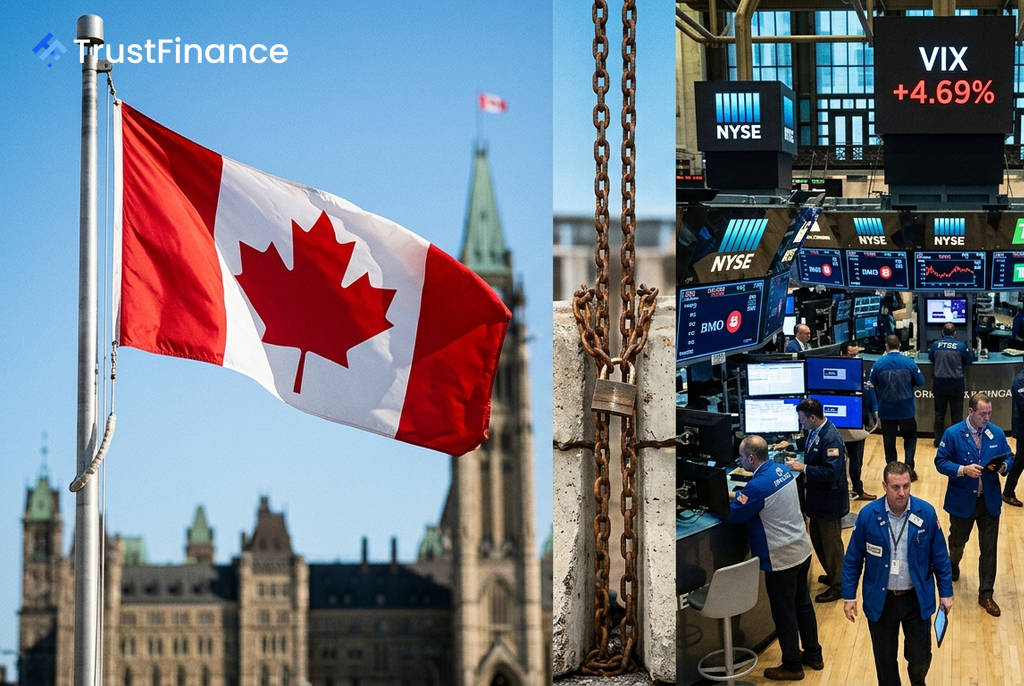
Investors are seeking shelter in domestically focused Canadian stocks after the United States imposed a 50% tariff on Canadian imports this month. Sectors such as banking, utilities, and consumer staples are emerging as defensive plays, shielded from the trade dispute roiling export-oriented industries.
Tariff Impact on Canadian Exporters
The new tariffs threaten approximately $780 billion in annual bilateral trade after recent negotiations between the two countries collapsed, according to an Investing.com report. The impact is most acute for industries with deeply integrated cross-border supply chains, including Canadian aluminum, auto parts, and energy.
Companies in these sectors are particularly vulnerable. For example, some auto parts cross the U.S.-Canada border up to eight times during the manufacturing process, which significantly magnifies the financial impact of the import duties.
Insulated Sectors Emerge as Defensive Plays
In contrast, companies whose revenues are generated almost entirely within Canada's domestic economy are structurally protected from the trade conflict. These firms' performance is tied to local consumer and business activity rather than international trade flows, making them attractive safe havens for investors.
Financials and Utilities
Canada’s major banks derive their earnings from domestic mortgages, lending, and wealth management, giving them minimal direct exposure to the tariffs. Regulated utilities are similarly protected, as their revenue is based on government-approved infrastructure investments, not export volumes.
 Ad
Key performance indicators as of August 24, 2026, highlight their resilience:
- Bank of Montreal (BMO): +38.0% year-to-date (YTD)
- Toronto-Dominion Bank (TD): +27.5% YTD
- Royal Bank of Canada (RY): +23.1% YTD
- Fortis Inc. (FTS): Offers a 3.4% dividend yield with a low beta of 0.43.
Consumer Staples
Consumer staples companies like grocery retailer Loblaw Companies (L) also provide a haven. Because its business is entirely domestic, its performance is insulated from trade volatility, a fact reflected in its exceptionally low beta of 0.38.
Energy Sector Navigates Uncertainty
The energy sector presents a more complex picture. Suncor Energy (SU) has rallied an impressive 56.9% YTD, buoyed by strong global oil prices. This performance comes despite Canada supplying roughly 60% of U.S. crude oil imports, placing the sector at high risk from the tariffs.
While the stock's strength highlights the powerful influence of global commodity markets, analysts cited by Investing.com note that a potential disruption to energy exports remains a key tail risk for the sector should trade tensions persist.
Read next
More on Stocks
FTC Orders Walmart, Uber, Delta to Disclose Data on Personalized Pricing
The U.S. Federal Trade Commission is demanding nine major companies, including leading retail, travel, and gig economy firms, to provide information on how they use consumer data for setting individual prices and wages.

Google Launches Gemini 4 Carbon AI Model to Bolster Cybersecurity Capabilities
Alphabet's Google has unveiled Gemini 4 Carbon, its latest AI model specifically designed for advanced cybersecurity tasks like vulnerability detection and secure code generation. The launch escalates competition with rivals OpenAI and Anthropic in the enterprise AI market.

Oracle Shares Surge After Unveiling $225 Billion Revenue Target for 2030
Oracle stock rose sharply after the company presented a long-term financial outlook targeting at least $225 billion in annual revenue by fiscal 2030, driven by its expanding AI infrastructure business.

DOJ Scrutinizes Nvidia's $12.9B Hugging Face Deal Amid Broader Antitrust Probe, Sources Say
The U.S. Department of Justice is reportedly examining Nvidia's planned $12.93 billion acquisition of AI platform Hugging Face as part of a wider, ongoing antitrust investigation into the chipmaker's market conduct.