
Story
Bristol Myers Squibb Raises Full-Year Forecast on Strong Eliquis, New Drug Sales
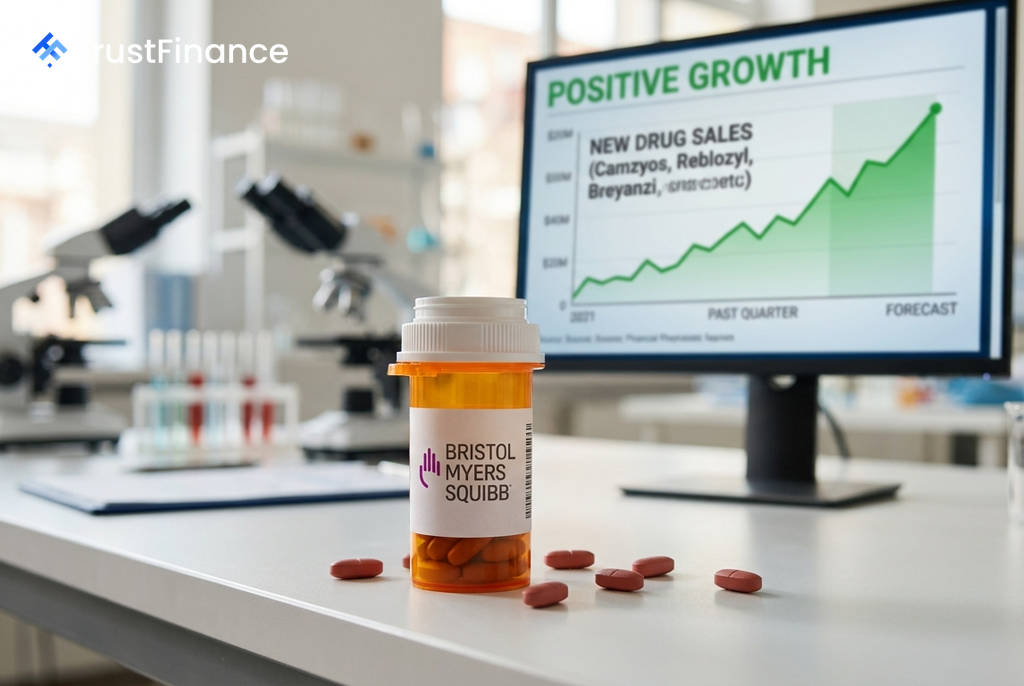
Bristol Myers Squibb on Thursday raised its full-year revenue and profit forecast after strong second-quarter results, driven by robust demand for its blockbuster blood thinner Eliquis and a portfolio of newer medicines that are successfully offsetting sales declines from older drugs.
The U.S. drugmaker's shares rose as much as 2.5% in premarket trading following the announcement.
Upgraded Outlook and Q2 Performance
Bristol Myers now projects full-year revenue between $49 billion and $50 billion, an increase from its previous range of $46 billion to $47.5 billion. The company also lifted its adjusted earnings forecast to between $6.75 and $7.00 per share, up from a prior view of $6.05 to $6.35.
The revised guidance comes after a strong second quarter where revenue grew 6% year-over-year to $12.97 billion, significantly surpassing the average analyst estimate of $11.75 billion, according to LSEG data. Adjusted earnings were $2.04 per share, also beating Wall Street expectations of $1.59 per share.
Growth Portfolio Offsets Patent Cliffs
The company's results indicate its strategy to counter declining sales from drugs facing generic competition is gaining traction. Sales of the blood cancer treatment Revlimid, once its top-selling drug, fell 49% to $425 million. However, this was more than offset by the performance of its newer products.
 Ad
Chief Commercialization Officer Adam Lenkowsky noted in an interview that the company's "growth portfolio grew 15% in Q2." Key performers that beat analyst expectations include:
- Reblozyl: The anemia treatment posted sales of $735 million.
- Camzyos: The heart drug generated $416 million in revenue.
- Breyanzi: The cancer cell therapy brought in $484 million.
Blockbuster Drug Highlights
Sales of the blood thinner Eliquis, which Bristol Myers shares with Pfizer, were a standout, rising 22% to $4.48 billion in the quarter. Citing strong demand, the company raised its full-year sales growth forecast for Eliquis to a range of 20% to 25%, up from a prior projection of 10% to 15%.
Meanwhile, sales of the blockbuster cancer immunotherapy Opdivo fell 3% to $2.49 billion. However, the company highlighted that sales of its new subcutaneous version, Qvantig, reached $261 million. Combined sales for the Opdivo franchise are growing at a mid-single-digit rate as the company works to convert patients to the new formulation.
Read next
More on Stocks
FTC Orders Walmart, Uber, Delta to Disclose Data on Personalized Pricing
The U.S. Federal Trade Commission is demanding nine major companies, including leading retail, travel, and gig economy firms, to provide information on how they use consumer data for setting individual prices and wages.

Google Launches Gemini 4 Carbon AI Model to Bolster Cybersecurity Capabilities
Alphabet's Google has unveiled Gemini 4 Carbon, its latest AI model specifically designed for advanced cybersecurity tasks like vulnerability detection and secure code generation. The launch escalates competition with rivals OpenAI and Anthropic in the enterprise AI market.

Oracle Shares Surge After Unveiling $225 Billion Revenue Target for 2030
Oracle stock rose sharply after the company presented a long-term financial outlook targeting at least $225 billion in annual revenue by fiscal 2030, driven by its expanding AI infrastructure business.

DOJ Scrutinizes Nvidia's $12.9B Hugging Face Deal Amid Broader Antitrust Probe, Sources Say
The U.S. Department of Justice is reportedly examining Nvidia's planned $12.93 billion acquisition of AI platform Hugging Face as part of a wider, ongoing antitrust investigation into the chipmaker's market conduct.