
Story
BofA Issues First 'Sell' Signal Since 2021, Urges Rotation to Defensive Assets
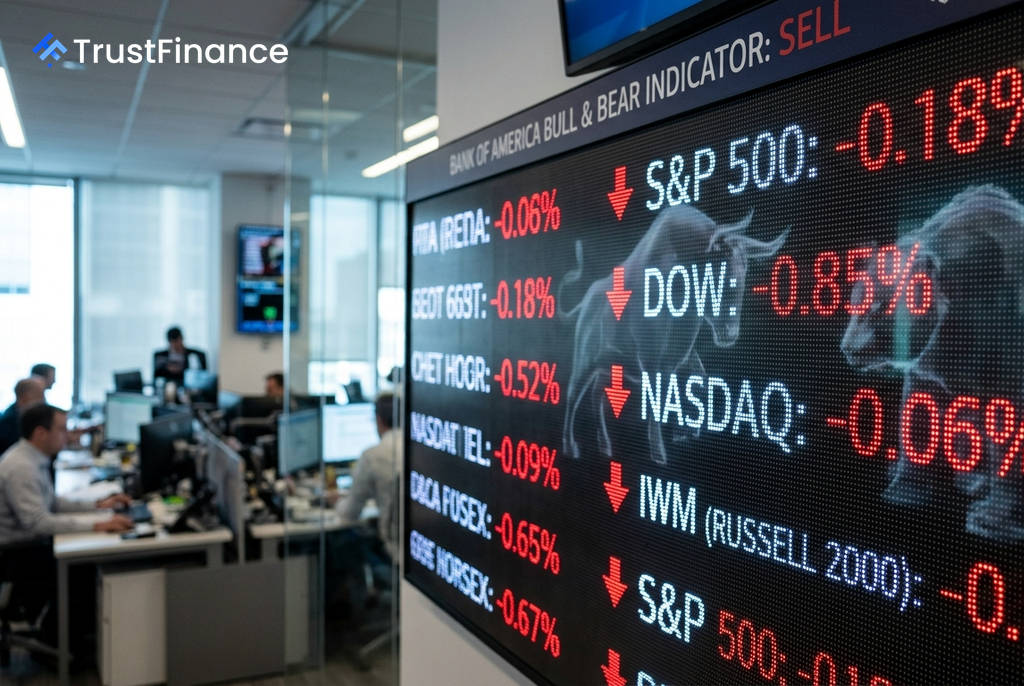
Bank of America's closely watched Bull & Bear Indicator has flashed a sell signal for the first time since 2021, leading the firm's strategists to recommend that investors reduce exposure to risk assets and rotate into more defensive positions for the summer.
Indicator Triggers Defensive Shift
In a note to clients, BofA's Chief Investment Strategist Michael Hartnett and his team reported that the Bull & Bear Indicator climbed to 9.7 from 9.4, pushing it into contrarian "sell" territory. The increase was attributed to strong inflows into high-yield bonds, tighter credit spreads, and improving breadth across global stock indices.
In response, the strategists are advocating a "retreat/rotate not reload" approach. They advise clients to pull back from risk and move into assets that are less cyclically exposed, such as:
- Consumer staples
- Duration plays like Real Estate Investment Trusts (REITs)
- Small caps and biotech
- The U.S. dollar
Hedging Against Consensus Complacency
 Ad
The recommended shift is designed as a hedge against ongoing financial conditions tightening and a potential disappointment of the current bullish consensus. Hartnett characterized this consensus view as a belief in "no macro landing, no Fed hike, no AI capex cut, no DEM midterm sweep."
Despite the tactical sell signal, Hartnett noted that BofA's official asset allocation remains "long stocks, short bonds." The rationale is that policymakers view the equity market as "too big to fail" given the economy's reliance on the wealth effect and the capital expenditure boom in AI data centers.
Capital Flows Show Broad Inflows
Fund flow data for the week ending August 5 showed continued investor appetite for most asset classes. Money market funds saw the largest inflows at $53.7 billion, followed by stocks at $32.9 billion and bonds at $23.1 billion.
U.S. equities attracted $9.6 billion, putting them on an annualized pace for a record $652 billion inflow. However, technology funds experienced their first outflow in six weeks, shedding $700 million, though they are still annualizing a record $217 billion inflow. In contrast, emerging market equities are annualizing a $55 billion outflow, the worst since 2015, according to the report.
Read next
More on Stocks
FTC Orders Walmart, Uber, Delta to Disclose Data on Personalized Pricing
The U.S. Federal Trade Commission is demanding nine major companies, including leading retail, travel, and gig economy firms, to provide information on how they use consumer data for setting individual prices and wages.

Google Launches Gemini 4 Carbon AI Model to Bolster Cybersecurity Capabilities
Alphabet's Google has unveiled Gemini 4 Carbon, its latest AI model specifically designed for advanced cybersecurity tasks like vulnerability detection and secure code generation. The launch escalates competition with rivals OpenAI and Anthropic in the enterprise AI market.

Oracle Shares Surge After Unveiling $225 Billion Revenue Target for 2030
Oracle stock rose sharply after the company presented a long-term financial outlook targeting at least $225 billion in annual revenue by fiscal 2030, driven by its expanding AI infrastructure business.

DOJ Scrutinizes Nvidia's $12.9B Hugging Face Deal Amid Broader Antitrust Probe, Sources Say
The U.S. Department of Justice is reportedly examining Nvidia's planned $12.93 billion acquisition of AI platform Hugging Face as part of a wider, ongoing antitrust investigation into the chipmaker's market conduct.